front cover of Unaffordable
Unaffordable
American Healthcare from Johnson to Trump
Jonathan Engel
University of Wisconsin Press, 2018
Written for nonexperts, this is a brisk, engaging history of American healthcare from the advent of Medicare and Medicaid in the 1960s to the impact of the Affordable Care Act in the 2010s. Step by step, Jonathan Engel shows how we arrived at our present convoluted situation, where generic drugs prices can jump 1,000 percent in a day and primary care physicians can lose 20 percent of their income at the stroke of a Congressional pen.

Unaffordable covers, in a conversational style punctuated by apt examples, topics ranging from health insurance, pharmaceutical pricing, and physician training to health maintenance organizations and hospital networks. Along the way, Engel introduces approaches that other nations have taken in organizing and paying for healthcare and offers insights on ethical quandaries around end-of-life decisions, neonatal care, life-sustaining treatments, and the limits of our ability to define death. While describing the political origins of many of the federal and state laws that govern our healthcare system today, he never loses sight of the impact that healthcare delivery has on our wallets and on the balance sheets of hospitals, doctors' offices, government agencies, and private companies.

[more]

front cover of Uncertain Times
Uncertain Times
Kenneth Arrow and the Changing Economics of Health Care
Peter J. Hammer, Deborah Haas-Wilson, Mark A. Peterson, and William M. Sage, eds.
Duke University Press, 2003
This volume revisits the Nobel Prize-winning economist Kenneth Arrow’s classic 1963 essay “Uncertainty and the Welfare Economics of Medical Care” in light of the many changes in American health care since its publication. Arrow’s groundbreaking piece, reprinted in full here, argued that while medicine was subject to the same models of competition and profit maximization as other industries, concepts of trust and morals also played key roles in understanding medicine as an economic institution and in balancing the asymmetrical relationship between medical providers and their patients. His conclusions about the medical profession’s failures to “insure against uncertainties” helped initiate the reevaluation of insurance as a public and private good.

Coming from diverse backgrounds—economics, law, political science, and the health care industry itself—the contributors use Arrow’s article to address a range of present-day health-policy questions. They examine everything from health insurance and technological innovation to the roles of charity, nonprofit institutions, and self-regulation in addressing medical needs. The collection concludes with a new essay by Arrow, in which he reflects on the health care markets of the new millennium. At a time when medical costs continue to rise, the ranks of the uninsured grow, and uncertainty reigns even among those with health insurance, this volume looks back at a seminal work of scholarship to provide critical guidance for the years ahead.

Contributors
Linda H. Aiken
Kenneth J. Arrow
Gloria J. Bazzoli
M. Gregg Bloche
Lawrence Casalino
Michael Chernew
Richard A. Cooper
Victor R. Fuchs
Annetine C. Gelijns
Sherry A. Glied
Deborah Haas-Wilson
Mark A. Hall
Peter J. Hammer
Clark C. Havighurst
Peter D. Jacobson
Richard Kronick
Michael L. Millenson
Jack Needleman
Richard R. Nelson
Mark V. Pauly
Mark A. Peterson
Uwe E. Reinhardt
James C. Robinson
William M. Sage
J. B. Silvers
Frank A. Sloan
Joshua Graff Zivin
[more]

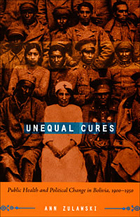
front cover of Unequal Cures
Unequal Cures
Public Health and Political Change in Bolivia, 1900–1950
Ann Zulawski
Duke University Press, 2007
Unequal Cures illuminates the connections between public health and political change in Bolivia from the beginning of the twentieth century, when the country was a political oligarchy, until the eve of the 1952 national revolution that ushered in universal suffrage, agrarian reform, and the nationalization of Bolivia’s tin mines. Ann Zulawski examines both how the period’s major ideological and social transformations changed medical thinking and how ideas of public health figured in debates about what kind of country Bolivia should become. Zulawski argues that the emerging populist politics of the 1930s and 1940s helped consolidate Bolivia’s medical profession and that improved public health was essential to the creation of a modern state. Yet she finds that at mid-century, women, indigenous Bolivians, and the poor were still considered inferior and consequently received often inadequate medical treatment and lower levels of medical care.

Drawing on hospital and cemetery records, censuses, diagnoses, newspaper accounts, and interviews, Zulawski describes the major medical problems that Bolivia faced during the first half of the twentieth century, their social and economic causes, and efforts at their amelioration. Her analysis encompasses the Rockefeller Foundation’s campaign against yellow fever, the almost total collapse of Bolivia’s health care system during the disastrous Chaco War with Paraguay (1932–35), an assessment of women’s health in light of their socioeconomic realities, and a look at Manicomio Pacheco, the national mental hospital.
[more]

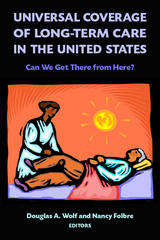
front cover of Universal Coverage of Long-Term Care in the United States
Universal Coverage of Long-Term Care in the United States
Can We Get There from Here?
Douglas A. Wolfe
Russell Sage Foundation, 2013
As millions of baby boomers retire and age in the coming years, more American families will confront difficult choices about the long-term care of their loved ones. The swelling ranks of the disabled and elderly who need such care—including home care, adult day care, or a nursing home stay—are faced with a strained, inequitable and expensive system. How will American society and policy adapt to this demographic transition? In Universal Coverage of Long-Term Care in the United States, editors Nancy Folbre and Douglas Wolf and an expert group of care researchers assess the current U.S. long-term care policies and exercise what can be learned from other countries facing similar care demands. After the high-profile suspension of the Obama Administration’s public long-term insurance program in 2011, Robert Hudson and Howard Gleckman provide concrete suggestions for lowering the cost and improving the quality of long-term care coverage in America. In a deeply personal and empirically rigorous analysis, family care expert Carol Levine draws crucial lessons from her experience as a caregiver for her ailing husband. She sheds light on the often fraught interactions that occur between the formal care system and family caregivers and analyzes how public policy can best support long-term family care. The volume next examines recent reforms in other developed countries and finds valuable lessons for American policy-makers. Contributors David Bell and Alison Bowes discuss the provision of personal care services in Scotland, which have been publicly financed since 2002. Their analysis shows that the new program reduced costs improved efficiency and allowed more recipients to receive care. The volume assesses the political and institutional prospects for moving towards a truly universal long-term care system in the United States. Robyn Stone provides a sobering overview of the formal, paid long-term care workforce in America, which is in crisis due to increasing demand and a shortage of qualified workers. Economist Leonard Burman focuses on public finances of the long-term care system, which will come under increasing strain as more Americans rely on Medicaid to pay for their long-term care. In the volume’s concluding chapter, Folbre and Wolf summarize criticisms of existing long-term care policies and outline particular reforms that can move the United States toward a universal system of long-term care insurance. Universal Coverage of Long-Term Care in the United States provides an essential resource on how to improve the long-term care sector in America and helps advance the national debate on this pressing topic. This volume is available for free download on the Foundation’s website, as are the volume’s individual chapters.
[more]

front cover of Unmasked
Unmasked
COVID, Community, and the Case of Okoboji
Emily Mendenhall
Vanderbilt University Press, 2022
Unmasked is the story of what happened in Okoboji, a small Iowan tourist town, when a collective turn from the coronavirus to the economy occurred in the COVID summer of 2020. State political failures, local negotiations among political and public health leaders, and community (dis)belief about the virus resulted in Okoboji being declared a hotspot just before the Independence Day weekend, when an influx of half a million people visit the town.

The story is both personal and political. Author Emily Mendenhall, an anthropologist at Georgetown University, grew up in Okoboji, and her family still lives there. As the events unfolded, Mendenhall was in Okoboji, where she spoke formally with over 100 people and observed a community that rejected public health guidance, revealing deep-seated mistrust in outsiders and strong commitments to local thinking. Unmasked is a fascinating and heartbreaking account of where people put their trust, and how isolationist popular beliefs can be in America's small communities.

This book is the recipient of the 2022 Norman L. and Roselea J. Goldberg Prize from Vanderbilt University Press for the best book in the area of art or medicine.
[more]

front cover of Unmasked
Unmasked
COVID, Community, and the Case of Okoboji
Emily Mendenhall
Vanderbilt University Press, 2022
Unmasked is the story of what happened in Okoboji, a small Iowan tourist town, when a collective turn from the coronavirus to the economy occurred in the COVID summer of 2020. State political failures, local negotiations among political and public health leaders, and community (dis)belief about the virus resulted in Okoboji being declared a hotspot just before the Independence Day weekend, when an influx of half a million people visit the town.

The story is both personal and political. Author Emily Mendenhall, an anthropologist at Georgetown University, grew up in Okoboji, and her family still lives there. As the events unfolded, Mendenhall was in Okoboji, where she spoke formally with over 100 people and observed a community that rejected public health guidance, revealing deep-seated mistrust in outsiders and strong commitments to local thinking. Unmasked is a fascinating and heartbreaking account of where people put their trust, and how isolationist popular beliefs can be in America's small communities.

This book is the recipient of the 2022 Norman L. and Roselea J. Goldberg Prize from Vanderbilt University Press for the best book in the area of art or medicine.
[more]

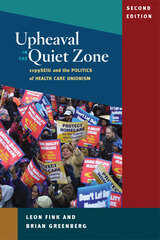
front cover of Upheaval in the Quiet Zone
Upheaval in the Quiet Zone
1199/SEIU and the Politics of Healthcare Unionism
Leon Fink and Brian Greenberg
University of Illinois Press, 2008
This expanded second edition of Upheaval in the Quiet Zone updates the dramatic story of an insurgent labor union that by the end of the 1980s had established itself as a vital force in the modern labor movement. But even bigger changes were on the way. Overcoming internal divisions that originated in its 1930s-inflected and civil rights-era militancy, 1199SEIU adopted a new strategy of labor-management cooperation to emerge as a key player in state and city politics. When SEIU president Andrew Stern laid plans in 2006 for a new national health care workers union that would simultaneously reach out to the unorganized and campaign for universal, national health insurance, he turned to 1199 president Dennis Rivera--and the 1199 political model--to lead the effort. With new material that updates the union's history since the 1990s, this book conveys the promise and problems of movement-building in the twenty-first century health care industry.
[more]


Send via email Share on Facebook Share on Twitter