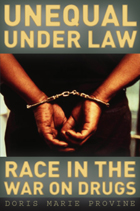
front cover of Unequal under Law
Unequal under Law
Race in the War on Drugs
Doris Marie Provine
University of Chicago Press, 2007
Race is clearly a factor in government efforts to control dangerous drugs, but the precise ways that race affects drug laws remain difficult to pinpoint. Illuminating this elusive relationship, Unequal under Law lays out how decades of both manifest and latent racism helped shape a punitive U.S. drug policy whose onerous impact on racial minorities has been willfully ignored by Congress and the courts.

Doris Marie Provine’s engaging analysis traces the history of race in anti-drug efforts from the temperance movement of the early 1900s to the crack scare of the late twentieth century, showing how campaigns to criminalize drug use have always conjured images of feared minorities. Explaining how alarm over a threatening black drug trade fueled support in the 1980s for a mandatory minimum sentencing scheme of unprecedented severity, Provine contends that while our drug laws may no longer be racist by design, they remain racist in design. Moreover, their racial origins have long been ignored by every branch of government. This dangerous denial threatens our constitutional guarantee of equal protection of law and mutes a much-needed national discussion about institutionalized racism—a discussion that Unequal under Law promises to initiate.
[more]

logo for Pluto Press
Unfree in Palestine
Registration, Documentation and Movement Restriction
Adah Kay and Nadia Abu-Zahra
Pluto Press, 2012
Based on first-hand accounts and extensive fieldwork, Unfree in Palestine reveals the role played by identity documents in Israel’s apartheid policies towards the Palestinians, from the red passes of the 1950s to the orange, green and blue passes of today.

The authors chronicle how millions of Palestinians have been denationalised through the bureaucratic tools of census, population registration, blacklisting and a discriminatory legal framework. They show how identity documents are used by Israel as a means of coercion, extortion, humiliation and informant recruitment. Movement restrictions tied to IDs and population registers threaten Palestinian livelihoods, freedom of movement and access to basic services such as health and education.

Unfree in Palestine is a masterful expose of the web of bureaucracy used by Israel to deprive the Palestinians of basic rights and freedoms, and calls for international justice and inclusive security in place of discrimination and division.

[more]


Send via email Share on Facebook Share on Twitter