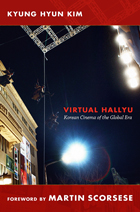
front cover of Virtual Hallyu
Virtual Hallyu
Korean Cinema of the Global Era
Kyung Hyun Kim
Duke University Press, 2011
“[T]his fine book . . . . enlarges our vision of one of the great national cinematic flowerings of the last decade.”—Martin Scorsese, from the foreword

In the late 1990s, South Korean film and other cultural products, broadly known as hallyu (Korean wave), gained unprecedented international popularity. Korean films earned an all-time high of $60.3 million in Japan in 2005, and they outperformed their Hollywood competitors at Korean box offices. In Virtual Hallyu, Kyung Hyun Kim reflects on the precariousness of Korean cinema’s success over the past decade. Arguing that state film policies and socioeconomic factors cannot fully explain cinema’s true potentiality, Kim draws on Deleuze’s concept of the virtual—according to which past and present and truth and falsehood coexist—to analyze the temporal anxieties and cinematic ironies embedded in screen figures such as a made-in-the-USA aquatic monster (The Host), a postmodern Chosun-era wizard (Jeon Woo-chi), a schizo man-child (Oasis), a weepy North Korean terrorist (Typhoon), a salary man turned vengeful fighting machine (Oldboy), and a sick nationalist (the repatriated colonial-era film Spring of Korean Peninsula). Kim maintains that the full significance of hallyu can only be understood by exposing the implicit and explicit ideologies of protonationalism and capitalism that, along with Korea’s ambiguous post-democratization and neoliberalism, are etched against the celluloid surfaces.


[more]

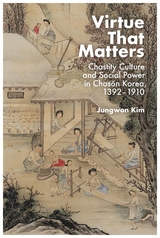
front cover of Virtue That Matters
Virtue That Matters
Chastity Culture and Social Power in Chosŏn Korea (1392–1910)
Jungwon Kim
Harvard University Press, 2025
Virtue That Matters is a groundbreaking exploration of the intricate dynamics of chastity culture in Chosŏn Korea from 1392 to 1910, shedding light on its political, legal, social, and cultural significance. In this book, Jungwon Kim demonstrates how an emphasis on female chastity came to pervade society as it intertwined with state ideology and elite interests. By analyzing a copious range of sources including governmental publications, legal records, and women’s own writings, Kim unveils the rich tapestry of Chosŏn society’s attitudes toward female chastity and argues that extreme chastity culture was not merely a product of Confucianization but was also shaped by diverse social forces and individual agency. Furthermore, Kim reframes the discourse on chastity by focusing on women’s experiences and perspectives, challenging the traditional portrayal of women as marginal to Chosŏn history. Virtue That Matters illustrates the complex interplay between state-led indoctrination, socio-legal changes, and gender relations in Chosŏn Korea. Kim also shows how the discourse on women’s chastity evolved over time and continued to influence social dynamics well into the twentieth century. By highlighting the enduring legacy of chastity culture in modern Korean society, Virtue That Matters provides valuable insights into contemporary debates on gender and sexuality.
[more]


Send via email Share on Facebook Share on Twitter