
 A SCHOLARLY BOOK REPOSITORY
8 start with W start with W
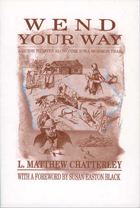
Wend Your Way: A Guide to Sites Along the Mormon Trail tells the story of this great movement through Iowa. Tracing the trail from east to west through 12 counties the guide includes:
• Mormon Trail history for each county•Directs visitors to the 27 interpretive roadside panels that were constructed on the trail by U.S. National Park Service and Iowa Mormon Trails Association
•Reproduces the poignant illustrations that author L. Matthew Chatterley drew for these wayside exhibits
•Provides a map and directions by county to guide travelers to the route of the Mormon Trail, sites of Mormon camps and settlements and the interpretive roadside panels
•Lists other locations in southern Iowa that visitors will want to explore
Twenty-one women and men discuss what it is about Mormonism that keeps them part of the fold. Their deep, unique experiences make their individual travels even more compelling. Kimberly Applewhite Teitter, growing up in the South as a Black Latter-day Saint, often encountered well-meaning Latter-day Saints whose words messaged the idea that she was at some level an outsider or perhaps not as authentically Mormon as others in her congregation. Thus, she writes, “At the end of the day I’m still Black—still have felt the weight of proving that I represent the church I’ve fought so hard for my entire life.” Yet the very episodes that could have driven her from the church became lessons on the meaning of discipleship.
For Carol Lynn Pearson, staying boiled down to two reasons: “I find a great deal of love in this church,” and “where I do not find love, I have an opportunity to help create love.” The stories she shares illuminate that mantra. Mitch Mayne, an openly gay man, has faced many challenges by his decision to stay. “Most days, it seems I can’t be Mormon enough for my LDS community, and I can’t be gay enough for my LGBT fellows.” In his essay, he answers the question many have asked: “Why don’t you just leave the church?”
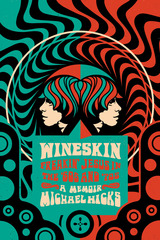
Michael Hicks’s story is a tale studded with awkward episodes of sex, drugs, and rock and roll (not necessarily in that order), along with alcohol, sci-fi, theft, radical politics, cartooning, halfway houses, and the musical avant-garde. The one constant is the brooding figure of Jesus Christ behind Hicks’s various personal reclamations and metamorphoses, often via methods admittedly off the books. While many readers know Hicks as a Mormon academic—thirty-five years a professor of music at Brigham Young University—Wineskin excavates the path, from boyhood to a PhD, that led him toward a faith that is both primitively Christian and highmindedly Mormon.
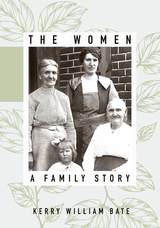
Kerry Bate proceeds on the premise that a story centering on the women of the clan could provide fresh perspective and insight. He portrays real people with well-rounded, flawed characters; builds from deep research; writes with a bit of style; and includes the rich context and detail of these lives. His main subjects are four generations of impressive women: the pioneer Catherine Campbell Steele; her daughter Young Elizabeth, the first Mormon child born in Utah; Kate, an accomplished community leader; and Sarah, a gifted seamstress trapped in an unhappy marriage. To enter their hardscrabble lives in small southern Utah communities is to meet women who pioneered in their own modest but determined ways.
Winner of the Mormon History Association's Best Personal History/Memoir Award.
Interview with Tom Williams on Access Utah
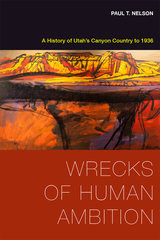
Most of the previous works regarding the history of this unique region have focused on either early exploration or twentieth-century controversies that erupted over mineral and water development and the creation of national parks and wilderness areas. This volume fills a gap in existing histories by focusing on early historical themes from the confrontation between Euro-Christian ideals and this challenging landscape. It centers on three interconnected interpretations of the area that unfolded when visitors from green, well-watered, productive lands approached this desert. The Judeo-Christian obligation to “make the desert bloom,” encompassed ideas of millenarianism and of Indian conversion and acculturation as well as the Old Testament symbolism of the “garden” and the “desert.” It was embodied in the efforts of Spanish missionaries who came to the canyon country from the 1500s to the 1700s, and in the experiences of Mormon settlers from about 1850 to 1909. Another conflicting sentiment saw the region simply as bad land to avoid, an idea strongly held by U.S. government explorers in the 1850s. This conclusion too was reinforced by the experiences of those who attempted to settle and exploit this country. Finally, though, the rise of tourism brought new ideas of wilderness reverence to the canyon country. The bad lands became valuable precisely because they were so distinct from traditionally settled landscapes.
In pursuing the conflict between Euro-Christian ideals and an arid, rugged, resistant landscape of deserts and canyons, Paul Nelson provides in clear, engaging language the most detailed examination yet published of colonial Spain’s encounter with the region and lays out some of Mormonism’s rare failures in settling the arid West.

Like its predecessor, Writing Mormon History, this book delves into the captivating narratives of multiple historians as they unfold the backstories of their various publishing endeavors. The authors detail their journeys in crafting influential books, articles, newspaper pieces, and anthologies that have significantly shaped our comprehension of Mormon history. Beyond the polished final products that readers typically encounter, the book explores the driving forces compelling authors to explore their topics and the sacrifices they make along the way.
The volume invites readers to ponder the motivations that fuel an author’s commitment to rigorous research and writing, and sheds light on the substantial time, ranging from minutes to long hours, invested in the sources they cite. Through these narratives, readers gain an appreciation for the dedication and passion that goes into the making of historical scholarship.
Whether you're an avid historian, a student of history, a scholar, or an aspiring author, Writing Mormon History 2 offers an important glimpse into the minds of these writers. This anthology provides a unique opportunity to connect with the human stories behind the academic works that have left an indelible mark on our understanding of Mormon history.
READERS
Browse our collection.
PUBLISHERS
See BiblioVault's publisher services.
STUDENT SERVICES
Files for college accessibility offices.
RECENTLY PUBLISHED



UChicago Accessibility Resources
home | accessibility | search | about | contact us
BiblioVault ® 2001 - 2026
The University of Chicago Press