
 A SCHOLARLY BOOK REPOSITORY
15 start with W start with W
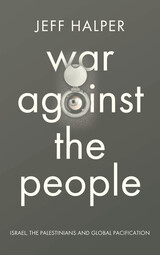
Modern warfare has a new form. The days of international combat are fading. So how do major world powers maintain control over their people today?
This book is a disturbing insight into the new ways world powers such as the US, Israel, Britain and China forge war today. It is a subliminal war of surveillance and whitewashed terror, conducted through new, high-tech military apparatuses, designed and first used in Israel against the Palestinian population. Including nano-technology, hidden camera systems, information databases on civilian activity, automated targeting systems and unmanned drones, it is used to control the very people the nation's leaders profess to serve.
Jeff Halper reveals that this practice is much more insidious than was previously thought. As Western governments claw back individual liberties, War Against the People is a reminder that fundamental human rights are being compromised for vast sections of the world, and that this is a subject that should concern everyone.
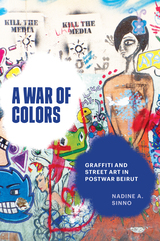
Demonstrates the role of Beirut’s postwar graffiti and street art in transforming the cityscape and animating resistance.
Over the last two decades in Beirut, graffiti makers have engaged in a fierce “war of colors,” seeking to disrupt and transform the city’s physical and social spaces. In A War of Colors, Nadine Sinno examines how graffiti and street art have been used in postwar Beirut to comment on the rapidly changing social dynamics of the country and region. Analyzing how graffiti makers can reclaim and transform cityscapes that were damaged or monopolized by militias during the war, Sinno explores graffiti’s other roles, including forging civic engagement, commemorating cultural icons, protesting political corruption and environmental violence, and animating resistance. In addition, she argues that graffiti making can offer voices to those who are often marginalized, especially women and LGBTQ people. Copiously illustrated with images of graffiti and street art, A War of Colors is a visually captivating and thought-provoking journey through Beirut, where local and global discourses intersect on both scarred and polished walls in the city.
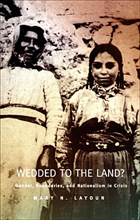
Drawing on readings of literature and of official documents and decrees, songs, poetry, cinema, public monuments, journalism, and conversations with exiles, refugees, and public officials, Layoun uses each historical incident as a means of highlighting a recurring trope within constructs of nationalism. The displacement of the Greek refugees in the 1920s calls into question the very idea of home, as well as the desire for ethnic homogeneity within nations. She reads the Cypriot coup and invasion as an illustration of the gendering of nation and how the notion of the inviolable woman came to represent sovereignity. In her third example she shows how the Palestinian and PLO expulsion from Beirut highlights the ambiguity of the borders upon which many manifestations of nationalism putatively depend. These chapters are preceded and introduced by a discussion of “culturing the nation” and closed by a consideration of citizenship and silence in which Layoun discusses rights ostensibly possessed by all members of a political community.
This book will be of interest to scholars engaged in cultural and critical theory, Middle Eastern and Mediterranean history, literary studies, political science, postcolonial studies, and gender studies.

Israel claims it is a security measure to protect Israeli citizens from terrorist attacks. Opponents point to the serious impact on the rights of Palestinians, depriving them of their land, mobility and access to health and educational services.
This book explores the Palestinian experience of the Wall in their international context. What are the real intentions behind the Israeli security argument? Is it a means of securing territory permanently through an illegal annexation of East Jerusalem? The West Bank Wall is a cutting account of the impact of the wall and how it affects prospects of a future peace in the Middle East.
The West-Eastern Divan is one of the world’s great works of literature, an inspired masterpiece, and a poetic linking of European and Persian traditions. This new bilingual edition expertly presents the wit, intelligence, humor, and technical mastery of the poetry in Goethe’s Divan. In order to preserve the work’s original power, Eric Ormsby has created this translation in clear contemporary prose rather than in rhymed verse, which tends to obscure the works sharpness. This edition is also accompanied by explanatory notes of the verse in German and in English and a translation of Goethe’s own commentary, the “Notes and Essays for a Better Understanding of the West-Eastern Divan.” This edition not only bring this classic collection to English-language readers, but also, at a time of renewed Western unease about the other, to open up the rich cultural world of Islam.
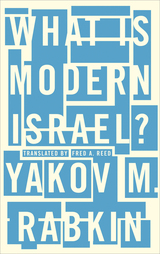
Drawing on many overlooked pages of history, including English, French, Hebrew, Yiddish and Russian sources, Yakov Rabkin shows that Zionism was conceived as a sharp break with Judaism and Jewish continuity. Israel’s past and present must be seen in the context of European ethnic nationalism, colonial expansion and geopolitical interests, rather than as an incarnation of Biblical prophecies or a culmination of Jewish history.
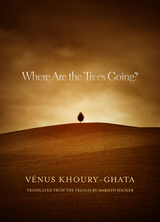
Longlist finalist, 2015 PEN Award for Poetry in Translation
Bringing the work of acclaimed poet Venus Khoury-Ghata to a new generation of anglophone readers, renowned award-winning poet and translator Marilyn Hacker has rendered Khoury-Gata's highly praised collection Où vont les arbres? into unforgettable English verse. In it, Khoury-Ghata takes on perennial themes of womanhood, immigration, and cultural conflict. Characters take root in her memory as weathered trees and garden plants, lending grit and body to the imaginative collection. As bracing as the turn of seasons, Where Are the Trees Going? highlights a poet writing with renewed urgency and maturity.
Khoury-Ghata's collection has been translated into fifteen languages. In this special edition, Paris-resident Hacker has also included selections from Khoury-Ghata's short fiction collection La maison aux orties (The House of Nettles). The resulting interplay illuminates the poet’s contrasting and complementary drives toward surreal lyricism and stark narrative exposition.

— from the Judge’s Citation by Kimiko Hahn
Why Misread a Cloud takes its name from clouds of ash and smoke in wartime which appear to the author as a “storm, blown over the sea.” Both an exploration of the mind’s ability to turn what is into something else, in order to survive, and the mind’s ability to resist the effects of psychosocial warfare—imposed by the military and the police. “Who wants you to be afraid” the poet’s friend asks as he “added sugar to his tea.” The realization this question brings enables the poet to explore forces that separate us from one another and ways we rise up within ourselves to move through fear toward love.
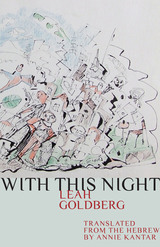
When she arrived in Palestine in 1935 at the age of twenty-four, Leah Goldberg was already known as a significant emerging poet in contemporary Hebrew literature. Today, mention of her name is apt to evoke a nostalgic sigh among Israelis who have grown up hearing her poems read, quoted, recollected, and—having been set to some four hundred melodies—sung on the radio. In the wake of overwhelming new attention on Goldberg's work in Israel, With This Night makes available for the first time in English the final collection of poetry that Goldberg published during her lifetime.
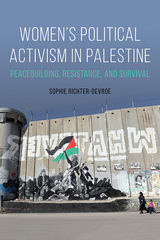
Richter-Devroe's ethnographic approach draws from revealing in-depth interviews and participant observation in Palestine. The result: a forceful critique of mainstream conflict resolution methods and the failed woman-to-woman peacebuilding projects so lauded around the world. The liberal faith in dialogue as core of "the political" and the assumption that women's "nurturing" nature makes them superior peacemakers, collapse in the face of past and ongoing Israeli state violences.
Instead, women confront Israeli settler colonialism directly and indirectly in their popular and everyday acts of resistance. Richter-Devroe's analysis zooms in on the intricate dynamics of daily life in Palestine, tracing the emergent politics that women articulate and practice there. In shedding light on contemporary gendered "politics from below" in the region, the book invites a rethinking of the workings, shapes, and boundaries of the political.
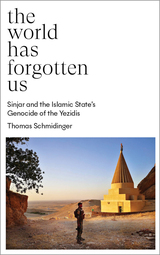
The persecution of the Yezidis, a religious community originating in Upper Mesopotamia, has been ongoing since at least the 10th century. On 3 August 2014, Islamic State attacked the Yezidi community in Sinjar, Kurdistan. Thousands were enslaved or killed in this genocide, and 100,000 people fled to Mount Sinjar, permanently exiled from their homes.
Here, Thomas Schmidinger talks to the Yezidis in Iraq who tell the history of their people, why the genocide happened and how it affects their lives today. This is the first full account of these events, as told by the Yezidis in their own words, to be published in English.
The failure of the Kurdistan Peshmerga of the PDK in Iraq to protect the Yezidis is explored, as is the crucial support given by the Syrian-Kurdish YPG. This multi-faceted and important history brings the fight and trauma of the Yezidis back into focus, calling for the world to remember their struggle.
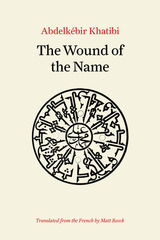
Winner of the Global Humanities Translation Prize
Abdelkébir Khatibi’s The Wound of the Name (1974) is a classic work of North African critical theory that seeks to decolonize French ways of looking at and writing about Maghreb cultures. Writing at the height of French semiotics’ popularity and prestige, Khatibi proposes intersemiotics as a study of signs that pass through related but different cultural geographies, times, and expressions. Proverbs, tattoos, the rhetoric of lovemaking, calligraphy, and oral storytelling show a circulation of cultural signifiers over, across, and against borders. Signs are not stagnant; meaning is not fixed. Khatibi’s intent is in keeping with his emergent double critique, which aims to redefine not only European understanding of North African culture but also North African self-understanding, by freeing it from the anthropological mandates of the modern colonial era as well as from the retrenched theocratic models that were characteristic of North African postcolonial states.
READERS
Browse our collection.
PUBLISHERS
See BiblioVault's publisher services.
STUDENT SERVICES
Files for college accessibility offices.
RECENTLY PUBLISHED


UChicago Accessibility Resources
home | accessibility | search | about | contact us
BiblioVault ® 2001 - 2026
The University of Chicago Press