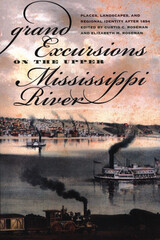
front cover of Grand Excursions on the Upper Mississippi River
Grand Excursions on the Upper Mississippi River
Places, Landscapes, and Regional Identity after 1854
Curtis C. & Elizabeth M. Roseman & Roseman
University of Iowa Press, 2004
In June 1854 the Grand Excursion celebrated in festive style the completion of the Chicago and Rock Island Railroad to the Mississippi River. Hundreds of dignitaries including newspaper editors and other journalists; politicians; academics, writers and artists; business and industry leaders; and railroad officials were among those who traveled by rail from Chicago to Rock Island, Illinois, then by steamboat to St. Paul in Minnesota Territory. The travelers were shown a region undergoing rapid settlement by Europeans—an area of great natural beauty offering many promises for additional development.

One hundred and fifty years later, the thirteen essays in this volume examine the activities and environments of the 1854 Grand Excursion and place them in the context of an evolving regional identity for the Upper Mississippi River Valley based on the economy, culture, geography, and history of the area. In a series of “excursions,” the contributors explore the building of the Chicago and Rock Island Railroad, eastern newspaper accounts of the 1854 excursion, steamboating, the area’s pictorial landscape, passenger trains along the scenic river, the genesis and features of river towns, the control of the river for navigation, the development of preserves, parks, and recreation areas, the lumber industry, and commercial fishing. The book concludes by examining the resurgence of river-oriented development, as river towns are once again embracing the Mississippi.

Generously illustrated with maps, engravings, ephemera, and historic and present-day photographs, Grand Excursions on the Upper Mississippi River will be of interest to tourists and residents of the area, river aficionados, railroad and steamboat history buffs, as well as academics interested in the history, geography, and regional development of the area.

[more]

front cover of Immigrants in the Valley
Immigrants in the Valley
Irish, Germans, and Americans in the Upper Mississippi Country, 1830-1860
Mark Wyman
Southern Illinois University Press, 1984
Thousands of newcomers flocked into the Upper Mississippi country in the decades leading up to the Civil War. Illinois, Wisconsin, Iowa, Missouri, and Minnesota received immigrants from most areas of Europe, as well as Americans from the Upper South, New England, and the Middle Atlantic states. They all carried with them religious beliefs, experiences, and expectations that differed widely, attitudes and opinions which often threw them into conflict with each other. Drawing extensively on family letters sent home to Europe, missionary reports, employment records, and other diverse materials from 1830 to 1860, Wyman shows the interplay between the major groups traveling the roads and waterways of the Upper Mississippi Valley during those crucial decades. The result is a lively, richly illustrated account that will help Americans everywhere better understand their diverse heritage and the environment in which their family trees took root. A new preface to this paperback edition helps to bring the scholarship up to date.
[more]

front cover of The Silver Man
The Silver Man
The Life and Times of Indian Agent John Kinzie
Peter Shrake
Wisconsin Historical Society Press, 2016

In The Silver Man: The Life and Times of John Kinzie, readers witness the dramatic changes that swept the Wisconsin frontier in the early and mid-1800s, through the life of Indian agent John Harris Kinzie. From the War of 1812 and the monopoly of the American Fur Company, to the Black Hawk War and the forced removal of thousands of Ho-Chunk people from their native lands—John Kinzie’s experience gives us a front-row seat to a pivotal time in the history of the American Midwest.

As an Indian agent at Fort Winnebago—in what is now Portage, Wisconsin—John Kinzie served the Ho-Chunk people during a time of turbulent change, as the tribe faced increasing attacks on its cultural existence and very sovereignty, and struggled to come to terms with American advancement into the upper Midwest. The story of the Ho-Chunk Nation continues today, as the tribe continues to rebuild its cultural presence in its native homeland.

Through John Kinzie’s story, we gain a broader view of the world in which he lived—a world that, in no small part, forms a foundation for the world in which we live today.
[more]

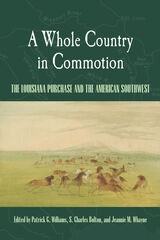
front cover of A Whole Country in Commotion
A Whole Country in Commotion
The Louisiana Purchase and the American Southwest
Patrick G. Williams
University of Arkansas Press, 2005
Bringing together the work of prominent scholars and rising stars in southern, western, and Indian history, A Whole Country in Commotion explores lesser-known aspects of one of the better-known episodes in U.S. history. While the purchase has been seen as a great boon for the United States, doubling the size of the new nation and securing American navigation on the Mississippi River, it also brought turmoil to many. Looking past the triumphal aspects of the purchase, this book examines the “negotiations among peoples, nations and empires that preceded and followed the actual transfer of territory.” Its nine essays highlight the “commotion” the purchase stirred up—among nations, among Louisiana residents and newcomers, even among those who remained east of the Mississippi. Many of these essays look at the portion of the Louisiana territory that would become Arkansas to illustrate the profound impact of the purchase on the diverse populations of the American Southwest. Others explore the woeful commotion brought to many thousands of lives as Jefferson’s “noble bargain” set the stage for the forced migration of native and African Americans from the east to the west of the Mississippi.
[more]


Send via email Share on Facebook Share on Twitter