
 A SCHOLARLY BOOK REPOSITORY
In 1921 Austria became the first interwar European country to experience hyperinflation. The League of Nations, among other actors, stepped in to help reconstruct the economy, but a decade later Austria’s largest bank, Credit-Anstalt, collapsed. Historians have correlated these events with the banking and currency crisis that destabilized interwar Europe—a narrative that relies on the claim that Austria and the global monetary system were the victims of financial interlopers. In this corrective history, Nathan Marcus deemphasizes the destructive role of external players in Austria’s reconstruction and points to the greater impact of domestic malfeasance and predatory speculation on the nation’s financial and political decline.
Consulting sources ranging from diplomatic dossiers to bank statements and financial analyses, Marcus shows how the League of Nations’ efforts to curb Austrian hyperinflation in 1922 were politically constrained. The League left Austria in 1926 but foreign interests intervened in 1931 to contain the fallout from the Credit-Anstalt collapse. Not until later, when problems in the German and British economies became acute, did Austrians and speculators exploit the country’s currency and compromise its value. Although some statesmen and historians have pinned Austria’s—and the world’s—economic implosion on financial colonialism, Marcus’s research offers a more accurate appraisal of early multilateral financial supervision and intervention.
Illuminating new facets of the interwar political economy, Austrian Reconstruction and the Collapse of Global Finance reckons with the true consequences of international involvement in the Austrian economy during a key decade of renewal and crisis.
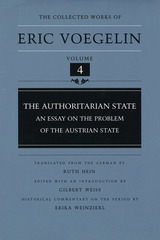
Published in Vienna in 1936, The Authoritarian State by Eric Voegelin has remained virtually unknown to the public until now. Sales of the German edition were halted following the Nazi invasion of Austria in 1938, and the entire printing was later destroyed by wartime bombing. In this volume, Voegelin offers a critical examination of the most prominent European theories of state and constitutional law of the period while providing a political and historical analysis of the Austrian situation. He discusses the dismissal of Parliament in 1933, the civil war, the murder of Federal Chancellor Dollfuss, the adoption of the "Authoritarian Constitution" of 1934, and the predicament of being sandwiched between Hitler and Mussolini.
A radical critique of Hans Kelsen's pure theory of law lies at the heart of this work, marking Voegelin's definitive departure from Neo-Kantian epistemology. For the first time, Voegelin elaborates on the important distinction between theoretical concepts and political symbols as a basis for explaining the nontheoretical and speculative character of ideologies, both left and right. He shows that total and authoritarian are symbols of ideological self-interpretation that have no theoretical value, a distinction basic to his later work in The New Science of Politics.
Available for the first time in English, The Authoritarian State is a valuable addition to the Voegelin canon and to the field of intellectual history in general.
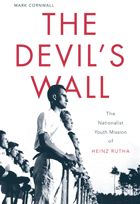
Legend has it that twenty miles of volcanic rock rising through the landscape of northern Bohemia was the work of the devil, who separated the warring Czechs and Germans by building a wall. The nineteenth-century invention of the Devil’s Wall was evidence of rising ethnic tensions. In interwar Czechoslovakia, Sudeten German nationalists conceived a radical mission to try to restore German influence across the region. Mark Cornwall tells the story of Heinz Rutha, an internationally recognized figure in his day, who was the pioneer of a youth movement that emphasized male bonding in its quest to reassert German dominance over Czech space.
Through a narrative that unravels the threads of Rutha’s own repressed sexuality, Cornwall shows how Czech authorities misinterpreted Rutha’s mission as sexual deviance and in 1937 charged him with corrupting adolescents. The resulting scandal led to Rutha’s imprisonment, suicide, and excommunication from the nationalist cause he had devoted his life to furthering. Cornwall is the first historian to tackle the long-taboo subject of how youth, homosexuality, and nationalism intersected in a fascist environment. The Devil’s Wall also challenges the notion that all Sudeten German nationalists were Nazis, and supplies a fresh explanation for Britain’s appeasement of Hitler, showing why the British might justifiably have supported the 1930s Sudeten German cause. In this readable biography of an ardent German Bohemian who participated as perpetrator, witness, and victim, Cornwall radically reassesses the Czech-German struggle of early twentieth-century Europe.
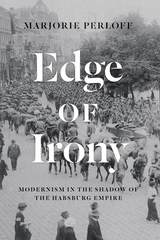
Perloff explores works ranging from Karl Kraus’s drama The Last Days of Mankind and Elias Canetti’s memoir The Tongue Set Free to Ludwig Wittgenstein’s notebooks and Paul Celan’s lyric poetry. Throughout, she shows that Austro-Modernist literature is characterized less by the formal and technical inventions of a modernism familiar to us in the work of Joyce and Pound, Dada and Futurism, than by a radical irony beneath a seemingly conventional surface, an acute sense of exile, and a sensibility more erotic and quixotic than that of its German contemporaries. Skeptical and disillusioned, Austro-Modernism prefers to ask questions rather than formulate answers.

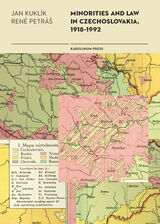
The authors of this volume challenge conventional notions about Habsburg and Czechoslovak politics, arguing that they were more democratic than they often appear. At combining political science and history, the authors’ guiding principle and means of analysis is the consociational model of democracy. This theory, linked best to Arend Lijphart, asserts that consociationalism guarantees minorities a say in government and helps preserve democracy in societies that experience deep ideological, cultural, or ethnic divisions. It enables the main segments to be isolated organizationally from each other, thus avoiding conflict, and affording the leaders to make compromises for the good of the whole.
Consociationalism has proven its worth as a model for describing contemporary democracies and diagnosing their ills. By exploring the institutions and practices of the Habsburg Monarchy before 1918 and the Czechoslovak First Republic, Howe, Lorman, and Miller prove the value of the consociational theory at analyzing the past. They hold that a multitude of parties, frequent cabinet changes, and reliance on circles of experts do not necessarily signal flawed democracies, when, in fact, they are features of consociationalism. This book is a call to specialists to view current politics not just in terms of majoritarian democracy but rather by the standard of the consociational democracies.
READERS
Browse our collection.
PUBLISHERS
See BiblioVault's publisher services.
STUDENT SERVICES
Files for college accessibility offices.
RECENTLY PUBLISHED






UChicago Accessibility Resources
home | accessibility | search | about | contact us
BiblioVault ® 2001 - 2025
The University of Chicago Press