logo for Georgetown University Press
Black Georgetown Remembered
A History of Its Black Community from the Founding of “The Town of George” in 1751 to the Present Day, 30th Anniversary Edition
Kathleen Menzie Lesko, Valerie M. Babb, and Carroll R. Gibbs
Georgetown University Press, 2023

Georgetown's little-known Black heritage shaped a Washington, DC, community long associated with white power and privilege.

Black Georgetown Remembered reveals a rich but little-known history of the Georgetown Black community from the colonial period to the present. Drawing on primary sources, including oral interviews with past and current residents and extensive research in church and historical society archives, the authors record the hopes, dreams, disappointments, and successes of a vibrant neighborhood as it persevered through slavery and segregation, war and peace, prosperity and depression.

This thirtieth anniversary edition of Black Georgetown Remembered, first published in 1991, features more than two hundred illustrations, including portraits of prominent community leaders, sketches, maps, and nineteenth-century and contemporary photographs. A new chapter includes a conversation with former and current Georgetown residents reflecting on the community, past and present.

Black Georgetown Remembered is a compelling and inspiring journey through more than two hundred years of history. A one-of-a-kind book, it invites readers to share in the lives, dreams, aspirations, struggles, and triumphs of real people, to join them in their churches, at home, and on the street, and to consider how the unique heritage of this neighborhood intersects and contributes to broader themes in African American and Washington, DC, history and urban studies.

[more]

front cover of Sand In a Whirlwind, 30th Anniversary Edition
Sand In a Whirlwind, 30th Anniversary Edition
The Paiute Indian War of 1860
Ferol Egan
University of Nevada Press, 1985
Sand in a Whirlwind is a dramatic account of the events surrounding hostilities between settlers and Pyramid Paiutes in the spring of 1860. Thirty years after its publication Ferol Egan’s now classic tale continues to enlighten and engage readers.
[more]

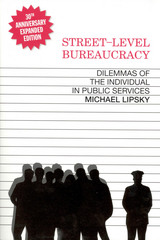
front cover of Street-Level Bureaucracy, 30th Anniversary Edition
Street-Level Bureaucracy, 30th Anniversary Edition
Dilemmas of the Individual in Public Service
Michael Lipsky
Russell Sage Foundation, 2010
First published in 1980, Street-Level Bureaucracy received critical acclaim for its insightful study of how public service workers, in effect, function as policy decision makers, as they wield their considerable discretion in the day-to-day implementation of public programs. Three decades later, the need to bolster the availability and effectiveness of healthcare, social services, education, and law enforcement is as urgent as ever. In this thirtieth anniversary expanded edition, Michael Lipsky revisits the territory he mapped out in the first edition to reflect on significant policy developments over the last several decades. Despite the difficulties of managing these front-line workers, he shows how street-level bureaucracies can be and regularly are brought into line with public purposes. Street-level bureaucrats—from teachers and police officers to social workers and legal-aid lawyers—interact directly with the public and so represent the frontlines of government policy. In Street-Level Bureaucracy, Lipsky argues that these relatively low-level public service employees labor under huge caseloads, ambiguous agency goals, and inadequate resources. When combined with substantial discretionary authority and the requirement to interpret policy on a case-by-case basis, the difference between government policy in theory and policy in practice can be substantial and troubling. The core dilemma of street-level bureaucrats is that they are supposed to help people or make decisions about them on the basis of individual cases, yet the structure of their jobs makes this impossible. Instead, they are forced to adopt practices such as rationing resources, screening applicants for qualities their organizations favor, "rubberstamping" applications, and routinizing client interactions by imposing the uniformities of mass processing on situations requiring human responsiveness. Occasionally, such strategies work out in favor of the client. But the cumulative effect of street-level decisions made on the basis of routines and simplifications about clients can reroute the intended direction of policy, undermining citizens' expectations of evenhanded treatment. This seminal, award-winning study tells a cautionary tale of how decisions made by overburdened workers translate into ad-hoc policy adaptations that impact peoples' lives and life opportunities. Lipsky maintains, however, that these problems are not insurmountable. Over the years, public managers have developed ways to bring street-level performance more in line with agency goals. This expanded edition of Street-Level Bureaucracy underscores that, despite its challenging nature, street-level work can be made to conform to higher expectations of public service.
[more]


Send via email Share on Facebook Share on Twitter