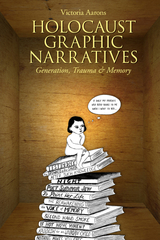
front cover of Holocaust Graphic Narratives
Holocaust Graphic Narratives
Generation, Trauma, and Memory
Victoria Aarons
Rutgers University Press, 2020
In Holocaust Graphic Narratives, Victoria Aarons demonstrates the range and fluidity of this richly figured genre. Employing memory as her controlling trope, Aarons analyzes the work of the graphic novelists and illustrators, making clear how they extend the traumatic narrative of the Holocaust into the present and, in doing so, give voice to survival in the wake of unrecoverable loss. In recreating moments of traumatic rupture, dislocation, and disequilibrium, these graphic narratives contribute to the evolving field of Holocaust representation and establish a new canon of visual memory. The intergenerational dialogue established by Aarons’ reading of these narratives speaks to the on-going obligation to bear witness to the Holocaust. Examined together, these intergenerational works bridge the erosions created by time and distance. As a genre of witnessing, these graphic stories, in retracing the traumatic tracks of memory, inscribe the weight of history on generations that follow.
 
[more]

front cover of Lessons and Legacies, Volume XVI
Lessons and Legacies, Volume XVI
Rethinking Paradigms
Sarah Phillips Casteel and Jennifer V. Evans
Northwestern University Press, 2027

Bringing forth new perspectives previously unrepresented in Holocaust studies

Lessons and Legacies, Volume XVI: Rethinking Paradigms does the difficult but crucial work of thinking through new methods and modes of representation that speak to where we find ourselves in Holocaust studies today, responding to—and developing new tools to analyze—the shifting shape of Holocaust memory: spatially, temporally, and in and across diverse media. The collection foregrounds the challenges visual sources pose to how we think about the Holocaust, including how it is represented differently in visual media, from photography to graphic novels, and establishes translation as a crucial concept for reframing Holocaust testimony and memory. The contributing authors also model ethical, nuanced ways to conduct comparative, connective work that challenges Eurocentric narratives of the Holocaust. The volume concludes with a section on memory work and activism that approaches the subject of post-1945 memory through different lenses to surface lesser-known aspects of Holocaust history.
[more]

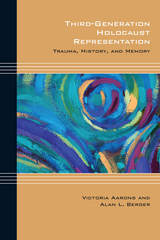
front cover of Third-Generation Holocaust Representation
Third-Generation Holocaust Representation
Trauma, History, and Memory
Victoria Aarons and Alan L. Berger
Northwestern University Press, 2017
Victoria Aarons and Alan L. Berger show that Holocaust literary representation has continued to flourish well into the twenty-first century—gaining increased momentum even as its perspective shifts, as a third generation adds its voice to the chorus of post-Holocaust writers. In negotiating the complex thematic imperatives and narrative conceits of the literature of third-generation writers, this bold new work examines those structures, tropes, patterns, ironies, disjunctions, and overall tensions that produce a literature that laments unrecoverable loss for a generation removed spatially and temporally from the extended trauma of the Holocaust. Aarons and Berger address evolving notions of “postmemory”; the intergenerational and ongoing transmission of trauma; issues of Jewish cultural identity; inherited memory; the psychological tensions of post-Holocaust Jewish identity; the characteristic tropes of memory and the personalized narrative voice; issues of generational dislocation and anxiety; the recurrent antagonisms of assimilation and historical alienation; the imaginative re-creation and reconstruction of the past; and the future of Holocaust memory and representation.
[more]


Send via email Share on Facebook Share on Twitter