logo for Assoc of College & Research Libraries
21st Century Access Services
On the Frontline of Academic Librarianship
Michael J. Krasulski
Assoc of College & Research Libraries, 2013

front cover of Academic Librarianship
Academic Librarianship
G. Edward Evans
American Library Association, 2018

Ideal for practitioners looking to advance their careers and for use in LIS programs, this "comprehensive overview" (Journal of Access Services) has been thoroughly revised and updated to provide a timely exploration of the characteristics of academic librarianship and its place in the ever-changing environment of higher education. Evans and new coauthor Greenwell guide readers towards understanding what is required to have a successful career in academic librarianship, explaining why academic libraries are distinct from other types of libraries and lending practical insight into their unique political and operational characteristics. The text offers comprehensive coverage of such key issues as

  • teaching faculty roles and the status of the academic librarian;
  • governance and the growing tension on some campuses between faculty and administration;
  • curriculum, with a discussion of the balance between general education requirements and applied courses;
  • the student body;
  • collections, data management, digitization, and metadata;
  • scholarly communication, plus alternative models such as open educational resources (OERs);
  • providing quality service, and the role of user experience (UX) in assessment;
  • ACRL's Information Literacy Framework;
  • funding, including how and where to find detailed higher education expenditure data;
  • classrooms, common learning spaces, and other facilities;
  • staffing and professional development;
  • technology and IT support;
  • career development, with advice on preparing a vita and undergoing a successful interview; and
  • the future of academic librarianship.

This updated edition enables readers to understand how academic libraries deliver information, offer services, and provide learning spaces in new ways to better meet the needs of today's students, faculty, and other communities of academic library users.

[more]

logo for American Library Association
Academic Librarianship
Camila Alire
American Library Association, 2010

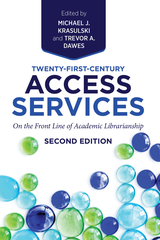
front cover of Twenty-First-Century Access Services
Twenty-First-Century Access Services
On the Front Line of Academic Librarianship, Second Edition
Trevor A. Dawes
Assoc of College & Research Libraries, 2023
Access services is the administrative umbrella typically found in academic libraries where the circulation, reserves, interlibrary loan, stacks maintenance, and related functions reside. These functions are central to daily operations and the staff are often seen as “the face” of the library. But while access services impact every user of the academic library, these functions can be unseen and often go unnoticed and uncelebrated. 
 
This thoroughly revised edition of 2013’s seminal Twenty-First-Century Access Services highlights the expanded duties of these departments; the roles these services continue to play in the success of the library, students, and faculty; and the knowledge, skills, and abilities these library workers need. In four parts it explores:
  • Facilitating Access
  • Leading Access Services
  • Assessing Access Services
  • Developing Access Services Professionals 
Chapters take in-depth looks at functions including circulation, stacks management, resource sharing, course reserve management and controlled digital lending, user experience, and assessing and benchmarking access services. The book also contains the full text of ACRL’s new A Framework for Access Services Librarianship: An Initiative Sponsored by the Association of College and Research Libraries’ Access Services Interest Group and a look at how it was developed and approved.
 
Twenty-First-Century Access Services demonstrates access services’ value, defines their responsibilities and necessary skills, and explores how access services departments are evolving new and traditional services to support the academic mission of their institutions. It is geared toward both access services practitioners and library and information science graduate students and faculty.

[more]


Send via email Share on Facebook Share on Twitter