
 A SCHOLARLY BOOK REPOSITORY
This book is also freely available online as an open access digital edition. The open access publication was financially supported by the Social Science Research Master and partly also by the Health, Care and the Body Programme Group of the Department of Anthropology, both at the Amsterdam Institute of Social Science Research, University of Amsterdam.

Caring for Red is Mindy Fried's moving and colorful account of caring for her ninety-seven-year-old father, Manny--an actor, writer, and labor organizer--in the final year of his life. This memoir chronicles the actions of two sisters as they discover concentric circles of support for their father and attempt to provide him with an experience of "engaged aging" in an assisted living facility.
The story is also that of a daughter of a powerful and outspoken man who took risks throughout his life and whose political beliefs had an enduring impact on his family. (After Manny was called before the House Un-American Activities Committee, he was blacklisted and his family was shunned.)
As an actor, Manny was affiliated with Elia Kazan's Group Theatre and the Federal Theatre Project. He did Shakespeare, Chekhov, and Ibsen, and played everything from the tormented father in Arthur Miller's All My Sons to an infant in a baby carriage in Thornton Wilder's Infancy, from the Rabbi in Fiddler on the Roof to--poignantly for this book--the role of Morrie in Tuesdays with Morrie.
As she devotes herself to caring for her dying father, Mindy grapples anew with the complexity of their relationship. She questions whether she can be there for him and how to assert her own voice as her father's caregiver in his last days.
“I decide that from now on we should listen to him. His lip may be deflated and his left side paralyzed, but he knows. And he has made terrible mistakes. But he knows. He knows. We are lucky that way.”
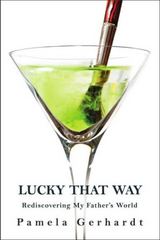
Lucky That Way, a nuanced, richly engaging memoir, chronicles the joys and tribulations of a daughter who rediscovers her father as he nears the end of his life. Ernie Gerhardt, an artist and teacher, is largely estranged from his five children, but when he suffers a debilitating stroke, his daughter Pamela must fly to Las Vegas to tend to him. When she arrives to find Ernie newly and shockingly fragile, she is hit by an unexpected wave of tenderness.
As she watches over him in intensive care, she recalls turning points in her family history—the early death of her mother and her father’s turn to heavy drinking--and reflects on the idiosyncrasies that make an imperfect and unique family, on what it means to become old, on what happens when parents are no longer the caregivers but the cared-for, and on how a family copes with their responsibility to the elderly.
Written in a crisp, engaging style, the story is less about the drudgery of finding the right mix of medicines, at-home caregivers, and rehabilitation centers and more about the emotional ramifications of caring for the sick under the weight of sometimes flawed attachments.
People make mistakes, grow old, get sick, and pass on from this world. Lucky That Way examines the irritations and comforts of contemporary family bonds. Gerhardt sifts through the complicated, multi-layered relationships for both wry comedy and high drama and records a string of triumphs and mishaps as Ernie and his five adult children struggle to manage his life and find meaning before their time runs out.
The emerging theme of imperfect humans struggling with life's great mysteries will strike a chord of recognition with the tens of thousands of Baby-Boomers and Gen-Xers who are currently facing similar circumstances with their elderly loved ones. Pamela Gerhardt’s heartfelt story about a family coming to terms with their aging father’s illness and imminent death takes readers on an emotional roller coaster that highlights love, loss, humor, and sadness.

In a series of moving vignettes, the author begins by describing a particular representation of Water-Moon Kuan Yin, a Buddhist teacher and goddess associated with compassion, who often sits on a precarious overhang or floats on a flimsy petal. Then Kuan Yin steps out of the frame to join the author in the mundane challenges of caring for her father-transferring his health insurance, struggling with a wheelchair van, managing adult diapers, or playing in the fictions of dementia. From perplexed to poignant to funny, the vignettes record the working-class English of a fading but still wise dad, and they find other human versions of Kuan Yin in a doctor who will still make house calls or kind strangers in the street.
The book includes ten illustrations: both classical representations of Kuan Yin and also the author's own drawings, which adapt Kuan Yin in an act of practical spirituality, reading art through life and life through art. Each vignette invites the harried caregiver to take a deep breath and meditate on the trials and joys of caring for an aging parent.
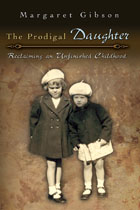
The 1950s and 1960s were years of shifting values and social changes that did not sit well with many citizens of Richmond, Virginia, and in particular with one conservative family, a staunchly southern mother and father and their two daughters. A powerful evocation of time and place, this memoir—a gifted poet's first book of prose—is the story of an inquisitive and sensitive young woman's coming of age and a deeply moving recounting of her reconciliation later in life with the family she left behind.
Returning us to a Cold War world marked by divisions of race, gender, wealth, and class, The Prodigal Daughter is an exploration of difference, the powerful wedge that separates individuals within a social milieu and within a family. Echoing the biblical Prodigal Son, Margaret Gibson's memoir is less concerned with the years of excess away from home than with the seeds of division sown in this family's early years. Hers is the story of a mother proud to be a Lady, a Southerner, and a Christian; of two daughters trapped by their mother's power; and of their father's breakdown under social and family expectations.
Slow to rebel, young Margaret finally flees the world of manners and custom—which she deems poor substitutes for right thought and right action in the face of the Civil Rights movement and the Vietnam War—and abandons her fundamentalist upbringing. In a defiant gesture that proves prophetic, she once signed a postcard home "The Prodigal." After years of being the distant, absent daughter, she finds herself returning home to meet the needs of her stroke-crippled younger sister and her incapacitated parents.
In this tale of homecoming and forgiveness, death and dying, Gibson recounts how she overcame her long indifference to a sister she had thought different from herself, recognizing the strengths of the bonds that both hold us and set us free. Interweaving astute social observations on social pressures, race relations, sibling rivalry, adolescent angst, and more, The Prodigal Daughter is a startlingly honest portrayal of one family in one southern city and the story of all too many families across America.

Christine's father, as it turned out, prepared too slowly for old age. Before he had made any decision, fate disabled him through a series of strokes. Confined to a nursing home, severely impaired by dementia and frustrated by his circumstances, his life epitomized the predicament her mother wanted to avoid.
So Far Away gives us an intimate view of a person interacting with and reacting to her parents at the ends of their lives. In a richly detailed, poignant story of family members' separate yet interwoven journeys, it underscores the complexities and opportunities that life presents each one of us.
ESS Public Sociology Award
Recommended Book in Domestic Violence by DomesticShelters.org
How do you go about caregiving for an ill and elderly parent with a lifelong history of abuse and control, intertwined with expressions of intense love and adoration? How do you reconcile the resulting ambivalence, fear, and anger?
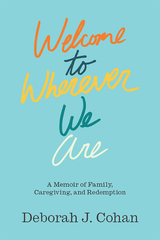
Welcome to Wherever We Are is a meditation on what we hold onto, what we let go of, how we remember others and ultimately how we’re remembered. Deborah Cohan shares her story of caring for her father, a man who was simultaneously loud, gentle, loving and cruel and whose brilliant career as an advertising executive included creating slogans like “Hey, how ‘bout a nice Hawaiian punch?” Wrestling with emotional extremes that characterize abusive relationships, Cohan shows how she navigated life with a man who was at once generous and affectionate, creating magical coat pockets filled with chocolate kisses when she was a little girl, yet who was also prone to searing, vicious remarks like “You’d make my life easier if you’d commit suicide.”
In this gripping memoir, Cohan tells her unique personal story while also weaving in her expertise as a sociologist and domestic abuse counselor to address broader questions related to marriage, violence, divorce, only children, intimacy and loss. A story most of us can relate to as we reckon with past and future choices against the backdrop of complicated family dynamics, Welcome to Wherever We Are is about how we might come to live our own lives better amidst unpredictable changes through grief and healing.
Questions for Discussion (https://d3tto5i5w9ogdd.cloudfront.net/wp-content/uploads/2020/05/11140346/Cohan_Discussion.docx)
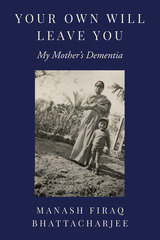
“Memory’s barriers are without barriers,” writes Manash Firaq Bhattacharjee in the opening of his touching and thoughtful memoir, Your Own Will Leave You. Bhattacharjee eloquently reflects on family, care, and memory as he chronicles his experiences with his elderly mother who suffers from dementia. Working from his journal, Bhattacharjee ruminates on the ways we understand dementia and memory as well as end-of-life issues. He is not only a loving son, but also an Indian with a universal sensibility who turns to ancient and contemporary thinkers that inform his perspective.
Bhattacharjee focuses on the last months of his mother’s life and her changing demeanor—her stubbornness, humor, and vulnerability. He traces her interactions with family members, neighbors, and caregivers, while also addressing burden-of-care issues. Recounting his moments of grief and guilt with candor, Bhattacharjee also re-evaluates how Western culture prejudices popular perceptions of mental illness.
Lyrical, penetrating, occasionally aphoristic, and full of insights, Your Own Will Leave You is a heartfelt, and at times heartbreaking, memoir and a warm elegy for the author’s late mother.
READERS
Browse our collection.
PUBLISHERS
See BiblioVault's publisher services.
STUDENT SERVICES
Files for college accessibility offices.
RECENTLY PUBLISHED



UChicago Accessibility Resources
home | accessibility | search | about | contact us
BiblioVault ® 2001 - 2026
The University of Chicago Press