
 A SCHOLARLY BOOK REPOSITORY
Results by Title
3 books about African American mothers in literature
3 books about African American mothers in literature

How We Write Now
Living with Black Feminist Theory
Jennifer C. Nash
Duke University Press, 2024
In How We Write Now Jennifer C. Nash examines how Black feminists use beautiful writing to allow writers and readers to stay close to the field’s central object and preoccupation: loss. She demonstrates how contemporary Black feminist writers and theorists such as Jesmyn Ward, Elizabeth Alexander, Christina Sharpe, and Natasha Trethewey mobilize their prose to ask readers to feel, undo, and reassemble themselves. These intimate invitations are more than a set of tools for decoding the social world; Black feminist prose becomes a mode of living and feeling, dreaming and being, and a distinctly affective project that treats loss as not only paradigmatic of Black life but also an aesthetic question. Through her own beautiful writing, Nash shows how Black feminism offers itself as a companion to readers to chart their own lives with and in loss, from devastating personal losses to organizing around the movement for Black lives. Charting her own losses, Nash reminds us that even as Black feminist writers get as close to loss as possible, it remains a slippery object that troubles memory and eludes capture.
[more]
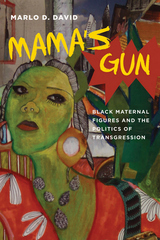
Mama's Gun
Black Maternal Figures and the Politics of Transgression
Marlo D. David
The Ohio State University Press, 2016
In Mama’s Gun: Black Maternal Figures and the Politics of Transgression, Marlo D. David identifies five bold, new archetypes of black motherhood for the post-civil rights generation in order to imagine new ways of thinking about pervasive maternal stereotypes of black women. Rather than avoiding “negative” images of black motherhood, such as welfare queens, teen mothers, and “baby mamas,” Mama’s Gun centralizes these dispossessed figures and renames them as the Young Mother, the Blues Mama, the Surrogate, Big Mama, and the Mothership.
Taking inspiration from African American fiction, historical accounts of black life, Afrofuturism, and black popular culture in music and on screen, David turns her attention to Sapphire’s Push, Octavia Butler’s Dawn, and Suzan-Lori Parks’s Getting Mother’s Body as well as the performance art of Erykah Badu and the films of Tyler Perry. She draws out the implications of black maternal figures in these texts who balk at tradition and are far from “ideal.” David’s study shows how representations of blackness are deeply embedded in the neoliberal language of contemporary American politics and how black writers and performers resist such mainstream ideologies with their own transgressive black maternal figures.
Taking inspiration from African American fiction, historical accounts of black life, Afrofuturism, and black popular culture in music and on screen, David turns her attention to Sapphire’s Push, Octavia Butler’s Dawn, and Suzan-Lori Parks’s Getting Mother’s Body as well as the performance art of Erykah Badu and the films of Tyler Perry. She draws out the implications of black maternal figures in these texts who balk at tradition and are far from “ideal.” David’s study shows how representations of blackness are deeply embedded in the neoliberal language of contemporary American politics and how black writers and performers resist such mainstream ideologies with their own transgressive black maternal figures.
[more]
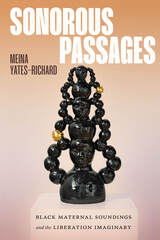
Sonorous Passages
Black Maternal Soundings and the Liberation Imaginary
Meina Yates-Richard
Duke University Press, 2026
In Sonorous Passages, Meina Yates-Richard demonstrates how, within Black Atlantic literary and cultural productions, the sounds of Black maternal figures function as mediators of liberatory thought. Under the press of chattel slavery, Black mothers were discursively rendered as points of passage between freedom and unfreedom in the political imaginary, creating a paradigm wherein Black male subjects came to be imagined as the appropriate heirs and subjects of freedom. Sonorous Passages offers the methodology of “double-listening” as a Black feminist interpretive heuristic through which we are to hear and assess the Black maternal sonority within Black Atlantic textual and sonic objects. Through works ranging from Frederick Douglass’s nineteenth-century writings to twenty-first-century literary and sonic art, Sonorous Passages traces how Black maternal figures are conceptually excised from the imaginative realms of Black political freedom, even as the soundings of Black mothers provide protective and generative sites for developing liberatory thought. As Yates-Richard shows, by listening closely to Black maternal sonority, we can access, resound, and reproduce resonant maternal inheritances of freedom.
[more]
READERS
Browse our collection.
PUBLISHERS
See BiblioVault's publisher services.
STUDENT SERVICES
Files for college accessibility offices.
RECENTLY PUBLISHED



UChicago Accessibility Resources
home | accessibility | search | about | contact us
BiblioVault ® 2001 - 2026
The University of Chicago Press