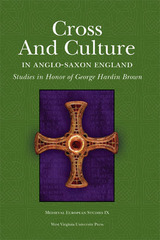
front cover of Cross and Culture in Anglo-Saxon England
Cross and Culture in Anglo-Saxon England
Studies in Honor of George Hardin Brown
KAREN L. JOLLY
West Virginia University Press, 2008

As Volume One in the Sancta Crux/Halig Rod series, this collection of new research offers fascinating glimpses into how the way the cross, the central image of Christianity in the Anglo-Saxon period, was textualized, reified, visualized, and performed. The cross in early medieval England was so ubiquitous it became invisible to the modern eye, and yet it played an innovative role in Anglo-Saxon culture, medicine, and popular practice. It represented one of the most powerful relics, emblems, and images in medieval culture because it could be duplicated in many forms and was accessible to every layer of society. The volume speaks to critical issues of cultural interpretation for Anglo-Saxonists, medievalists of all disciplines, and those interested in cultural studies in general.
[more]

front cover of The Footsteps of Israel
The Footsteps of Israel
Understanding Jews in Anglo-Saxon England
Andrew P. Scheil
University of Michigan Press, 2004
"This innovative, well-researched study looks at anti-Judaic rhetoric in the Old English and Latin texts of Anglo-Saxon England-a land lacking real Jews. The author isolates a common pool of inherited images for portraying the Jew, and teaches us to hear, especially in the vernacular, their increasingly dark and disturbing inflections." ---Roberta Frank, Yale University "The Footsteps of Israel is a fascinating study of a pervasive stereotype. Scheil's analysis of how Jews, with no real physical presence in Anglo-Saxon England, captured the imagination of writers of the period, is a superb achievement." ---Louise Mirrer, President and CEO, New-York Historical Society "The elegance of Scheil's prose weaves a unifying thread through the vast literary and historical tapestry he presents, moving with grace from Latin to Old English, from Bede to later authors, from Wordsworth and Blake to modern writers. He speaks elegantly of these texts' conversations with the past, and the Jews emerge as both enemies and spiritual antecedents of the 'New Israel' of Anglo-Saxon England." ---Stephen Spector, State University of New York, Stonybrook Jews are the omnipresent border-dwellers of medieval culture, a source of powerful metaphors active in the margins of medieval Christianity. This book outlines an important prehistory to later persecutions in England and beyond, yet it also provides a new understanding of the previously unrecognized roles Jews and Judaism played in the construction of social identity in early England. Andrew P. Scheil approaches the Anglo-Saxon understanding of Jews from a variety of directions, including a survey of the lengthy history of the ideology of England as the New Israel, its sources in late antique texts and its manifestation in both Old English and Latin texts from Anglo-Saxon England. In tandem with this perhaps more sympathetic understanding of the Jews is a darker vision of anti-Judaism, associating the Jews in an emotional fashion with the materiality of the body. In exploring the complex ramifications of this history, the author is the first to assemble and study references to Jews in Anglo-Saxon culture. For this reason, The Footsteps of Israel will be an important source for Anglo-Saxonists, scholars of late antiquity and the early Middle Ages, scholars of medieval antisemitism in general, students of Jewish history, and medievalists interested in cultural studies.
[more]

front cover of Naked Before God
Naked Before God
Uncovering the Body in Anglo-Saxon England
BENJAMIN C. WITHERS
West Virginia University Press, 2003

At different times and in different places, the human form has been regarded in different ways. The Ancient Greeks thought it was the most admirable subject for art, whereas early Christians often viewed it as lascivious in our post-lapsarian state. With illustrations taken from manuscripts, statuary and literary, this is a fascinating collection of essays with much that will be new to scholars and general readers alike.

[more]


Send via email Share on Facebook Share on Twitter