
 A SCHOLARLY BOOK REPOSITORY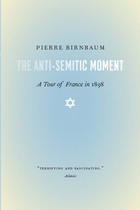
In 1898, the Dreyfus Affair plunged French society into a yearlong frenzy. In Paris and provincial villages throughout the country, angry crowds paraded through the streets, threatening to attack Jews and destroy Jewish-owned businesses. Anger about the imagined power of Jewish capital, as well as fears of treason and racial degeneration, made anti-Semitism a convenient banner behind which social and political factions could fall in line. Anti-Semitic feelings that had been simmering in France for decades came boiling to the surface.
Here Pierre Birnbaum guides readers on a tour of France during this crisis. He shows that in the midst of violence, Jewish citizens bravely and effectively defended themselves and were aided by a police force determined to maintain order. Birnbaum paints a vivid portrait of French Jewish culture at the time and explains why the French state remained strong in this time of widespread unrest.
The book begins with a revised and updated version of David Engel’s seminal essay “Away from a Definition of Antisemitism.” Subsequent contributions by renowned specialists in ancient, medieval, and modern history, religious studies, and other fields explore the various and changing definitions and uses of the term “antisemitism” in a range of contexts, including ancient Rome and Greece, the Byzantine Empire, medieval Europe, early modern and modern Europe, North America, and the United Kingdom. The volume also includes a section that focuses on the Second World War, including the Holocaust and its memory. Engel offers a contemporary response to conclude the book.
First published in Hebrew in 2020 as a special issue of the journal Zion: A Quarterly for Research in Jewish History in cooperation with the Zalman Shazar Center in Jerusalem, this compelling collection has already had an impact on the study of antisemitism in Israel. It is certain to become a critical resource for scholars, policymakers, and journalists researching antisemitism, Holocaust studies, and related fields.
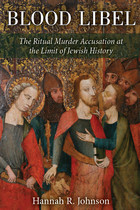
The ritual murder accusation is one of a series of myths that fall under the label blood libel, and describes the medieval legend that Jews require Christian blood for obscure religious purposes and are capable of committing murder to obtain it. This malicious myth continues to have an explosive afterlife in the public sphere, where Sarah Palin's 2011 gaffe is only the latest reminder of its power to excite controversy. Blood Libel is the first book-length study to analyze the recent historiography of the ritual murder accusation and to consider these debates in the context of intellectual and cultural history as well as methodology. Hannah R. Johnson articulates how ethics shapes methodological decisions in the study of the accusation and how questions about methodology, in turn, pose ethical problems of interpretation and understanding. Examining recent debates over the scholarship of historians such as Gavin Langmuir, Israel Yuval, and Ariel Toaff, Johnson argues that these discussions highlight an ongoing paradigm shift that seeks to reimagine questions of responsibility by deliberately refraining from a discourse of moral judgment and blame in favor of an emphasis on historical contingencies and hostile intergroup dynamics.

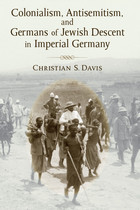
Colonialism, Antisemitism, and Germans of Jewish Descent in Imperial Germany examines the relationship between the colonial and antisemitic movements of modern Germany from 1871 to 1918, examining the complicated ways in which German antisemitism and colonialism fed off of and into each other in the decades before the First World War. Author Christian S. Davis studies the significant involvement with and investment in German colonialism by the major antisemitic political parties and extra-parliamentary organizations of the day, while also investigating the prominent participation in the colonial movement of Jews and Germans of Jewish descent and their tense relationship with procolonial antisemites.
Working from the premise that the rise and propagation of racial antisemitism in late-nineteenth-century Germany cannot be separated from the context of colonial empire, Colonialism, Antisemitism, and Germans of Jewish Descent in Imperial Germany is the first work to study the dynamic and evolving interrelationship of the colonial and antisemitic movements of the Kaiserreich era. It shows how individuals and organizations who originated what would later become the ideological core of National Socialism---racial antisemitism---both influenced and perceived the development of a German colonial empire predicated on racial subjugation. It also examines how colonialism affected the contemporaneous German antisemitic movement, dividing it over whether participation in the nationalist project of empire building could furnish patriotic credentials to even Germans of Jewish descent. The book builds upon the recent upsurge of interest among historians of modern Germany in the domestic impact and character of German colonialism, and on the continuing fascination with the racialization of the German sense of self that became so important to German history in the twentieth century.
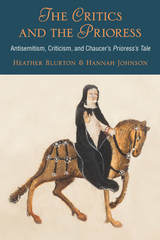
The Critics and the Prioress responds to a critical stalemate between the demands of ethics and the entailments of methodology. The book addresses key moments in criticism of the Prioress’s Tale—particularly those that stage an encounter between historicism and ethics—in order to interrogate these critical impasses while suggesting new modes for future encounters. It is an effort to identify, engage, and reframe some significant—and perennially repeated—arguments staked out in this criticism, such as the roles of gender, aesthetics, source studies, and the appropriate relationship between ethics and historicism.
The Critics and the Prioress will be an essential resource for Chaucer scholars researching as well as teaching the Prioress’s Tale. Scholars and students of Middle English literature and medieval culture more generally will also be interested in this book’s rigorous analysis of contemporary scholarly approaches to expressions of antisemitism in Chaucer’s England.
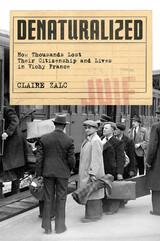
“In Denaturalized, Claire Zalc combines the precision of the scholar with the passion of a storyteller…This is a deftly written book. Zalc combines in an accessible style (smoothly translated by Catherine Porter) the stories of people trapped within a bureaucracy that was as obsessed, perhaps, with clearing files as with hunting Jews. In other words, Zalc reminds us how cruel the banality of indifference could be.”—Wall Street Journal
Winner of the Prix d’histoire de la justice
A leading historian radically revises our understanding of the fate of Jews under the Vichy regime.
Thousands of naturalized French men and women had their citizenship revoked by the Vichy government during the Second World War. Once denaturalized, these men and women, mostly Jews who were later sent to concentration camps, ceased being French on official records and walked off the pages of history. As a result, we have for decades severely underestimated the number of French Jews murdered by Nazis during the Holocaust. In Denaturalized, Claire Zalc unearths this tragic record and rewrites World War II history.
At its core, this is a detective story. How do we trace a citizen made alien by the law? How do we solve a murder when the body has vanished? Faced with the absence of straightforward evidence, Zalc turned to the original naturalization papers in order to uncover how denaturalization later occurred. She discovered that, in many cases, the very officials who granted citizenship to foreigners before 1940 were the ones who retracted it under Vichy rule.
The idea of citizenship has always existed alongside the threat of its revocation, and this is especially true for those who are naturalized citizens of a modern state. At a time when the status of millions of naturalized citizens in the United States and around the world is under greater scrutiny, Denaturalized turns our attention to the precariousness of the naturalized experience—the darkness that can befall those who suddenly find themselves legally cast out.
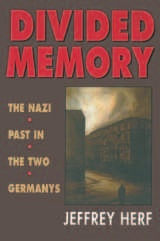
What has Germany made of its Nazi past?
A significant new look at the legacy of the Nazi regime, this book exposes the workings of past beliefs and political interests on how—and how differently—the two Germanys have recalled the crimes of Nazism, from the anti-Nazi emigration of the 1930s through the establishment of a day of remembrance for the victims of National Socialism in 1996.
Why, Jeffrey Herf asks, would German politicians raise the specter of the Holocaust at all, in view of the considerable depth and breadth of support its authors and their agenda had found in Nazi Germany? Why did the public memory of Nazi anti-Jewish persecution and the Holocaust emerge, if selectively, in West Germany, yet was repressed and marginalized in “anti-fascist” East Germany? And how do the politics of left and right come into play in this divided memory? The answers reveal the surprising relationship between how the crimes of Nazism were publicly recalled and how East and West Germany separately evolved a Communist dictatorship and a liberal democracy. This book, for the first time, points to the impact of the Cold War confrontation in both West and East Germany on the public memory of anti-Jewish persecution and the Holocaust.
Konrad Adenauer, Theodor Heuss, Kurt Schumacher, Willy Brandt, Richard von Weizsacker, and Helmut Kohl in the West and Walter Ulbricht, Wilhelm Pieck, Otto Grotewohl, Paul Merker, and Erich Honnecker in the East are among the many national figures whose private and public papers and statements Herf examines. His work makes the German memory of Nazism—suppressed on the one hand and selective on the other, from Nuremberg to Bitburg—comprehensible within the historical context of the ideologies and experiences of pre-1945 German and European history as well as within the international context of shifting alliances from World War II to the Cold War. Drawing on West German and recently opened East German archives, this book is a significant contribution to the history of belief that shaped public memory of Germany’s recent past.
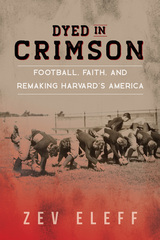
Zev Eleff tells the story of two immigrants’ sons shaped by a vision of an America that rewarded any person of virtue. As a player, the Chicago-born Horween had led Harvard to its 1920 Rose Bowl victory. As a coach, he faced intractable opposition from powerful East Coast alumni because of his values and Midwestern, Jewish background. Eleff traces Bingham and Horween’s careers as student-athletes and their campaign to wrest control of the football program from alumni. He also looks at how Horween undermined stereotypes of Jewish masculinity and dealt with the resurgent antisemitism of the 1920s.
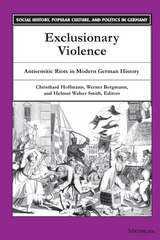
In the Western mind, outbursts of collective violence against Jews have been largely identified with Tzarist Russia and the medieval crusade massacres. However, by narrating pogroms as archaic, historians have overlooked their significance to the development of modern antisemitism in Germany and Europe as well as the reasons for its continued presence in the contemporary world. The evidence presented in this volume suggests that acts of exclusionary violence were not dead-end streets of futile protest. Rather, they were rehearsals for new kinds of destruction.
The integration of various perspectives and the close cooperation of scholars from different disciplines is a major achievement of this volume, which will be of interest to advanced undergraduates, graduate students, academics and the general reader in a variety of disciplines, including German studies, Jewish studies, Holocaust and genocide studies, ethnic relations, history, and the social sciences in general.
Christhard Hoffmann is Associate Professor of Modern European History, University of Bergen, Norway. Werner Bergmann is Professor of Research on Antisemitism, Technical University, Berlin, Germany. Helmut W. Smith is Associate Professor of History, Vanderbilt University.

In the mid-1800s, Judson argues, German liberal activists built an effective political movement whose ideology was rooted in its members' social experience in voluntary associations. The liberals were committed to the creation of a market economy based on personal property rights, to a society based on the values of individual self-improvement and personal respectability, and to a fundamental distinction between active and passive citizenship. They were determined to achieve a harmonious community of free peoples, in which personal enlightenment would bring an end to the divisive influence of localism, ethnicity, religion, and feudal social hierarchy.
Yet after 1880, as newer, more radical mass political movements threatened their political fortunes, the liberals forged a German nationalist politics based increasingly on ethnic identity. Their emphasis on national identity became a way for former liberals to hold together an increasingly diverse coalition of German speakers who had little in common outside of their shared language. Only "Germanness" bridged the dangerous gulf between social classes. This nationalism helped the liberals to compete for power in the multinational, multicultural Austrian Empire down to 1914, but it left a legacy of nationalist extremism and tolerance of anti-Semitism that continues to influence political cultures in the former lands of the Habsburg Monarchy today.
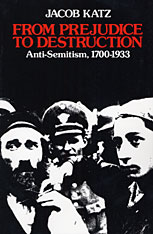
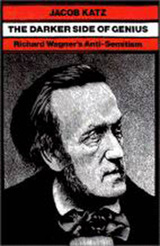
Jacob Katz here presents a major reinterpretation of modern anti-Semitism, which blends history of ideas about the Jews gradually became transformed and then, around 1879, picked up so much social force as to result in the premeditated and systematic destruction of the Jewish people of Europe.
Mr. Katz revises the prevalent thesis that medieval and modern animosities against Jews were fundamentally different. He also rejects the scapegoat theory, according to which the Jews were merely a lightning rod for underlying economic and social tensions. On the contrary, he argues, there were very real tensions between Jews and non-Jews, because the Jews were a highly visible and cohesive group and so came into conflict with non-Jews in competing for social and economic rewards.
In the late 19th century, Mr. Katz argues, hatred of the Jews shifted from their religion to more essential aspects of their character and behavior. The term “anti-Semitism,” he explains, which first came into use around 1870, was meant to describe this change. Thus, ironically, just as Jews were being integrated into the political state, skillful propagandists such as Theodore Fritzche and Houston Stewart Chamberlain were extraordinarily successful in spreading notions of Jewish racial inferiority and its threat to the pure Aryan stock. And so when Hitler came on the scene, the seeds of Jewish race hatred were widely sown.
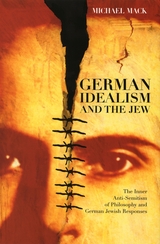
Offering the first analytical account of the connection between anti-Semitism and philosophy, Mack begins his exploration by showing how the fundamental thinkers in the German idealist tradition—Kant, Hegel, and, through them, Feuerbach and Wagner—argued that the human world should perform and enact the promises held out by a conception of an otherworldly heaven. But their respective philosophies all ran aground on the belief that the worldly proved incapable of transforming itself into this otherworldly ideal. To reconcile this incommensurability, Mack argues, philosophers created a construction of Jews as symbolic of the "worldliness" that hindered the development of a body politic and that served as a foil to Kantian autonomy and rationality.
In the second part, Mack examines how Moses Mendelssohn, Heinrich Heine, Franz Rosenzweig, and Freud, among others, grappled with being both German and Jewish. Each thinker accepted the philosophies of Kant and Hegel, in varying degrees, while simultaneously critiquing anti-Semitism in order to develop the modern Jewish notion of what it meant to be enlightened—a concept that differed substantially from that of Kant, Hegel, Feuerbach, and Wagner. By speaking the unspoken in German philosophy, this book profoundly reshapes our understanding of it.
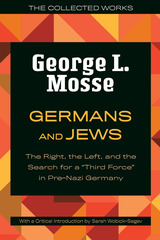
This innovative perspective has implications for understanding not only the rise of fascism and Nazism in Germany but also the rise and fall of the New Left in the United States and Europe, which was occurring at the time of Mosse’s writing. A new critical introduction by Sarah Wobick-Segev, research associate at the University of Hamburg, places Mosse’s work in its historical and intellectual contexts and draws lessons for students and scholars today.
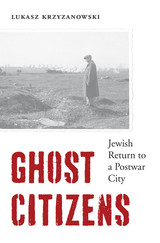
The poignant story of Holocaust survivors who returned to their hometown in Poland and tried to pick up the pieces of a shattered world.
In the immediate aftermath of World War II, the lives of Polish Jews were marked by violence and emigration. But some of those who had survived the Nazi genocide returned to their hometowns and tried to start their lives anew. Lukasz Krzyzanowski recounts the story of this largely forgotten group of Holocaust survivors. Focusing on Radom, an industrial city about sixty miles south of Warsaw, he tells the story of what happened throughout provincial Poland as returnees faced new struggles along with massive political, social, and legal change.
Non-Jewish locals mostly viewed the survivors with contempt and hostility. Many Jews left immediately, escaping anti-Semitic violence inflicted by new communist authorities and ordinary Poles. Those who stayed created a small, isolated community. Amid the devastation of Poland, recurring violence, and bureaucratic hurdles, they tried to start over. They attempted to rebuild local Jewish life, recover their homes and workplaces, and reclaim property appropriated by non-Jewish Poles or the state. At times they turned on their own. Krzyzanowski recounts stories of Jewish gangs bent on depriving returnees of their prewar possessions and of survivors shunned for their wartime conduct.
The experiences of returning Jews provide important insights into the dynamics of post-genocide recovery. Drawing on a rare collection of documents—including the postwar Radom Jewish Committee records, which were discovered by the secret police in 1974—Ghost Citizens is the moving story of Holocaust survivors and their struggle to restore their lives in a place that was no longer home.
Globalizing Race explores how intersections between French antisemitism and imperialism shaped the development of European racial thought. Ranging from the African misadventures of the antisemitic Marquis de Morès to the Parisian novels and newspapers of late nineteenth-century professional antisemites, Dorian Bell argues that France’s colonial expansion helped antisemitism take its modern, racializing form—and that, conversely, antisemitism influenced the elaboration of the imperial project itself.
Globalizing Race radiates from France to place authors like Guy de Maupassant and Émile Zola into sustained relation with thinkers from across the ideological spectrum, including Hannah Arendt, Friedrich Nietzsche, Frantz Fanon, Karl Marx, Max Horkheimer, and Theodor Adorno. Engaging with what has been called the “spatial turn” in social theory, the book offers new tools for thinking about how racisms interact across space and time. Among these is what Bell calls racial scalarity. Race, Bell argues, did not just become globalized when European racism and antisemitism accompanied imperial penetration into the farthest reaches of the world. Rather, race became most thoroughly global as a method for constructing and negotiating the different scales (national, global, etc.) necessary for the development of imperial capitalism.
As France, Europe, and the world confront a rising tide of Islamophobia, Globalizing Race also brings into fascinating focus how present-day French responses to Muslim antisemitism hark back to older, problematic modes of representing the European colonial periphery.
While Heidegger’s affiliation with National Socialism is well known, the anti-Semitic dimension of that engagement could not be fully told until now. Trawny traces Heidegger’s development of a grand “narrative” of the history of being, the “being-historical thinking” at the center of Heidegger’s work after Being and Time. Two of the protagonists of this narrative are well known to Heidegger’s readers: the Greeks and the Germans. The world-historical antagonist of this narrative, however, has remained hitherto undisclosed: the Jews, or, more specifically, “world Judaism.” As Trawny shows, world Judaism emerges as a racialized, destructive, and technological threat to the German homeland, indeed, to any homeland whatsoever. Trawny pinpoints recurrent, anti-Semitic themes in the Notebooks, including Heidegger’s adoption of crude cultural stereotypes, his assigning of racial reasons to philosophical decisions (even undermining his Jewish teacher, Edmund Husserl), his endorsement of a Jewish “world conspiracy,” and his first published remarks on the extermination camps and gas chambers (under the troubling aegis of a Jewish “self-annihilation”). Trawny concludes with a thoughtful meditation on how Heidegger’s achievements might still be valued despite these horrifying facets. Unflinching and systematic, this is one of the most important assessments of one of the most important philosophers in our history.
Since its founding, the journal Kritika: Explorations in Russian and Eurasian History has led the way in exploring the East European and Soviet experience of the Holocaust. This volume combines revised articles from the journal and previously unpublished pieces to highlight the complex interactions of prejudice, power, and publicity. It offers a probing examination of the complicity of local populations in the mass murder of Jews perpetrated in areas such as Poland, Ukraine, Bessarabia, and northern Bukovina and analyzes Soviet responses to the Holocaust.
Based on Soviet commission reports, news media, and other archives, the contributors examine the factors that led certain local residents to participate in the extermination of their Jewish neighbors; the interaction of Nazi occupation regimes with various sectors of the local population; the ambiguities of Soviet press coverage, which at times reported and at times suppressed information about persecution specifically directed at the Jews; the extraordinary Soviet efforts to document and prosecute Nazi crimes and the way in which the Soviet state’s agenda informed that effort; and the lingering effects of silence about the true impact of the Holocaust on public memory and state responses.
The nineteenth- and twentieth-century relationship between European culture, German history, and the Jewish experience produced some of the West’s most powerful and enduring intellectual creations—and, perhaps in subtly paradoxical and interrelated ways, our century’s darkest genocidal moments. In Times of Crisis explores the flashpoints of this vexed relationship, mapping the coordinates of a complex triangular encounter of immense historical import.
In essays that range from the question of Nietzsche’s legacy to the controversy over Daniel Goldhagen’s Hitler’s Willing Executioners, the distinguished historian Steven E. Aschheim presents this encounter as an ongoing dialogue between two evolving cultural identities. He touches on past dimensions of this exchange (such as the politics of Weimar Germany) and on present dilemmas of grasping and representing it (such as the Israeli discourse on the Holocaust). His work inevitably traces the roots and ramifications of Nazism but at the same time brings into focus historical circumstances and contemporary issues often overshadowed or distorted by the Holocaust.
These essays reveal the ubiquitous charged inscriptions of Nazi genocide within our own culture and illuminate the projects of some later thinkers and historians—from Hannah Arendt to George Mosse to Saul Friedlander—who have wrestled with its problematics and sought to capture its essence. From the broadly historical to the personal, from the politics of Weimar Germany to the experience of growing up German Jewish in South Africa, the essays expand our understanding of German Jewish history in particular, but also of historical processes in general.
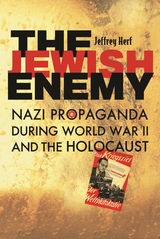
The sheer magnitude of the Holocaust has commanded our attention for the past sixty years. The extent of atrocities, however, has overshadowed the calculus Nazis used to justify their deeds.
According to German wartime media, it was German citizens who were targeted for extinction by a vast international conspiracy. Leading the assault was an insidious, belligerent Jewish clique, so crafty and powerful that it managed to manipulate the actions of Roosevelt, Churchill, and Stalin. Hitler portrayed the Holocaust as a defensive act, a necessary move to destroy the Jews before they destroyed Germany.
Joseph Goebbels, Minister of Propaganda, and Otto Dietrich’s Press Office translated this fanatical vision into a coherent cautionary narrative, which the Nazi propaganda machine disseminated into the recesses of everyday life. Calling on impressive archival research, Jeffrey Herf recreates the wall posters that Germans saw while waiting for the streetcar, the radio speeches they heard at home or on the street, the headlines that blared from newsstands. The Jewish Enemy is the first extensive study of how anti-Semitism pervaded and shaped Nazi propaganda during World War II and the Holocaust, and how it pulled together the diverse elements of a delusionary Nazi worldview. Here we find an original and haunting exposition of the ways in which Hitler legitimized war and genocide to his own people, as necessary to destroy an allegedly omnipotent Jewish foe. In an era when both anti-Semitism and conspiracy theories continue to influence world politics, Herf offers a timely reminder of their dangers along with a fresh interpretation of the paranoia underlying the ideology of the Third Reich.
Such striking similarities between present and past suggest that we are not done with the issues raised by the historical Jewish Question: that is, what is the place of “the Jew”—the minority, the relic, the rootless stranger, the racialized other, the exiled, the displaced, the immigrant, the diasporic? In The Jewish Question Again, leading scholars grapple with our inability to keep these struggles in the past and why we continue to repeat these atrocities. This book explores the haunting recurrence of the Jewish Question today and begs why we find ourselves here yet again.
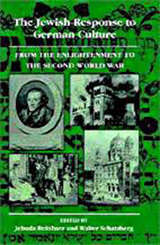
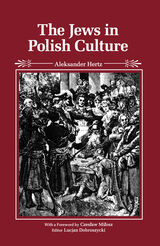
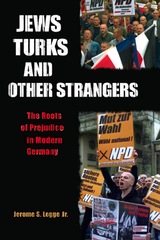
Scholarly, objective, insightful, and analytical, Jews, Turks, and Other Strangers studies the causes of prejudice against Jews, foreign workers, refugees, and emigrant Germans in contemporary Germany. Using survey material and quantitative analyses, Legge convincingly challenges the notion that German xenophobia is rooted in economic causes. Instead, he sees a more complex foundation for German prejudice, particularly in a reunified Germany where perceptions of the "other" sometimes vary widely between east and west, a product of a traditional racism rooted in the German past. By clarifying the foundations of xenophobia in a new German state, Legge offers a clear and disturbing picture of a conflicted country and a prejudice that not only affects Jews but also fuels a larger, anti-foreign sentiment.
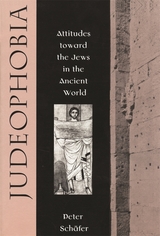
Taking a fresh look at what the Greeks and Romans thought about Jews and Judaism, Peter Schäfer locates the origin of anti-Semitism in the ancient world. Judeophobia firmly establishes Hellenistic Egypt as the generating source of anti-Semitism, with roots extending back into Egypt’s pre-Hellenistic history.
A pattern of ingrained hostility toward an alien culture emerges when Schäfer surveys an illuminating spectrum of comments on Jews and their religion in Greek and Roman writings, focusing on the topics that most interested the pagan classical world: the exodus or, as it was widely interpreted, expulsion from Egypt; the nature of the Jewish god; food restrictions, in particular abstinence from pork; laws relating to the sabbath; the practice of circumcision; and Jewish proselytism. He then probes key incidents, two fierce outbursts of hostility in Egypt: the destruction of a Jewish temple in Elephantine in 410 B.C.E. and the riots in Alexandria in 38 C.E. Asking what fueled these attacks on Jewish communities, the author discovers deep-seated ethnic resentments. It was from Egypt that hatred of Jews, based on allegations of impiety, xenophobia, and misanthropy, was transported first to Syria-Palestine and then to Rome, where it acquired a new element: fear of this small but distinctive community. To the hatred and fear, ingredients of Christian theology were soon added—a mix all too familiar in Western history.
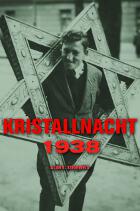
On November 7, 1938, a Jewish teenager, Herschel Grynszpan, fatally shot a German diplomat in Paris. Within three days anti-Jewish violence erupted throughout Germany, initially incited by local Nazi officials, and ultimately sanctioned by the decisions of Hitler and Goebbels at the pinnacle of the Third Reich. As synagogues burned and Jews were beaten in the streets, police stood aside. Men, women, and children—many neighbors of the victims—participated enthusiastically in acts of violence, rituals of humiliation, and looting. By the night of November 10, a nationwide antisemitic pogrom had inflicted massive destruction on synagogues, Jewish schools, and Jewish-owned businesses. During and after this spasm of violence and plunder, 30,000 Jewish men were rounded up and sent to concentration camps, where hundreds would perish in the following months.
Kristallnacht revealed to the world the intent and extent of Nazi Judeophobia. However, it was seen essentially as the work of the Nazi leadership. Now, Alan Steinweis counters that view in his vision of Kristallnacht as a veritable pogrom—a popular cathartic convulsion of antisemitic violence that was manipulated from above but executed from below by large numbers of ordinary Germans rioting in the streets, heckling and taunting Jews, cheering Stormtroopers' hostility, and looting Jewish property on a massive scale.
Based on original research in the trials of the pogrom's perpetrators and the testimonies of its Jewish survivors, Steinweis brings to light the evidence of mob action by all sectors of the civilian population. Kristallnacht 1938 reveals the true depth and nature of popular antisemitism in Nazi Germany on the eve of the Holocaust.
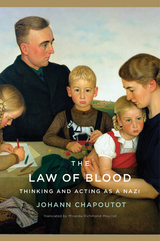
Winner of the Yad Vashem International Book Prize for Holocaust Research
The scale and the depth of Nazi brutality seem to defy understanding. What could drive people to fight, kill, and destroy with such ruthless ambition? Observers and historians have offered countless explanations since the 1930s. According to Johann Chapoutot, we need to understand better how the Nazis explained it themselves. We need a clearer view, in particular, of how they were steeped in and spread the idea that history gave them no choice: it was either kill or die.
Chapoutot, one of France’s leading historians, spent years immersing himself in the texts and images that reflected and shaped the mental world of Nazi ideologues, and that the Nazis disseminated to the German public. The party had no official ur-text of ideology, values, and history. But a clear narrative emerges from the myriad works of intellectuals, apparatchiks, journalists, and movie-makers that Chapoutot explores.
The story went like this: In the ancient world, the Nordic-German race lived in harmony with the laws of nature. But since Late Antiquity, corrupt foreign norms and values—Jewish values in particular—had alienated Germany from itself and from all that was natural. The time had come, under the Nazis, to return to the fundamental law of blood. Germany must fight, conquer, and procreate, or perish. History did not concern itself with right and wrong, only brute necessity. A remarkable work of scholarship and insight, The Law of Blood recreates the chilling ideas and outlook that would cost millions their lives.

Legacies of Anti-Semitism in France was first published in 1983. Minnesota Archive Editions uses digital technology to make long-unavailable books once again accessible, and are published unaltered from the original University of Minnesota Press editions.
These four essays—on Blanchot, Lacan, Giraudoux, and Gide—have as their focus the barely imaginable coherence which the writings of four major contemporaries take on when read in the light of France's pre-World War II heritage of anti-Jewish thought. As the essays delve into such crucial topics as the inaugural silence in Blanchot's sense of literature, the "style" of Lacan, Giraudoux's relation to Racine, and the sexual politics of Gide, they engage a realm that at times seems—or seemed—anti-Semitic in its essence. Negotiating the complex ramifications of a lost tradition and the structure of its obliteration, Jeffrey Mehlman, in his conclusion, speculates on the emblematic value of Walter Benjamin's perpetually deferred "journey to Palestine via France" and its import for textual interpretation.
A French version of Mehlman's essay on Blanchot, published in Tel quel,spurred an impassioned journalistic debate in Paris and London. Broadening still further the context of that inquiry, Legacies will prove a source of provocation and insight to all who are interested in the intellectual history of contemporary France.
Nationalizing a Borderland enriches understanding of ethnic conflict by examining the factors in the Austro-Hungarian province of Galicia between 1914 and 1920 that led to the rise of xenophobic nationalism and to the ethnocide of World War II. From Russian, Polish, Ukrainian, and Austrian archival sources, Prusin argues that while the violence inflicted upon Jews during that period may at first seem irrational and indiscriminate, a closer examination reveals that it was generated by traditional antisemitism and by the security concerns of the Russian and Polish militaries in the front zone. This violence, Prusin contends, served as a means of reshaping the socio-economic and political space of the province by diminishing Jewish cultural and economic influence.
On Interpretive Conflict delves into four case studies where sharply different sets of values come into play—gun control, anti-Semitism, the religious force of images, and climate change. In each case, Frow lays out the way these controversies unfold within interpretive regimes that establish what counts as an interpretable object and the protocols of evidence and proof that should govern it. Whether applied to a Shakespeare play or a Supreme Court case, interpretation, he argues, is at once rule-governed and inherently conflictual. Ambitious and provocative, On Interpretive Conflict will attract readers from across the humanities and beyond.
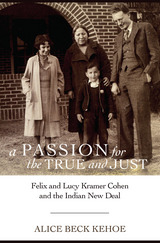
Kehoe argues that, due to anti-Semitism in 1930s America, Cohen could not speak for his legislation before Congress, and that Collier, an upper-class WASP, became the spokesman as well as the administrator. According to the author, historians of the Indian New Deal have not given due weight to Cohen’s work, nor have they recognized its foundation in his liberal secular Jewish culture. Both Felix and Lucy Cohen shared a belief in the moral duty of mitzvah, creating a commitment to the “true and the just” that was rooted in their Jewish intellectual and moral heritage, and their Social Democrat principles.
A Passion for the True and Just takes a fresh look at the Indian New Deal and the radical reversal of US Indian policies it caused, moving from ethnocide to retention of Indian homelands. Shifting attention to the Jewish tradition of moral obligation that served as a foundation for Felix and Lucy Kramer Cohen (and her professor Franz Boas), the book discusses Cohen’s landmark contributions to the principle of sovereignty that so significantly influenced American legal philosophy.

In his lifetime, French philosopher Jacques Maritain (1882–1973) achieved a reputation as both a leading Catholic intellectual and as an outspoken critic of antisemitism. Here historian Richard Francis Crane traces the development of Maritain’s opposition toward antisemitism and analyzes the Catholic appreciation of Judaism that animated his stance. Crane probes the writings and teachings of Maritain—from before, during, and after the Holocaust—and illuminates how his ideas altered Christian perceptions of Jews and Judaism during his lifetime and continue to do so today.
From 1931 to 1945 Pound's poetry took a back seat to his activities as an economic reformer and propagandist for the corporate state. Pound believed he had a simple and practical solution for the economic woes of the world brought on by the Great Depression, and he became increasingly preoccupied with capturing political power for the economic reform he envisioned.
As the world spiraled toward war, Pound's program of economic reform foundered and he gradually succumbed to a paranoid belief in a Jewish conspiracy. Through an incisive analysis of Pound's correspondence and writings, much of it previously unexamined, Surette shows how this belief fostered the virulent anti-Semitism that pervades his work-–both poetry and prose-–from this time forward.
As Paul Brykczynski tells this gripping story, he explores the complex role of antisemitism, nationalism, and violence in Polish politics between the two World Wars. Though focusing on Poland, the book sheds light on the rise of the antisemitic right in Europe and beyond, and on the impact of violence on political culture and discourse.

Scholars exploring the history of science under the Nazis have generally concentrated on the Nazi destruction of science or the corruption of intellectual and liberal values. Racial Hygiene focuses on how scientists themselves participated in the construction of Nazi racial policy. Robert Proctor demonstrates that the common picture of a passive scientific community coerced into cooperation with the Nazis fails to grasp the reality of what actually happened—namely, that many of the political initiatives of the Nazis arose from within the scientific community, and that medical scientists actively designed and administered key elements of National Socialist policy.
The book presents the most comprehensive account to date of German medical involvement in the sterilization and castration laws, the laws banning marriage between Jews and non-Jews, and the massive program to destroy “lives not worth living.” The study traces attempts on the part of doctors to conceive of the “Jewish problem” as a “medical problem,” and how medical journals openly discussed the need to find a “final solution” to Germany’s Jewish and gypsy “problems.”
Proctor makes us aware that such thinking was not unique to Germany. The social Darwinism of the late nineteenth century in America and Europe gave rise to theories of racial hygiene that were embraced by enthusiasts of various nationalities in the hope of breeding a better, healthier, stronger race of people. Proctor also presents an account of the “organic” health movement that flourished under the Nazis, including campaigns to reduce smoking and drinking, and efforts to require bakeries to produce whole-grain bread. A separate chapter is devoted to the emergence of a resistance movement among doctors in the Association of Socialist Physicians. The book is based on a close analysis of contemporary documents, including German state archives and more than two hundred medical journals published during the period.
Proctor has set out not merely to tell a story but also to urge reflection on what might be called the “political philosophy of science”—how movements that shape the policies of nations can also shape the structure and priorities of science. The broad implications of this book make it of consequence not only to historians, physicians, and people concerned with the history and philosophy of science, but also to those interested in science policy and medical ethics.
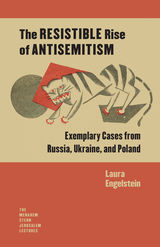
Antisemitism as a political weapon did not stand unchallenged, even in Eastern Europe, where its consequences were particularly dire. In this region, Jewish leaders mobilized across national borders and in alliance with non-Jewish public figures on behalf of Jewish rights and in opposition to anti-Jewish violence. Antisemites were called to account and forced on the defensive. In Imperial and then Soviet Russia, in newly emerging Poland, and in aspiring Ukraine—notorious in the West as antisemitic hotbeds—antisemitism was sometimes a moral and political liability. These intriguing essays explore the reasons why, and they offer lessons from surprising places on how we can continue to fight antisemitism in our times.
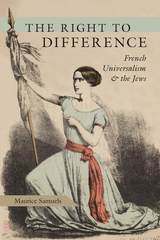
Samuels demonstrates that Jewish difference has always been essential to the elaboration of French universalism, whether as its foil or as proof of its reach. He traces the development of this discourse through key moments in French history, from debates over granting Jews civil rights during the Revolution, through the Dreyfus Affair and Vichy, and up to the rise of a “new antisemitism” in recent years. By recovering the forgotten history of a more open, pluralistic form of French universalism, Samuels points toward new ways of moving beyond current ethnic and religious dilemmas and argues for a more inclusive view of what constitutes political discourse in France.
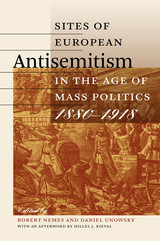
Looking closely at how medieval Jewish and Christian identities are distinguished from each other, yet intimately intertwined, Kruger demonstrates how Jews were often corporealized in ways that posited them as inferior to Christians—archaic and incapable of change—even as the two mutually shaped each other. But such attempts to differentiate Jews and Christians were inevitably haunted by the knowledge that Christianity had emerged out of Judaism and was, in its own self-understanding, a community of converts.
Examining the points of contact between Christian and Jewish communities, Kruger discloses the profound paradox of the Jew as different in all ways, yet capable of converting to fully Christian status. He draws from central medieval authors and texts such as Peter Damian, Guibert of Nogent, the Barcelona Disputation, and the Hebrew chronicles of the First Crusade, as well as lesser known writings such as the disputations of Ceuta, Majorca, and Tortosa and the immensely popular Dialogues of Peter Alfonsi.
By putting the conversion narrative at the center of this analysis, Kruger exposes it as a disruption of categories rather than a smooth passage and reveals the prominent role Judaism played in the medieval Christian imagination.
Steven F. Kruger is professor of English and medieval studies at Queens College and the Graduate Center, CUNY. He is author of several books and editor with Glenn Burger of Queering the Middle Ages (Minnesota, 2001).
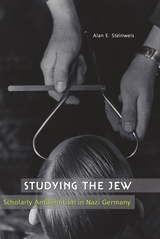
Early in his political career, Adolf Hitler declared the importance of what he called “an antisemitism of reason.” Determined not to rely solely on traditional, cruder forms of prejudice against Jews, he hoped that his exclusionary and violent policies would be legitimized by scientific scholarship. The result was a disturbing, and long-overlooked, aspect of National Socialism: Nazi Jewish Studies.
Studying the Jew investigates the careers of a few dozen German scholars who forged an interdisciplinary field, drawing upon studies in anthropology, biology, religion, history, and the social sciences to create a comprehensive portrait of the Jew—one with devastating consequences. Working within the universities and research institutions of the Third Reich, these men fabricated an elaborate empirical basis for Nazi antisemitic policies. They supported the Nazi campaign against Jews by defining them as racially alien, morally corrupt, and inherently criminal.
In a chilling story of academics who perverted their talents and distorted their research in support of persecution and genocide, Studying the Jew explores the intersection of ideology and scholarship, the state and the university, the intellectual and his motivations, to provide a new appreciation of the use and abuse of learning and the horrors perpetrated in the name of reason.

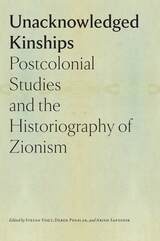
There is an “unacknowledged kinship” between studies of Zionism and post-colonial studies, a kinship that deserves to be both discovered and acknowledged. Unacknowledged Kinships strives to facilitate a conversation between the historiography of Zionism and postcolonial studies by identifying and exploring possible linkages and affiliations between their subjects as well as the limits of such connections. The contributors to this volume discuss central theoretical concepts developed within the field of postcolonial studies, and they use these concepts to analyze crucial aspects of the history of Zionism while contextualizing Zionist thought, politics, and culture within colonial and postcolonial histories. This book also argues that postcolonial studies could gain from looking at the history of Zionism as an example of not only colonial domination but also the seemingly contradictory processes of national liberation and self-empowerment.
Unacknowledged Kinships is the first work to systematically investigate the potential for a dialogue between postcolonial studies and Zionist historiography. It is also unique in suggesting that postcolonial concepts can be applied to the history of European Zionism just as comprehensively as to the history of Zionism in Palestine and Israel or Arab countries. Most importantly, the book is an overture for a dialogue between postcolonial studies and the historiography of Zionism.
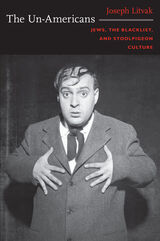
Litvak traces the outlines of comic cosmopolitanism in a series of performances in film and theater and before HUAC, performances by Jewish artists and intellectuals such as Zero Mostel, Judy Holliday, and Abraham Polonsky. At the same time, through an uncompromising analysis of work by informers including Jerome Robbins, Elia Kazan, and Budd Schulberg, he explains the triumph of a stoolpigeon culture that still thrives in the America of the early twenty-first century.
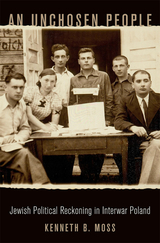
A revisionist account of interwar Europe’s largest Jewish community that upends histories of Jewish agency to rediscover reckonings with nationalism’s pathologies, diaspora’s fragility, Zionism’s promises, and the necessity of choice.
What did the future hold for interwar Europe’s largest Jewish community, the font of global Jewish hopes? When intrepid analysts asked these questions on the cusp of the 1930s, they discovered a Polish Jewry reckoning with “no tomorrow.” Assailed by antisemitism and witnessing liberalism’s collapse, some Polish Jews looked past progressive hopes or religious certainties to investigate what the nation-state was becoming, what powers minority communities really possessed, and where a future might be found—and for whom.
The story of modern Jewry is often told as one of creativity and contestation. Kenneth B. Moss traces instead a late Jewish reckoning with diasporic vulnerability, nationalism’s terrible potencies, Zionism’s promises, and the necessity of choice. Moss examines the works of Polish Jewry’s most searching thinkers as they confronted political irrationality, state crisis, and the limits of resistance. He reconstructs the desperate creativity of activists seeking to counter despair where they could not redress its causes. And he recovers a lost grassroots history of critical thought and political searching among ordinary Jews, young and powerless, as they struggled to find a viable future for themselves—in Palestine if not in Poland, individually if not communally.
Focusing not on ideals but on a search for realism, Moss recasts the history of modern Jewish political thought. Where much scholarship seeks Jewish agency over a collective future, An Unchosen People recovers a darker tradition characterized by painful tradeoffs amid a harrowing political reality, making Polish Jewry a paradigmatic example of the minority experience endemic to the nation-state.
A comprehensive overview of the controversy surrounding Hitler’s Willing Executioners.
Few if any books of the past fifty years have moved a broad section of the German public to think about their country’s Nazi past as has Daniel Jonah Goldhagen’s Hitler’s Willing Executioners. The main argument of his book is that Germans committed the unthinkable acts of the Holocaust not because they were forced to but out of a deeply held conviction that killing Jews was morally just. Unwilling Germans? traces the intense and varied reception of a book that has created more heated debate than any other treatment of Germany’s genocidal past.
When Goldhagen’s book first appeared, it was almost universally dismissed by journalists and historians alike. However, following a book tour in Germany, Goldhagen started winning over many of his ardent detractors and finding a young, receptive audience. Although German scholars reacted to Goldhagen and his argument with outrage and dismissal, ironically the German public was mesmerized by both the book and Goldhagen himself.Unwilling Germans? reprints articles that originally appeared in German newspapers, the popular press, and journals, as well as offering original essays. Among the writers whose work is represented are historians, journalists, political scientists, and literary critics, including Jürgen Habermas and Klaus Theweleit. The book traces the initial reactions in Germany to the debate surrounding the U.S. publication of the book, the subsequent reviews and reactions upon the publication of the German translation, and recent commentary by Goldhagen and the American historian Christopher Browning. A unique and fascinating collection, Unwilling Germans? will help to sort out the confusing nature of the response to the “Goldhagen Debate,” and shed light on both Germany’s continuing process of coming to terms with its Nazi past and the resonances of that debate in the United States.ISBN 0-8166-3100-X Cloth $44.95xxISBN 0-8166-3101-8 Paper $17.95224 pages 5 7/8 x 9 JuneTranslation inquiries: University of Minnesota Press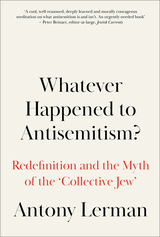
'This elegantly written, erudite book is essential reading for all of us, whatever our identifications' - Lynne Segal
Antisemitism is one of the most controversial topics of our time. The public, academics, journalists, activists and Jewish people themselves are divided over its meaning. Antony Lerman shows that this is a result of a 30-year process of redefinition of the phenomenon, casting Israel, problematically defined as the 'persecuted collective Jew', as one of its main targets.
This political project has taken the notion of the 'new antisemitism' and codified it in the flawed International Holocaust Remembrance Alliance's 'working definition' of antisemitism. This text is the glue holding together an international network comprising the Israeli government, pro-Israel advocacy groups, Zionist organizations, Jewish communal defence bodies and sympathetic governments fighting a war against those who would criticize Israel.
The consequences of this redefinition have been alarming, supressing free speech on Palestine/Israel, legitimizing Islamophobic right-wing forces, and politicizing principled opposition to antisemitism.
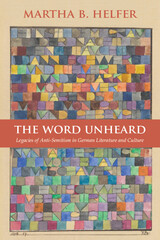
The publication of Martha B. Helfer’s The Word Unheard: Legacies of Anti-Semitism in German Literature and Culture marks a stunningly original new direction in the interpretation of canonical works of eighteenth- and nineteenth-century German literature.
Between 1749 and 1850—the formative years of the so-called Jewish Question in Germany—the emancipation debates over granting full civil and political rights to Jews provided the topical background against which all representations of Jewish characters and concerns in literary texts were read. Helfer focuses sharply on these debates and demonstrates through close readings of works by Gotthold Lessing, Friedrich Schiller, Achim von Arnim, Annette von Droste- Hülshoff, Adalbert Stifter, and Franz Grillparzer how disciplinary practices within the field of German studies have led to systematic blind spots in the scholarship on anti-Semitism to date.
While all the authors discussed are well known and justly celebrated, the particular works addressed represent an effective mix of enduring classics and less recognized, indeed often scandalously overlooked, texts whose consideration leads to a reevaluation of the author’s more mainstream oeuvre. Although some of the works and authors chosen have previously been noted for their anti-Semitic proclivities, the majority have not, and some have even been marked by German scholarship as philo-Semitic—a view that The Word Unheard undertakes not so much to refute as to complicate, and in the process to question not only these texts but also the deafness of the German scholarly tradition. With implications that reach into many disciplines, The Word Unheard will be a foundational study for all scholars of modern Germany.
READERS
Browse our collection.
PUBLISHERS
See BiblioVault's publisher services.
STUDENT SERVICES
Files for college accessibility offices.
RECENTLY PUBLISHED



UChicago Accessibility Resources
home | accessibility | search | about | contact us
BiblioVault ® 2001 - 2024
The University of Chicago Press