
 A SCHOLARLY BOOK REPOSITORY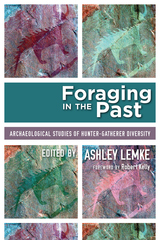
Well-established and young scholars present new prehistoric data and describe new methods and theories to investigate ancient forager lifeways and document hunter-gatherer variability across the globe. The authors use relationships established by cross-cultural data as a background for examining the empirical patterns of prehistory. Covering underwater sites in North America, the peaks of the Andes, Asian rainforests, and beyond, chapters are data rich, methodologically sound, and theoretically nuanced, effectively exploring the latest evidence for behavioral diversity in the fundamental process of hunting and gathering.
Foraging in the Past establishes how hunter-gatherers can be considered archaeologically, extending beyond the reach of ethnographers and historians to argue that only through archaeological research can the full range of hunter-gatherer variability be documented. Presenting a comprehensive and integrated approach to forager diversity in the past, the volume will be of significance to both students and scholars working with or teaching about hunter-gatherers.
Contributors: Nicholas J. Conard, Raven Garvey, Keiko Kitagawa, John Krigbaum, Petra Krönneck, Steven Kuhn, Julia Lee-Thorp, Peter Mitchell, Katherine Moore, Susanne C. Münzel, Kurt Rademaker, Patrick Roberts, Britt Starkovich, Brian A. Stewart, Mary Stiner
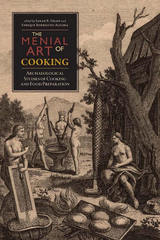
This book examines techniques and technologies of food preparation, the spaces where food was cooked, the relationship between cooking and changes in suprahousehold economies, the religious and symbolic aspects of cooking, the relationship between cooking and social identity, and how examining foodways provides insight into social relations of production, distribution, and consumption. Contributors use a wide variety of evidence-including archaeological data; archival research; analysis of ceramics, fauna, botany, glass artifacts, stone tools, murals, and painted ceramics; ethnographic analogy; and the distribution of artifacts across space-to identify signs of cooking and food processing left by ancient cooks.
The Menial Art of Cooking is the first archaeological volume focused on cooking and food preparation in prehistoric and historic settings around the world and will interest archaeologists, social anthropologists, sociologists, and other scholars studying cooking and food preparation or subsistence.
Archaeological obsidian studies in the American Southwest and beyond have significantly matured in the last two decades. Like ceramic analysis, obsidian artifact analysis has become a key factor in many archaeological projects because obsidian used to produce chipped stone tools is common across time periods in the Southwest—from Paleoindian through colonial periods. Even today, making stone tools from obsidian is used in teaching.
In the last twenty years, not only have the ways archaeologists use obsidian provenance to address twenty-first-century issues changed, but we now also see geologists and paleontologists using obsidian in ways never before imagined.
In the second edition of Obsidian, author M. Steven Shackley examines the newly discovered sources of archaeological obsidian and other volcanic rocks on both sides of the U.S.-Mexico border. This work has aided in building new inferences concerning exchange, group interaction, and social networks: subjects that were only emerging twenty years ago in obsidian studies.
The field of obsidian provenance studies is truly international, linking archaeologists and geologists in the United States like never before. While the obsidian sources covered in this volume are regionally specific, the applications and methods used in the understanding of source recording, composition issues, and provenance are relevant worldwide.
READERS
Browse our collection.
PUBLISHERS
See BiblioVault's publisher services.
STUDENT SERVICES
Files for college accessibility offices.
RECENTLY PUBLISHED



UChicago Accessibility Resources
home | accessibility | search | about | contact us
BiblioVault ® 2001 - 2026
The University of Chicago Press