
 A SCHOLARLY BOOK REPOSITORY
Results by Title
2 books about Architecture, Industrial
2 books about Architecture, Industrial

Fill 'er Up
The Glory Days of Wisconsin Gas Stations
Jim Draeger
Wisconsin Historical Society Press, 2008
Step back to the day when a visit to the gas station meant service with a smile, a wash of the windshield, and the cheerful question, "Fill 'er up?" Since their unremarkable beginnings as cheap shacks and curbside pumps at the dawn of the automobile age, gas stations have taken many forms and worn many guises: castles, cottages and teepees, Art Deco and Streamline Moderne, clad with wood, stucco, or gleaming porcelain in seemingly infinite variety.
The companion volume to the Wisconsin Public Television documentary of the same name, Fill 'er Up: The Glory Days of Wisconsin Gas Stations visits 60 Wisconsin gas stations that are still standing today and chronicles the history of these humble yet ubiquitous buildings. The book tells the larger story of the gas station's place in automobile culture and its evolution in tandem with American history, as well as the stories of the individuals influenced by the gas stations in their lives.
Fill 'er Up provides a glimpse into the glory days of gas stations, when full service and free oil changes were the rule and the local station was a gathering place for neighbors. More importantly, Fill 'er Up links the past and the present, showing why gas stations should be preserved and envisioning what place these historic structures can have in the 21st century and beyond.
[more]
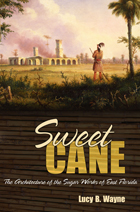
Sweet Cane
The Architecture of the Sugar Works of East Florida
Lucy B. Wayne
University of Alabama Press, 2010
A look at the antebellum history and architecture of the little-known sugar industry of East Florida
From the late eighteenth century to early 1836, the heart of the Florida sugar industry was concentrated in East Florida, between the St. Johns River and the Atlantic Ocean. Producing the sweetest sugar, molasses, and rum, at least 22 sugar plantations dotted the coastline by the 1830s. This industry brought prosperity to the region—employing farm hands, slaves, architects, stone masons, riverboats and their crews, shop keepers, and merchant traders. But by January 1836, Native American attacks of the Second Seminole War, intending to rid the Florida frontier of settlers, devastated the whole sugar industry.
Although sugar works again sprang up in other Florida regions just prior to the Civil War, the competition from Louisiana and the Caribbean blocked a resurgence of sugar production for the area. The sugar industry would never regain its importance in East Florida—only two of the original sugar works were ever rebuilt. Today, remains of this once thriving industry are visible in a few parks. Some are accessible but others lie hidden, slowly disintegrating and almost forgotten. Archaeological, historical, and architectural research in the last decade has returned these works to their once prominent place in Florida’s history, revealing the beauty, efficiency of design, as well as early industrial engineering. Equally important is what can be learned of the lives of those associated with the sugar works and the early plantation days along the East Florida frontier
[more]
READERS
Browse our collection.
PUBLISHERS
See BiblioVault's publisher services.
STUDENT SERVICES
Files for college accessibility offices.
RECENTLY PUBLISHED







UChicago Accessibility Resources
home | accessibility | search | about | contact us
BiblioVault ® 2001 - 2026
The University of Chicago Press