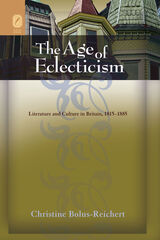
front cover of The Age of Eclecticism
The Age of Eclecticism
Literature and Culture in Britain, 1815–1885
Christine Bolus-Reichert
The Ohio State University Press, 2009
“The burden of the past” invoked by any discussion of eclecticism is a familiar aspect of modernity, particularly in the history of literature. The Age of Eclecticism: Literature and Culture in Britain, 1815–1885 by Christine Bolus-Reichert aims to reframe that dynamic and to place it in a much broader context by examining the rise of a manifold eclecticism in the nineteenth century. Bolus-Reichert focuses on two broad understandings of eclecticism in the period—one understood as an unreflective embrace of either conflicting beliefs or divergent historical styles, the other a mode of critical engagement that ultimately could lead to a rethinking of the contrast between creation and criticism and of the very idea of the original. She also contributes to the emerging field of transnational Victorian studies and, in doing so, finds a way to talk about a broader, post-Romantic nineteenth-century culture.
 
By reviving eclecticism as a critical term, Bolus-Reichert historicizes the theoretical language available to us for describing how Victorian culture functioned—in order to make the terrain of Victorian scholarship international and comparative and create a place for the Victorians in the genealogy of postmodernism. The Age of Eclecticism gives Victorianists—and other students of nineteenth-century literature and culture—a new perspective on familiar debates that intersect in crucial ways with issues still relevant to literature in an age of multiculturalism and postmodernism.
 
[more]

front cover of The Complete Prose Works of Matthew Arnold
The Complete Prose Works of Matthew Arnold
Volume XI. The Last Word
Matthew Arnold
University of Michigan Press, 1977
Essays on literary criticism, public education, and Irish home rule are included in the final volume of this series
[more]

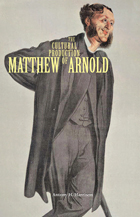
front cover of The Cultural Production of Matthew Arnold
The Cultural Production of Matthew Arnold
Antony H. Harrison
Ohio University Press, 2009

The career of Matthew Arnold as an eminent poet and the preeminent critic of his generation constitutes a remarkable historical spectacle orchestrated by a host of powerful Victorian cultural institutions.

The Cultural Production of Matthew Arnold investigates these constructions by situating Arnold’s poetry in a number of contexts that partially shaped it. Such analysis revises our understanding of the formation of the elite (and elitist) male literary-intellectual subject during the 1840s and 1850s, as Arnold attempts self-definition and strives simultaneously to move toward a position of ideological influence upon intellectual institutions that were contested sites of economic, social, and political power in his era.

Antony H. Harrison reopens discussion of selected works by Arnold in order to make visible some of their crucial sociohistorical, intertextual, and political components. Only by doing so can we ultimately view the cultural work of Arnold “steadily and … whole,” and in a fashion that actually eschews this mystifying premise of all Arnoldian inquiry which, by the early twentieth century, had become wholly naturalized in the academy as ideology.
[more]

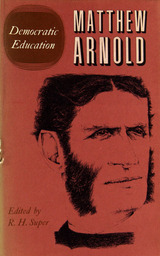
front cover of Democratic Education
Democratic Education
The Complete Prose Works of Matthew Arnold
Matthew Arnold; Edited by R. H. Super
University of Michigan Press, 1962
An inspector of schools as well as a professor of poetry, Matthew Arnold was an educator in the true sense of the word. Watching democracy breed self-satisfied Philistines, he relized that not all the liberty and industry in the world would insure the rule of right reason. If we are to survive, he said, we must seize on the best and make it prevail. The fate of civilization depends on our schools. Unfailingly relevant, his essays on education include Democracy, The Popular Education of France, and A French Eton, as well as three essays discovered by the editor in the pages of the London Review and republished here for the first time. They form a crucial chapter in the history of education, setting forth the standards upon which Arnold's literary criticism was to be based and from which his political utterances were to come.
[more]

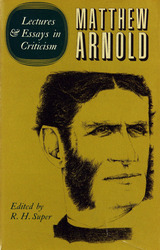
front cover of Lectures and Essays in Criticism
Lectures and Essays in Criticism
The Complete Prose Works of Matthew Arnold
Matthew Arnold; Edited by R. H. Super
University of Michigan Press, 1962
The Essays in Criticism is the basis of Arnold's high reputation as critic of literature. The range of subject—from the classical humor of Theocritus and the serious morality of Marcus Aurelius to the romantic religious struggles of Maurice de Guerin and the sober piety of his sister—gives scope for all Arnold's skill."The Function of Criticism at the Present Time" lays down wittily and urbanely doctrines which have shaped literary criticism for a century. Here too are his devastating attacks on the Biblical criticism of Bishop Conlenso, his needle pricks at the complacent politicians, and his sensitive analysis of the "natural magic" of English poetry.
[more]

front cover of Matthew Arnold and the Classical Tradition
Matthew Arnold and the Classical Tradition
Warren D. Anderson
University of Michigan Press, 1988
To be born into the middle or upper classes of Matthew Arnold's England was in a sense to be born into the classical tradition. The precise contour and uses of the tradition, in Arnold's thought and writing, are the subject of this unique study by Warren D. Anderson. In Matthew Arnold and the Classical Tradition, Anderson shows how the young poet first experimented with his classical heritage, how he moved toward deep involvement and then withdrew to a more objective position. The author examines Arnold's school and university background, his poetry and later prose, his relationship to Stoicism and Epicureanism. The resulting study is absolutely central to an appreciation of Arnold and to an understanding of the classical foundations of Western literature. It shows clearly and accurately the ways in which the nineteenth century interpreted the fifth century B.C.
[more]

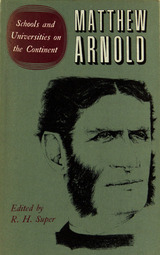
front cover of Schools and Universities on the Continent
Schools and Universities on the Continent
The Complete Prose Works of Matthew Arnold
Matthew Arnold; Edited by R. H. Super
University of Michigan Press, 1964
This description of European higher education is unequaled for its clarity and comprehensiveness. Today, 100 years later, Matthew Arnold's observations are as timely as when first written. Inspector of schools as well as a poet and critic, Arnold watched democracy breed self-satisfied Philistines and realized that not all the liberty and industry in the world could ensure the rule of right reason. In 1865 he left England to investigate higher education in France, Italy, Germany, and Switzerland. In this volume Arnold traces the growth of schools and universities on the continent, examines the role of government in their development, and argues for organized public education and state schools in England. Included are the 1868 and 1882 Prefaces to Schools and Universities on the Continent, a newly discovered essay entitled "German and English Universities," and three letters written to the editor of the Pall Mall Gazette. This book makes clear the goals and achievements of European higher education and their relation to 19th-century and modern standards of learning.
[more]

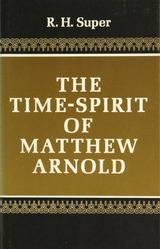
front cover of Time-Spirit of Matthew Arnold
Time-Spirit of Matthew Arnold
R. H. Super
University of Michigan Press, 2025
The Time-Spirit of Matthew Arnold—his remarkable grasp of the main intellectual currents of the day—is the quality of mind that most recommends Arnold to the modern reader. Trained in the classics and theology, Arnold was able to evaluate the writings of his contemporaries in terms of the main traditions of Western thought, and by plotting the direction of intellectual currents in the past he could project the course of the main streams into the future. Dr. Super focuses on Arnold's achievement as a poet, a social political thinker, and a religious mind. He gives detailed treatment to Arnold's major poetical work, Empedocles on Etna; he analyzes Arnold's liberalism and contrasts it with the Utilitarianism of John Stuart Mill; and he examines Arnold's approach to Christianity in a penetrating discussion of Arnold's book Literature and Dogma. The Time-Spirit of Matthew Arnold demonstrates the impact such figures as Carlyle, Mill, and Newman had upon Arnold, as well as the more enduring cast his mind took from Goethe and Spinoza. Throughout, the book reveals the essential homogeneity of Arnold's work and its continued usefulness in dealing with twentieth-century problems in politics, education, and religion.
[more]


Send via email Share on Facebook Share on Twitter