
 A SCHOLARLY BOOK REPOSITORY
Results by Title
2 books about Ballots
2 books about Ballots
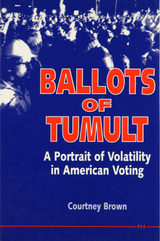
Ballots of Tumult
A Portrait of Volatility in American Voting
Courtney Brown
University of Michigan Press, 1991
Ballots of Tumult examines the dynamics of explosive and large-scale electoral change in the United States throughout the twentieth century. The case is made that electoral volatility, often overlooked, is nonetheless common to American politics. This conclusion runs counter to much of the conventional wisdom regarding stability in American politics.Four types of electoral events are brought together to demonstrate the massbased structure of electoral volatility: electoral realignments, the emergence of third parties, extensions of the franchise, and recurrent shocks to congressional mobilization. Among the historical episodes studied under these categories are the 1928-36 Roosevelt realignment, the Bull Moose and Populist parties, George Wallace’s and John Anderson's presidential bids, the bizarre effects of doubling the electorate in 1920, and changes in African-American and white voting in the 1980s.As well as testing formal theories of mass behavior, Ballots of Tumult also resolves such longstanding debates as whether new voters or partisan switchers voted for Roosevelt in the 1930s. It also shows that African-Americans have “long memories” with regard to voting against the Republican party, and that changes in the national economy affect congressional voting among separate subgroups in the population in dramatically different ways. To support this unconventional and provocative thesis Courtney Brown has used a large and newly organized set of electoral and census data. As well, new and sophisticated analyses of dynamic data using numerically intensive techniques are used to support Ballots of Tumult’s claim of volatility. These pioneering methods of data analysis were recognized by IBM in the 1989 Supercomputing Competition. This unique analytical sophistication has allowed Courtney Brown to examine his subject from a broad and general perspective and so create new and challenging conclusions.
[more]
Bullets, Ballots, and Rhetoric
Confederate States Policy for the United States Presidential Contest
Larry E. Nelson
University of Alabama Press, 1980
A fascinating study of Confederate perceptions of and attempts to manipulate the 1864 US presidential election
The Confederacy's hopes for independence were founded less on the belief that the South could defeat the North than on a strategy of staving off defeat long enough for the North to weary of the fight. The South’s single biggest opportunity to effect political change in the North was the presidential contest of 1864. If Lincoln’s support foundered and the North elected a president with a more flexible vision of peace on the continent, the South might realize its dream of independence.
Praised as an important contribution to understanding the Davis administration, in Bullets, Ballots, and Rhetoric, Larry Nelson vividly brings to life the complex state of Northern and Southern internal politics during the election year of 1863. He recounts fluctuations in the value of the dollar, draft resistance and riots, protests against emancipation, political defeats suffered by the Republicans in the elections of 1862, and growing discontent in the border states and Midwest. This gripping account explores a mission Davis sent to Canada in 1864 seeking to influence the election of a new US president, a strategy Nelson's persuasive analysis shows to have been intelligent and reasonable. Nevertheless, Davis's haphazard leadership contributed to its failure. Nelson hypothesizes that had Davis drawn the North into negotiations before the Democratic convention for the upcoming elections, a temporary armistice might well have proved permanent.
Nelson offers an insider’s look at the administration of Jefferson Davis as it searched for cracks in Northern unity and electoral opportunities to exploit—and yet also as it overlooked war-weariness in the South itself. Bullets, Ballots, and Rhetoric is an engrossing account of a little-known but critical aspect of Civil War statecraft and politics.
The Confederacy's hopes for independence were founded less on the belief that the South could defeat the North than on a strategy of staving off defeat long enough for the North to weary of the fight. The South’s single biggest opportunity to effect political change in the North was the presidential contest of 1864. If Lincoln’s support foundered and the North elected a president with a more flexible vision of peace on the continent, the South might realize its dream of independence.
Praised as an important contribution to understanding the Davis administration, in Bullets, Ballots, and Rhetoric, Larry Nelson vividly brings to life the complex state of Northern and Southern internal politics during the election year of 1863. He recounts fluctuations in the value of the dollar, draft resistance and riots, protests against emancipation, political defeats suffered by the Republicans in the elections of 1862, and growing discontent in the border states and Midwest. This gripping account explores a mission Davis sent to Canada in 1864 seeking to influence the election of a new US president, a strategy Nelson's persuasive analysis shows to have been intelligent and reasonable. Nevertheless, Davis's haphazard leadership contributed to its failure. Nelson hypothesizes that had Davis drawn the North into negotiations before the Democratic convention for the upcoming elections, a temporary armistice might well have proved permanent.
Nelson offers an insider’s look at the administration of Jefferson Davis as it searched for cracks in Northern unity and electoral opportunities to exploit—and yet also as it overlooked war-weariness in the South itself. Bullets, Ballots, and Rhetoric is an engrossing account of a little-known but critical aspect of Civil War statecraft and politics.
[more]
READERS
Browse our collection.
PUBLISHERS
See BiblioVault's publisher services.
STUDENT SERVICES
Files for college accessibility offices.
RECENTLY PUBLISHED




UChicago Accessibility Resources
home | accessibility | search | about | contact us
BiblioVault ® 2001 - 2026
The University of Chicago Press