
 A SCHOLARLY BOOK REPOSITORY
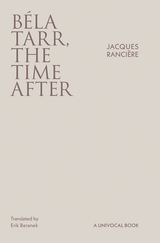
Exploring the concept of time in the work of one of Europe’s greatest filmmakers
From Almanac of Fall (1984) to The Turin Horse (2011), renowned Hungarian filmmaker Béla Tarr has followed the collapse of the communist promise. The “time after” is not the uniform and morose time of those who no longer believe in anything. It is the time when we are less interested in histories and their successes or failures than we are in the delicate fabric of time from which they are carved. It is the time of pure material events against which belief will be measured for as long as life will sustain it.

What relation is there between the existence of a work of art and that of a living being? Between the existence of an atom and that of a value like solidarity? These questions become our own each time a reality—whether it is a piece of music, someone we love, or a fictional character—is established and begins to take on an importance in our lives. Like William James or Gilles Deleuze, Souriau methodically defends the thesis of an existential pluralism. There are indeed different manners of existing and even different degrees or intensities of existence: from pure phenomena to objectivized things, by way of the virtual and the “super-existent,” to which works of art and the intellect, and even morality, bear witness. Existence is polyphonic, and, as a result, the world is considerably enriched and enlarged. Beyond all that exists in the ordinary sense of the term, it is necessary to allow for all sorts of virtual and ephemeral states, transitional realms, and barely begun realities, still in the making, all of which constitute so many “inter-worlds.”
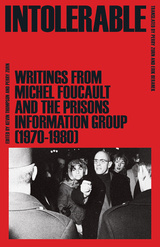
A groundbreaking collection of writings by Michel Foucault and the Prisons Information Group documenting their efforts to expose France’s inhumane treatment of prisoners
Founded by Michel Foucault and others in 1970–71, the Prisons Information Group (GIP) circulated information about the inhumane conditions within the French prison system. Intolerable makes available for the first time in English a fully annotated compilation of materials produced by the GIP during its brief but influential existence, including an exclusive new interview with GIP member Hélène Cixous and writings by Gilles Deleuze and Jean Genet.
These archival documents—public announcements, manifestos, reports, pamphlets, interventions, press conference statements, interviews, and round table discussions—trace the GIP’s establishment in post-1968 political turmoil, the new models of social activism it pioneered, the prison revolts it supported across France, and the retrospective assessments that followed its denouement. At the same time, Intolerable offers a rich, concrete exploration of Foucault’s concept of resistance, providing a new understanding of the arc of his intellectual development and the genesis of his most influential book, Discipline and Punish.
Presenting the account of France’s most vibrant prison resistance movement in its own words and on its own terms, this significant and relevant collection also connects the approach and activities of the GIP to radical prison resistance movements today.

Philosophically analyzing the work of one of the twentieth century’s most popular, and peculiar, science fiction authors
Despite his enduring popularity, Philip K. Dick (1928–1982)—whose short stories and novels were adapted into or influenced many major films and television shows, including Blade Runner, Total Recall, The Truman Show, and The Man in the High Castle—has long been a marginal figure in American literature, even in the science fiction genre he helped revolutionize. Here, an influential French philosopher offers a major new perspective on an author who was known as much for his eccentricities and excesses as for his writing. For David Lapoujade, it is precisely the many ways in which Dick’s works seem to hover on the brink of losing all touch with reality that make him such a singular figure, both as a sci-fi author and as a thinker of contemporary life.
In Worlds Built to Fall Apart, Lapoujade defines sci-fi as a way of thinking through the creation of worlds and argues that Dick does so by creating worlds that fall rapidly to pieces. Whatever his mechanism to bring this about (drugs or madness, alien satellite transmissions or encroaching parallel universes), the effect is always to reveal reality to be a construction, in which certain people determine what appears as real to the rest of us. Orienting Dick within philosophy and drawing connections to a wide variety of other thinkers and artists, this remarkable reading shows how he proposes unstable, fluctuating futures in which tinkering with reality has become the best means of resisting total control.
Engaging with most of Philip K. Dick’s published works, as well as with several of his essays and his notorious psychic autobiography The Exegesis, Lapoujade hones in on the “war of the psyches” that underlies Dick’s critique of reality. He puts Dick’s work in conversation with a vast array of subjects—from cybernetics to schizoanalysis, and from Pop art to David Lynch, J. G. Ballard, and William S. Burroughs—revealing Dick’s oeuvre to comprise a profound reality defined by artifice, precarity, and control.
Retail e-book files for this title are screen-reader friendly.
READERS
Browse our collection.
PUBLISHERS
See BiblioVault's publisher services.
STUDENT SERVICES
Files for college accessibility offices.
RECENTLY PUBLISHED






UChicago Accessibility Resources
home | accessibility | search | about | contact us
BiblioVault ® 2001 - 2026
The University of Chicago Press