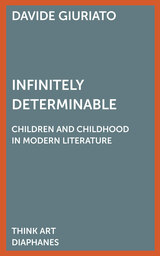
front cover of Infinitely Determinable
Infinitely Determinable
Children and Childhood in Modern Literature
Davide Giuriato
Diaphanes, 2021
Upon the “discovery of childhood,” as named by Philippe Ariès, bourgeois culture and modern literature marked out an arcane realm that, while scarcely accessible for adults, acted as a space for projections of the most contradictory kind and diverse ideological purposes: childhood. As this book reveals, from the eighteenth century onwards, the child increasingly came into focus in literature as a mysterious creature. Now the child seems a strange being, constantly unsettling and alienating, although exposed to ongoing territorialization. This is possible because the space of ‘childhood’ is essentially blank and indefinite. Modernity, therefore, has discovered it as a zone, in the words of Friedrich Schiller of “boundless determinability."
 
[more]

logo for Pluto Press
Interrogating Cultural Studies
Theory, Politics and Practice
Edited by Paul Bowman
Pluto Press, 2003

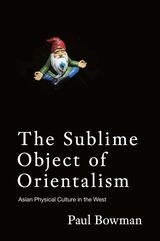
front cover of The Sublime Object of Orientalism
The Sublime Object of Orientalism
Asian Physical Culture in the West
Paul Bowman
Hong Kong University Press, 2026

An exploration of the little-understood relationship between popular Asian physical practices and the sublime.

This book proposes that globalized Asian physical and cultural practices such as taiji, qigong, yoga, and meditation can be understood by examining the intimate connection between Western orientalism and the Romantic aesthetic notion of the sublime. The Sublime Object of Orientalism recasts “orientalist physical culture” as a set of practices animated by the sublime.

Paul Bowman combines new readings of philosophers and cultural critics such as Slavoj Žižek and Jane Iwamura with analyses of film, media, and Asian physical practices and their entrepreneurial forms to shed light on the quest to articulate a philosophy of orientalist physical culture. He also explores ways to make sense of orientalist physical culture in the contemporary world and evaluate the often problematic ideologies that circulate around these cultural practices without uncritically accepting their value or rejecting them outright. This empathetic and accessible volume is a must-read for students, researchers, and teachers of cross-cultural studies, cultural theory, postcolonialism, and orientalism.


[more]


Send via email Share on Facebook Share on Twitter