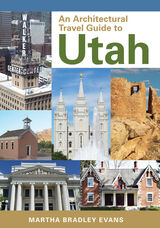
An Architectural Travel Guide to Utah
Martha Bradley Evans
University of Utah Press, 2020
An Architectural Travel Guide to Utah invites visitors and other explorers of Utah to see the state’s history, material culture, settlement, and natural landscape through the lens of its buildings. With more than 600 buildings as examples, this guide takes readers through Utah’s cities and rural villages, exploring neighborhoods and other built landscapes. An adobe house from the 1860s speaks volumes about the transmission of ideas, respectability, the places of origin of Utah’s white settlers, and their use of place-specific materials. The Utah State Capitol reflects the Neoclassicism preferred for statehouses throughout the nation, but its site overlooking a canyon to the east, the Great Salt Lake to the northwest, and the long view south down State Street—one of the longest streets in America—set it apart and make it very much of its place. From the most common vernacular cabin to the modern architecture of Abravanel Symphony Hall and the Salt Lake Arts Center, this guide uses the diversity of Utah’s architecture to showcase the diversity of its people, their visions for the good life, and the particular responses of their built environment to the unique geography of this beautiful state. Includes 276 images, many in color.
[more]