
 A SCHOLARLY BOOK REPOSITORY
Results by Title
3 books about Bronze
3 books about Bronze
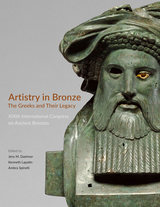
Artistry in Bronze
The Greeks and Their Legacy XIXth International Congress on Ancient Bronzes
Jens M Daehner
J. Paul Getty Trust, The, 2017
The papers in this volume derive from the proceedings of the nineteenth International Bronze Congress, held at the Getty Center and Villa in October 2015 in connection with the exhibition Power and Pathos: Bronze Sculpture of the Hellenistic World. The study of large-scale ancient bronzes has long focused on aspects of technology and production. Analytical work of materials, processes, and techniques has significantly enriched our understanding of the medium. Most recently, the restoration history of bronzes has established itself as a distinct area of investigation. How does this scholarship bear on the understanding of bronzes within the wider history of ancient art? How do these technical data relate to our ideas of styles and development? How has the material itself affected ancient and modern perceptions of form, value, and status of works of art?
www.getty.edu/publications/artistryinbronze
www.getty.edu/publications/artistryinbronze
[more]
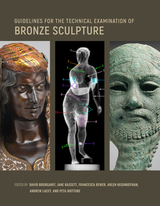
Guidelines for the Technical Examination of Bronze Sculpture
David Bourgarit
J. Paul Getty Trust, The, 2023
The essential reference for anyone engaged in the material study of cast bronze sculpture.
Since the fourth millennium BCE, bronze has been the preferred medium for some of the most prestigious and sacred works of art. But only through interdisciplinary research can the fabrication of these extraordinary objects be properly investigated, interpreted, and documented. This innovative publication bridges the expertise of myriad art-technological specialists to create a new framework for advancing the understanding of bronze sculpture.
Essential reading for curators, conservators, scientists, archaeologists, sculptors, metallurgists, founders, dealers, collectors, and anyone interested in the life cycle of a bronze, this volume explains how to identify the evidence of process steps, metals used, casting defects, and surface work and alterations before moving on to address analytical techniques ranging from visual exams to imaging, material analyses, and dating. The guidelines are accompanied by detailed illustrations, including videos, charts, and animations; a robust vocabulary, ensuring precision across English, German, French, Italian, and Chinese; a diverse selection of case studies; and a comprehensive bibliography.
The free online edition of this open-access publication is available at getty.edu/publications/bronze-guidelines/ and includes videos and zoomable illustrations. Also available are free PDF and EPUB downloads of the book.
Since the fourth millennium BCE, bronze has been the preferred medium for some of the most prestigious and sacred works of art. But only through interdisciplinary research can the fabrication of these extraordinary objects be properly investigated, interpreted, and documented. This innovative publication bridges the expertise of myriad art-technological specialists to create a new framework for advancing the understanding of bronze sculpture.
Essential reading for curators, conservators, scientists, archaeologists, sculptors, metallurgists, founders, dealers, collectors, and anyone interested in the life cycle of a bronze, this volume explains how to identify the evidence of process steps, metals used, casting defects, and surface work and alterations before moving on to address analytical techniques ranging from visual exams to imaging, material analyses, and dating. The guidelines are accompanied by detailed illustrations, including videos, charts, and animations; a robust vocabulary, ensuring precision across English, German, French, Italian, and Chinese; a diverse selection of case studies; and a comprehensive bibliography.
The free online edition of this open-access publication is available at getty.edu/publications/bronze-guidelines/ and includes videos and zoomable illustrations. Also available are free PDF and EPUB downloads of the book.
[more]
A Historical Archaeology of Jerusalem
Bronze and Iron Ages
Yuval Gadot
SBL Press, 2026
In the first book to examine Jerusalem’s archaeological remains in detail since Kathleen M. Kenyon’s Digging Up Jerusalem (1974), Yuval Gadot reexamines the results of more than one hundred years of excavations and incorporates findings from recent research based on the most up-to-date scientific methods. The book covers six pivotal periods of Jerusalem’s development and correlates those with historical texts, including those from the Hebrew Bible, for the purpose of portraying a nuanced and detailed reconstruction of Jerusalem during the Bronze and Iron Ages. More than one hundred color illustrations and maps supplement Gadot’s analysis of the archaeological data and reconstruction of Jerusalem’s history. This volume presents the most complete picture of Jerusalem’s history for scholars and students interested in the city’s role as a royal seat and a religious center.
[more]
READERS
Browse our collection.
PUBLISHERS
See BiblioVault's publisher services.
STUDENT SERVICES
Files for college accessibility offices.
RECENTLY PUBLISHED


UChicago Accessibility Resources
home | accessibility | search | about | contact us
BiblioVault ® 2001 - 2026
The University of Chicago Press