
 A SCHOLARLY BOOK REPOSITORY
Results by Title
2 books about Brown, Courtney
2 books about Brown, Courtney
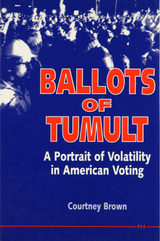
Ballots of Tumult
A Portrait of Volatility in American Voting
Courtney Brown
University of Michigan Press, 1991
Ballots of Tumult examines the dynamics of explosive and large-scale electoral change in the United States throughout the twentieth century. The case is made that electoral volatility, often overlooked, is nonetheless common to American politics. This conclusion runs counter to much of the conventional wisdom regarding stability in American politics.Four types of electoral events are brought together to demonstrate the massbased structure of electoral volatility: electoral realignments, the emergence of third parties, extensions of the franchise, and recurrent shocks to congressional mobilization. Among the historical episodes studied under these categories are the 1928-36 Roosevelt realignment, the Bull Moose and Populist parties, George Wallace’s and John Anderson's presidential bids, the bizarre effects of doubling the electorate in 1920, and changes in African-American and white voting in the 1980s.As well as testing formal theories of mass behavior, Ballots of Tumult also resolves such longstanding debates as whether new voters or partisan switchers voted for Roosevelt in the 1930s. It also shows that African-Americans have “long memories” with regard to voting against the Republican party, and that changes in the national economy affect congressional voting among separate subgroups in the population in dramatically different ways. To support this unconventional and provocative thesis Courtney Brown has used a large and newly organized set of electoral and census data. As well, new and sophisticated analyses of dynamic data using numerically intensive techniques are used to support Ballots of Tumult’s claim of volatility. These pioneering methods of data analysis were recognized by IBM in the 1989 Supercomputing Competition. This unique analytical sophistication has allowed Courtney Brown to examine his subject from a broad and general perspective and so create new and challenging conclusions.
[more]
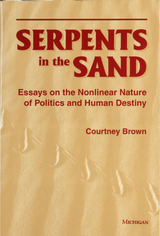
Serpents in the Sand
Essays in the Nonlinear Nature of Politics and Human Destiny
Courtney Brown
University of Michigan Press, 1995
For decades, social scientists have worked with models that have sought to quantify and explain human behavior. The common foundation for nearly all of these mathematical applications is the assumption of linear progression, equilibrium, and stability. Serpents in the Sand not only argues that political life is fundamentally nonlinear but thoroughly analyzes specific instances of extreme nonlinearity in politics. By so doing, Courtney Brown offers a guide to the reader on how to apply nonlinearity, including chaos theory, to real-world situations. The author develops his argument by in-depth analysis of four examples covering a broad spectrum of political life. He considers, first, the relationship between individual rationality and the influence of a voter's political milieu. He then turns to look at the dynamics behind the Johnson vs. Goldwater landslide presidential election of 1964. The fall of the Weimar Republic and the rise of Nazi Germany provide a third case study, followed, by an analysis of the relationship between democratic electoral politics and the ecological environment. Highly original in its finding, Serpents in the Sand resembles no other work on politics. It is the first study of nonlinearity in political behavior to base its argument on specific examples rather than on analogies to physical and ecological systems. Substantively, the book draws provocative conclusions from the test cases, examining for instance the potential for disaster in the oscillatory relationship between the way U.S. presidents are elected and the management of the country's environment. In the end, Serpents in the Sand extends its argument to the philosophy of human existence, showing that human behavior is as nonlinear as all other processes in the universe. Courtney Brown is Associate Professor of Political Science, Emory University.
[more]
READERS
Browse our collection.
PUBLISHERS
See BiblioVault's publisher services.
STUDENT SERVICES
Files for college accessibility offices.
RECENTLY PUBLISHED






UChicago Accessibility Resources
home | accessibility | search | about | contact us
BiblioVault ® 2001 - 2026
The University of Chicago Press