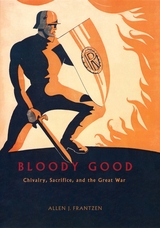
front cover of Bloody Good
Bloody Good
Chivalry, Sacrifice, and the Great War
Allen J. Frantzen
University of Chicago Press, 2003
In the popular imagination, World War I stands for the horror of all wars. The unprecedented scale of the war and the mechanized weaponry it introduced to battle brought an abrupt end to the romantic idea that soldiers were somehow knights in shining armor who always vanquished their foes and saved the day. Yet the concept of chivalry still played a crucial role in how soldiers saw themselves in the conflict.

Here for the first time, Allen J. Frantzen traces these chivalric ideals from the Great War back to their origins in the Middle Ages and shows how they resulted in highly influential models of behavior for men in combat. Drawing on a wide selection of literature and images from the medieval period, along with photographs, memorials, postcards, war posters, and film from both sides of the front, Frantzen shows how such media shaped a chivalric ideal of male sacrifice based on the Passion of Jesus Christ. He demonstrates, for instance, how the wounded body of Christ became the inspiration for heroic male suffering in battle. For some men, the Crucifixion inspired a culture of revenge, one in which Christ's bleeding wounds were venerated as badges of valor and honor. For others, Christ's sacrifice inspired action more in line with his teachings—a daring stay of hands or reason not to visit death upon one's enemies.

Lavishly illustrated and eloquently written, Bloody Good will be must reading for anyone interested in World War I and the influence of Christian ideas on modern life.

[more]

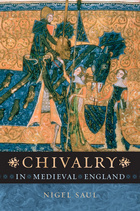
front cover of Chivalry in Medieval England
Chivalry in Medieval England
Nigel Saul
Harvard University Press, 2011

Popular views of medieval chivalry—knights in shining armor, fair ladies, banners fluttering from battlements—were inherited from the nineteenth-century Romantics. This is the first book to explore chivalry’s place within a wider history of medieval England, from the Norman Conquest to the aftermath of Henry VII’s triumph at Bosworth in the Wars of the Roses.

Saul invites us to view the world of castles and cathedrals, tournaments and round tables, with fresh eyes. Chivalry in Medieval England charts the introduction of chivalry by the Normans, the rise of the knightly class as a social elite, the fusion of chivalry with kingship in the fourteenth century, and the influence of chivalry on literature, religion, and architecture. Richard the Lionheart and the Crusades, the Black Death and the Battle of Crecy, the Magna Carta and the cult of King Arthur—all emerge from the mists of time and legend in this vivid, authoritative account.

[more]

logo for Harvard University Press
The Decline of Chivalry as Shown in the French Literature of the Late Middle Ages
Raymond Lincoln Kilgour
Harvard University Press
Although standard court literature in France and Burgundy during the late Middle Ages (1350-1500) continued to view chivalry as the dominant force in lay society, the large majority of authors were concerned over social changes, and their works often show an astonishingly clear understanding of such matters. In general, it was an age when authors were better observers and moralists than literary artists. One can discern currents of clerical and lay criticism that moved side by side in constant opposition to the partisans of chivalric self-satisfaction. At the same time, the reform of the army reduced knighthood to a mere decoration for the noble classes, and it ceased to be an inspiration for literature. Dr. Kilgour's purpose in the present volume has been to show the reflection of this slow disintegration of chivalry in the work of such writers as Deschamps, Christine de Pisan, Gerson, Chastellain, and Commines.
[more]

logo for Brandeis University Press
The Quest for Eternity
Manners and Morals in the Age of Chivalry. [Orig. pub. as The Age of Chivalry.]
Charles T. Wood
Brandeis University Press, 1983
(First published as THE AGE OF CHIVALRY) A lively and insightful interpretation of the Middle Ages.
[more]


Send via email Share on Facebook Share on Twitter