
 A SCHOLARLY BOOK REPOSITORY
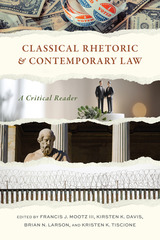
A rigorous interdisciplinary inquiry into how classical rhetorical traditions continue to inform, challenge, and enrich modern legal reasoning and jurisprudence.
Classical Rhetoric and Contemporary Law: A Critical Reader is a rich work that analyzes the interplay between ancient rhetorical traditions and modern legal practice, reestablishing the lost connections between law and classical rhetoric. From Isocrates’s Panegyricus in 380 BCE to the landmark US Supreme Court case Trump v. Hawaii in 2018, and from Antiphon’s fifth century BCE First Tetralogy to 1995’s O. J. Simpson trial, the volume draws on an array of sources to illuminate how ancient rhetorical insights may even today challenge and enrich our grasp of contemporary legal principles.
The collection opens with a brisk review of the historical development of rhetoric. The second part examines a pair of rhetorical theorists whose works frame the period across which classical rhetoric declined as a mode of thought. A contemporary appellate case contrasts with the work of Giambattista Vico, an eighteenth-century professor of rhetoric who warned of the separation of law from rhetoric. The analysis of the work of twentieth-century scholars Chaïm Perelman and Lucie Olbrects-Tyteca shows that where Cartesian rationality fails, the humanistic tradition of rhetoric allows the law to respond to the needs of justice. In the third part, ten case studies bring together a classical rhetorical theorist with a contemporary court case, demonstrating the abiding relevance of the classical tradition to contemporary jurisprudence.
With its cross-disciplinary appeal, Classical Rhetoric and Contemporary Law encompasses the work of legal, rhetorical, English, and communication scholars alike, catalyzing interactive exploration into the profound ways ancient rhetorical insights continue to shape our comprehension of today’s legal landscape.
CONTRIBUTORS
Vasileios Adamidis / Elizabeth C. Britt / Kirsten K. Davis / David A. Frank / Michael Gagarin / Eugene Garver / Mark A. Hannah / Catherine L. Langford / Brian N. Larson / Craig A. Meyer / Francis J. Mootz III / Susan E. Provenzano / Nick J. Sciullo / Kristen K. Tiscione / Laura A. Webb
Back in print after 17 years, this is a concise history of rhetoric as it relates to structure, genre, and style, with special reference to English literature and literary criticism from Ancient Greece to the end of the 18th century.
The core of the book is a quite original argument that the figures of rhetoric were not mere mechanical devices, were not, as many believed, a "nuisance, a quite sterile appendage to rhetoric to which (unaccountably) teachers, pupils, and writers all over the world devoted much labor for over 2,000 years." Rather, Vickers demonstrates, rhetoric was a stylized representation of language and human feelings.
Vickers supplements his argument through analyses of the rhetorical and emotional structure of four Renaissance poems. He also defines 16 of the most common figures of rhetoric, citing examples from the classics, the Bible, and major English poets from Chaucer to Pope.
Eighteen essays by leading scholars in English, speech communication, education, and philosophy explore the vitality of the classical rhetorical tradition and its influence on both contemporary discourse studies and the teaching of writing.
Some of the essays investigate theoretical and historical issues. Others show the bearing of classical rhetoric on contemporary problems in composition, thus blending theory and practice. Common to the varied approaches and viewpoints expressed in this volume is one central theme: the 20th-century revival of rhetoric entails a recovery of the classical tradition, with its marriage of a rich and fully articulated theory with an equally efficacious practice. A preface demonstrates the contribution of Edward P. J.Corbett to the 20th-century revival, and a last chapter includes a bibliography of his works.
Here, for the first time in one volume, are all the extant writings focusing on rhetoric that were composed before the fall of Rome.
This unique anthology of primary texts in classical rhetoric contains the work of 24 ancient writers from Homer through St. Augustine, including Herodotus, Thucydides, Plato, Aristotle, Cicero, Quintilian, Tacitus, and Longinus.
Along with many widely recognized translations, special features include the first English translations of works by Theon and Nicolaus, as well as new translations of two works by important sophists, Gorgias’ encomium on Helen and Alcidamas’ essay on composition.
The writers are grouped chronologically into historical periods, allowing the reader to understand the scope and significance of rhetoric in antiquity. Introductions are included to each period, as well as to each writer, with writers’ biographies, major works, and salient features of excerpts.
READERS
Browse our collection.
PUBLISHERS
See BiblioVault's publisher services.
STUDENT SERVICES
Files for college accessibility offices.
RECENTLY PUBLISHED



UChicago Accessibility Resources
home | accessibility | search | about | contact us
BiblioVault ® 2001 - 2026
The University of Chicago Press