Rediscovering the quietly radical writing of a poet who chose simplicity, solitude, and contemplation over modern haste
American author Robert Francis, whom Robert Frost called “the best neglected poet,” lived in Amherst, Massachusetts from the 1920s to the 1980s. As an underappreciated but prolific poet, Francis authored eight poetry collections and received a number of prestigious prizes. Still, like many poets committed to their craft, he lived most of his quiet life at or well below the poverty level. To sustain himself financially, Francis turned to essay writing in popular magazines, such as the Christian Science Monitor and Forum. From 1938 to 1953, as America and the world experienced a period of intense modernization, he produced an invigorating, challenging, and enlightening quantity of prose whose quality should rank him alongside writers such as Emerson, Thoreau, Wendell Berry, and Annie Dillard.
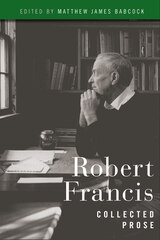
Published in one volume for the first time, Robert Francis: Collected Prose invites readers to a retrospective retreat into the solitude and serenity of Francis’s cabin, Fort Juniper, where he ardently and artfully dueled the most psychologically, socially, and economically destructive aspects of industrialized America. These essays, together with selections from Francis’s previously unpublished nature treatise, Traveling in Concord, offer an avenue toward an enhanced understanding of many commonly overlooked aspects of the natural world, offering 21st-century readers a refreshing reorientation of worldviews, advocating life principles of simplicity over unnecessary technological complexity, and conservation over consumerism. Vibrant, jubilant, at times sardonic and brooding but always absorbing, Francis’s essays draw readers into the meditative mood of his woodland walks, apple harvests, and autumn landscapes to discover, as he writes, “the importance of the unimportant, the virtue of the small, the rewards of intense cultivation.”