
 A SCHOLARLY BOOK REPOSITORY
11 start with M start with M
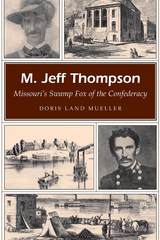
In the treacherous swamps of southeast Missouri, a different kind of Civil War was waged.
Meriwether Jeff Thompson was one of the most intriguing but least-known Missouri participants in the Civil War. He and his troops traveled fast and light to harass Union forces, materializing out of the countryside to surprise the enemy and evading the traps set for them by Northern commanders. Early in the war, Union General Ulysses S. Grant gave Thompson the name “Swamp Fox” for his exploits in the Bootheel region. This book now tells his story—an adventure that will be appreciated by readers of all ages. Doris Mueller has produced a meticulously researched account of Thompson’s life, from his Virginia boyhood and early successes to his wartime exploits and postwar life. When the war began, Thompson left his adopted city of St. Joseph—where he had served as mayor—to fight for the Confederacy. He was elected brigadier general in the First Military District of Southeast Missouri and led poorly equipped and loosely trained men in skirmishes and raids, often using guerrilla tactics. He was captured in August 1863. After being released twelve months later in a prisoner exchange, he joined Sterling Price’s ill-fated raid into Missouri. After the war, he was one of the first Southern leaders to seek reinstatement as a U.S. citizen and worked to allay hostilities among fellow Southerners.
Thompson was also known as the “Poet Laureate of the Marshes,” and Mueller includes numerous excerpts from his writings about his experiences. Her account not only provides a wealth of little-known biographical details about this important Missourian but also offers insight into the state’s unique experiences during that bloody era, personalizing events through the life of this brave soldier.
Scorned by the Northern press for impudence, but beloved as a leader by his men, Thompson was courageous in battle, often to the point of recklessness, making him a constant thorn in the side of Union forces; after the war he was an oft-maligned model for reconciliation. Doris Mueller’s recounting of his life is an action-adventure story that will delight readers as it attests to his important role in Missouri’s heritage.
In the mid-eighteenth century, colonial Americans became enamored with the rich colors and silky surface of mahogany. This exotic wood, imported from the West Indies and Central America, quickly displaced local furniture woods as the height of fashion. Over the next century, consumer demand for mahogany set in motion elaborate schemes to secure the trees and transform their rough-hewn logs into exquisite objects. But beneath the polished gleam of this furniture lies a darker, hidden story of human and environmental exploitation.
Mahogany traces the path of this wood through many hands, from source to sale: from the enslaved African woodcutters, including skilled “huntsmen” who located the elusive trees amidst dense rainforest, to the ship captains, merchants, and timber dealers who scrambled after the best logs, to the skilled cabinetmakers who crafted the wood, and with it the tastes and aspirations of their diverse clientele. As the trees became scarce, however, the search for new sources led to expanded slave labor, vicious competition, and intense international conflicts over this diminishing natural resource. When nineteenth-century American furniture makers turned to other materials, surviving mahogany objects were revalued as antiques evocative of the nation's past.
Jennifer Anderson offers a dynamic portrait of the many players, locales, and motivations that drove the voracious quest for mahogany to adorn American parlors and dining rooms. This complex story reveals the cultural, economic, and environmental costs of America’s growing self-confidence and prosperity, and how desire shaped not just people’s lives but the natural world.
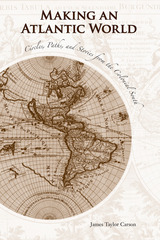
Based on the notion of “founding peoples” rather than “founding fathers,” Making an Atlantic World uses an innovative, interdisciplinary approach to interpret the Colonial South. James Taylor Carson uses historical ethnogeography-a new methodology that brings together the study of history, anthropology, and geography. This method seeks to incorporate concepts of space and landscape with social perspectives to give students and scholars a better understanding of the forces that shaped the development of a synthesized southern culture.
Unlike previous studies, which considered colonization as a contest over land but rarely considered what the land was and how people understood their relationships to it, Making an Atlantic World shows how the founding peoples perceived their world before contact and how they responded to contact and colonization.
The author contends that each of the three groups involved-the first people, the invading people, and the enslaved people-possessed a particular worldview that they had to adapt to each other to face the challenges brought about by contact.
James Taylor Carson is associate professor of history at Queen’s University in Ontario, Canada. He is the author of <i>Searching for the Bright Path: The Mississippi Choctaws from Prehistory to Removal</i>. His articles and reviews have appeared in <i>Ethnohistory, Journal of Mississippi History, Agricultural History, Journal of Military History</i>, and other publications.

The British government had few imperial administrators in the American colonies and perhaps fewer ways to exert its authority by force, yet Americans rarely questioned that authority until the eve of the American Revolution. The empire worked and Americans accepted British rule not because they feared the government, but rather because they had effective methods for influencing it to their own benefit.
Alison Olson reveals a source of that influence in networks of interest groups working cooperatively in England and America. Between 1640 and 1790 voluntary interest groups emerged in English politics. They began in London and gradually formed loose connections with smaller but similar interests in the English and American provinces. When the London groups became capable of lobbying the national government, they were willing to use their influence on behalf of the provincials as well. This “representation” of the Americans, though never official, was crucial to keeping the colonists content within the empire.
The type of interest group that could accommodate colonial participation was the associational, identified by the voluntary character of its membership. It included religious and ethnic communities—Presbyterians, Jews, Lutherans, Quakers, Baptists, Huguenots—and merchant groups. London lobbyists, acting as intermediaries between the colonies and the imperial government, gave American interests a vitally important role in the making of English imperial decisions and gave the English government a key source of information on just what decisions would and would not provoke American resistance. When these connections collapsed, the dissolution of the first British empire was not far away.
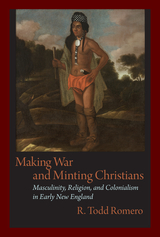
For the English, the cultivation of manliness became an important aspect of missionary efforts. Conversion demanded that the English "make men" of the Indians before they could "make them Christians," a process that involved reshaping Native masculinity according to English patriarchal ideals that the colonists themselves rarely matched. For their part, Native Americans held on to older ways of understanding the divine and defining gender even as they entered English "praying towns" and negotiated the steep demands of the missionaries.
Evolving ideas of masculinity resonated with religious significance and shaped the meaning of warfare for Natives and colonists alike. Just as the English believed that their territorial expansion was divinely sanctioned, Indians attributed a string of victories in King Philip's War to "the Great God" and the perception that their enemies "were like women." Trusting that war and manliness were necessarily linked, both groups engaged in ritual preparations for battle, believed deeply in the efficacy of the supernatural to affect the outcome of combat, and comprehended the meaning of war in distinctly religious ways.
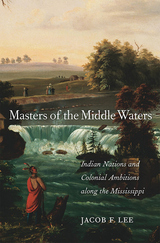
A riveting account of the conquest of the vast American heartland that offers a vital reconsideration of the relationship between Native Americans and European colonists, and the pivotal role of the mighty Mississippi.
America’s waterways were once the superhighways of travel and communication. Cutting a central line across the landscape, with tributaries connecting the South to the Great Plains and the Great Lakes, the Mississippi River meant wealth, knowledge, and power for those who could master it. In this ambitious and elegantly written account of the conquest of the West, Jacob Lee offers a new understanding of early America based on the long history of warfare and resistance in the Mississippi River valley.
Lee traces the Native kinship ties that determined which nations rose and fell in the period before the Illinois became dominant. With a complex network of allies stretching from Lake Superior to Arkansas, the Illinois were at the height of their power in 1673 when the first French explorers—fur trader Louis Jolliet and Jesuit priest Jacques Marquette—made their way down the Mississippi. Over the next century, a succession of European empires claimed parts of the midcontinent, but they all faced the challenge of navigating Native alliances and social structures that had existed for centuries. When American settlers claimed the region in the early nineteenth century, they overturned 150 years of interaction between Indians and Europeans.
Masters of the Middle Waters shows that the Mississippi and its tributaries were never simply a backdrop to unfolding events. We cannot understand the trajectory of early America without taking into account the vast heartland and its waterways, which advanced and thwarted the aspirations of Native nations, European imperialists, and American settlers alike.
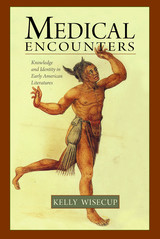
Against the prevailing view that colonial texts provide insight only into their writers' perspectives, Wisecup demonstrates that Europeans, Natives, and Africans held certain medical ideas in common, including a conception of disease as both a spiritual and a physical entity, and a belief in the power of special rituals or prayers to restore health. As a consequence, medical knowledge and practices operated as a shared form of communication on which everyone drew in order to adapt to a world of devastating new maladies and unfamiliar cures.
By signaling one's relation to supernatural forces, to the natural world, and to other people, medicine became an effective means of communicating a variety of messages about power and identity as well as bodies and minds. Native Americans in Virginia and New England, for example, responded to the nearly simultaneous arrival of mysterious epidemics and peoples by incorporating colonists into explanations of disease, while British American colonists emphasized to their audiences back home the value of medical knowledge drawn from cross-cultural encounters in the New World.
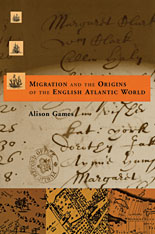
England's seventeenth-century colonial empire in North America and the Caribbean was created by migration. The quickening pace of this essential migration is captured in the London port register of 1635, the largest extant port register for any single year in the colonial period and unique in its record of migration to America and to the European continent. Alison Games analyzes the 7,500 people who traveled from London in that year, recreating individual careers, exploring colonial societies at a time of emerging viability, and delineating a world sustained and defined by migration.
The colonial travelers were bound for the major regions of English settlement--New England, the Chesapeake, the West Indies, and Bermuda--and included ministers, governors, soldiers, planters, merchants, and members of some major colonial dynasties--Winthrops, Saltonstalls, and Eliots. Many of these passengers were indentured servants. Games shows that however much they tried, the travelers from London were unable to recreate England in their overseas outposts. They dwelled in chaotic, precarious, and hybrid societies where New World exigencies overpowered the force of custom. Patterns of repeat and return migration cemented these inchoate colonial outposts into a larger Atlantic community. Together, the migrants' stories offer a new social history of the seventeenth century. For the origins and integration of the English Atlantic world, Games illustrates the primary importance of the first half of the seventeenth century.
In more recent decades, historians have pieced together a story that is not only more likely but more complicated and interesting. Patrick Jung synthesizes the research about Nicolet and his superior Samuel de Champlain, whose diplomatic goals in the region are crucial to understanding this much misunderstood journey across the Great Lakes. Additionally, historical details about Franco-Indian relations and the search for the Northwest Passage provide a framework for understanding Nicolet’s famed mission.
Benjamin Franklin's invention of the lightning rod is the founding fable of American science, but Franklin was only one of many early Americans fascinated by electricity. As a dramatically new physical experience, electricity amazed those who dared to tame the lightning and set it coursing through their own bodies. Thanks to its technological and medical utility, but also its surprising ability to defy rational experimental mastery, electricity was a powerful experience of enlightenment, at once social, intellectual, and spiritual.
In this compelling book, James Delbourgo moves beyond Franklin to trace the path of electricity through early American culture, exploring how the relationship between human, natural, and divine powers was understood in the eighteenth century. By examining the lives and visions of natural philosophers, spectacular showmen, religious preachers, and medical therapists, he shows how electrical experiences of wonder, terror, and awe were connected to a broad array of cultural concerns that defined the American Enlightenment. The history of lightning rods, electrical demonstrations, electric eels, and medical electricity reveals how early American science, medicine, and technology were shaped by a culture of commercial performance, evangelical religion, and republican politics from mid-century to the early republic.
The first book to situate early American experimental science in the context of a transatlantic public sphere, A Most Amazing Scene of Wonders offers a captivating view of the origins of American science and the cultural meaning of the American Enlightenment. In a story of shocks and sparks from New England to the Caribbean, Delbourgo brilliantly illuminates a revolutionary New World of wonder.
READERS
Browse our collection.
PUBLISHERS
See BiblioVault's publisher services.
STUDENT SERVICES
Files for college accessibility offices.
RECENTLY PUBLISHED





UChicago Accessibility Resources
home | accessibility | search | about | contact us
BiblioVault ® 2001 - 2024
The University of Chicago Press