
 A SCHOLARLY BOOK REPOSITORY
12 start with O start with O
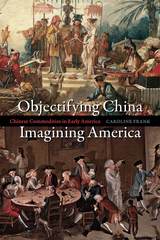
With the ever-expanding presence of China in the global economy, Americans more and more look east for goods and trade. But as Caroline Frank reveals, this is not a new development. China loomed as large in the minds—and account books—of eighteenth-century Americans as it does today. Long before they had achieved independence from Britain and were able to sail to Asia themselves, American mariners, merchants, and consumers were aware of the East Indies and preparing for voyages there. Focusing on the trade and consumption of porcelain, tea, and chinoiserie, Frank shows that colonial Americans saw themselves as part of a world much larger than just Britain and Europe

Chet shows how the traditional focus on the growth of the modern state overlooked the extent to which old attitudes and cultural practices continued to hold sway. Even as the British government extended its naval, legal, and bureaucratic reach, in many parts of the Atlantic world illegal trade was not only tolerated but encouraged. In part this was because Britain's constabulary command of the region remained more tenuous than some have suggested, and in part because maritime insurance and wartime tax policies ensured that piracy and smuggling remained profitable. When Atlantic piracy eventually waned in the early nineteenth century, it had more to do with a reduction in its profitability at port than with forceful confrontation at sea.
Challenging traditional accounts that chronicle forces of civilization taming a wild Atlantic frontier, this book is a valuable addition to a body of borderlands scholarship reevaluating the relationship between the emerging modern state and its imperial frontiers.

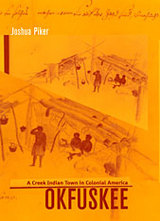
A work of original scholarship and compelling sweep, Okfuskee is a community-centered Indian history with an explicitly comparativist agenda. Joshua Piker uses the history of Okfuskee, an eighteenth-century Creek town, to reframe standard narratives of both Native and American experiences.
This unique, detailed perspective on local life in a Native society allows us to truly understand both the pervasiveness of colonialism's influence and the inventiveness of Native responses. At the same time, by comparing the Okfuskees' experiences to those of their contemporaries in colonial British America, the book provides a nuanced discussion of the ways in which Native and Euro-American histories intersected with, and diverged from, each other.
Piker examines the diplomatic ties that developed between the Okfuskees and their British neighbors; the economic implications of the Okfuskees' shifting world view; the integration of British traders into the town; and the shifting gender and generational relationships in the community. By both providing an in-depth investigation of a colonial-era Indian town in Indian country and placing the Okfuskees within the processes central to early American history, Piker offers a Native history with important implications for American history.
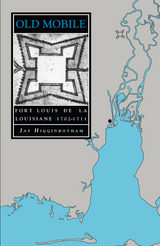
The highly praised, landmark history of the founding of Mobile
Commissioned to mark the 275th anniversary of the founding of the city of Mobile, Old Mobile is award-winning historian Jay Higginbotham’s definitive history of the origins of French settlement on Mobile Bay and the birth of the city.
Higginbotham’s narrative is replete with memorable characters, such as the LeMoyne brothers: Iberville, the aristocratic adventurer who abandoned the settlement and the younger Bienville, whose iron determination and Catholic faith sustained the community through its first hardscrabble years 26 miles upriver, a disastrous flood in 1711, and the community’s retreat to the city’s current location, nearer the French supply depot on Dauphin Island.
The majestic sweep of Higginbotham’s fascinating account also takes in early Mobile’s relations with neighboring European settlements, such as their meddling French neighbors in Louisana to the west and the Spanish in Pensacola to the east. Despite being rivals of a sort, Mobile and Pensacola became, of dire necessity, allies in survival. Higginbotham consulted a wealth of previously unpublished sources in the national archives of the United States, Canada, Mexico, France, England, Spain, and Cuba, creating an authoritative account never likely to be equaled. A copious bibliography, excellent illustrations and figures, tables of relevant statistics, and a detailed index round out this magisterial edition.
Scholars and readers interested in the founding of Alabama, the history of Gulf Coast settlements, the French colonial empire, or related subjects will find Old Mobile essential reading.
Banished from the Massachusetts Bay Colony for his refusal to conform to Puritan religious and social standards, Roger Williams established a haven in Rhode Island for those persecuted in the name of the religious establishment. He conducted a lifelong debate over religious freedom with distinguished figures of the seventeenth century, including Puritan minister John Cotton, Massachusetts governor John Endicott, and the English Parliament.
James Calvin Davis gathers together important selections from Williams’s public and private writings on religious liberty, illustrating how this renegade Puritan radically reinterpreted Christian moral theology and the events of his day in a powerful argument for freedom of conscience and the separation of church and state. For Williams, the enforcement of religious uniformity violated the basic values of Calvinist Christianity and presumed upon God’s authority to speak to the individual conscience. He argued that state coercion was rarely effective, often causing more harm to the church and strife to the social order than did religious pluralism.
This is the first collection of Williams’s writings in forty years reaching beyond his major work, The Bloody Tenent, to include other selections from his public and private writings. This carefully annotated book introduces Williams to a new generation of readers.
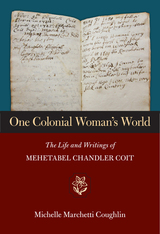
Michelle Marchetti Coughlin combs through these writings to create a vivid portrait of a colonial American woman and the world she inhabited. Coughlin documents the activities of daily life as well as dramas occasioned by war, epidemics, and political upheaval. Though Coit's opportunities were circumscribed by gender norms of the day, she led a rich and varied life, not only running a household and raising a family, but reading, writing, traveling, transacting business, and maintaining a widespread network of social and commercial connections. She also took a lively interest in the world around her and played an active role in her community.
Coit's long life covered an eventful period in American history, and this book explores the numerous—and sometimes surprising—ways in which her personal history was linked to broader social and political developments. It also provides insight into the lives of countless other colonial American women whose history remains largely untold.

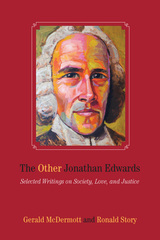
Through a selection of sermons and primary writings, McDermott and Story reveal an Edwards who preached love toward all humanity regardless of belief or appearance; who demanded private and public charity to the poor; who criticized hard-hearted business dealings as impious and socially destructive; and who condemned envy and status-seeking as anti-Christian and anti-community. This "other" Jonathan Edwards preached about grace and the love of God but also about responsive constitutional government, the iniquities of hypocrisy and corruption, and the nature of wise leadership. He acknowledged the need for national defense but left room for popular revolt from tyranny. He anticipated a millennial age of peace and prosperity and believed that people should live in the world as they would live through grace in heaven.
Jonathan Edwards was, in sum, a worldly as well as spiritual reformer who resisted the materialistic, acquisitive, and individualistic currents of American culture. For these reasons, McDermott and Story think he may have lessons to teach us today.
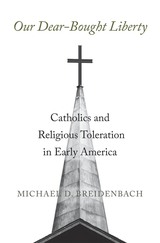
How early American Catholics justified secularism and overcame suspicions of disloyalty, transforming ideas of religious liberty in the process.
In colonial America, Catholics were presumed dangerous until proven loyal. Yet Catholics went on to sign the Declaration of Independence and helped to finalize the First Amendment to the Constitution. What explains this remarkable transformation? Michael Breidenbach shows how Catholic leaders emphasized their church’s own traditions—rather than Enlightenment liberalism—to secure the religious liberty that enabled their incorporation in American life.
Catholics responded to charges of disloyalty by denying papal infallibility and the pope’s authority to intervene in civil affairs. Rome staunchly rejected such dissent, but reform-minded Catholics justified their stance by looking to conciliarism, an intellectual tradition rooted in medieval Catholic thought yet compatible with a republican view of temporal independence and church–state separation. Drawing on new archival material, Breidenbach finds that early American Catholic leaders, including Maryland founder Cecil Calvert and members of the prominent Carroll family, relied on the conciliarist tradition to help institute religious toleration, including the Maryland Toleration Act of 1649.
The critical role of Catholics in establishing American church–state separation enjoins us to revise not only our sense of who the American founders were, but also our understanding of the sources of secularism. Church–state separation in America, generally understood as the product of a Protestant-driven Enlightenment, was in key respects derived from Catholic thinking. Our Dear-Bought Liberty therefore offers a dramatic departure from received wisdom, suggesting that religious liberty in America was not bestowed by liberal consensus but partly defined through the ingenuity of a persecuted minority.
READERS
Browse our collection.
PUBLISHERS
See BiblioVault's publisher services.
STUDENT SERVICES
Files for college accessibility offices.
RECENTLY PUBLISHED




UChicago Accessibility Resources
home | accessibility | search | about | contact us
BiblioVault ® 2001 - 2024
The University of Chicago Press