front cover of Producing Children
Producing Children
Critical Studies in Childhood Creativity
Peter C. Kunze
Rutgers University Press, 2025
Producing Children imagines the possibility, indeed the inevitability, of a creative relation between children as producers and consumers by revising the long-established, hierarchical relation between adults and children. The chapters in this collection reveal that studying child-produced culture complicates our received understandings of children’s culture as culture by adults, for children, about children. They also underscore “children’s literature” as a cultural phenomenon that moves across and beyond genres, forms, and media. As a whole, this collection reveals that attention to child-produced culture invites dialogue and collaboration across fields and disciplines invested in the critical understanding of children as embodied beings and childhood as both a stage of development and discursive construct with social, political, economic, and cultural dimensions and influence. With the ongoing vibrancy of childhood studies as a multidisciplinary area of inquiry, studies of child-produced culture provide scholars with an exciting opportunity to complicate, enrich, and expand theorization of childhood creativity, children’s culture, and even children themselves.
[more]


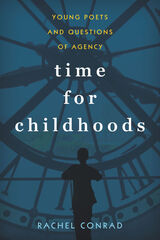
front cover of Time for Childhoods
Time for Childhoods
Young Poets and Questions of Agency
Rachel Conrad
University of Massachusetts Press, 2020
Poems written by children are not typically part of the literary canon. Because of cultural biases that frame young people as intellectually and artistically immature, these works are often excluded or dismissed as juvenilia. Rachel Conrad contends that youth-composed poems should be read as literary works in their own right—works that are deserving of greater respect in literary culture.

Time for Childhoods presents a selection of striking twentieth-and twenty-first-century American poetry written by young people, and highlights how young poets imagined and shaped time for their own poetic purposes. Through close engagement with archival materials, as well as select interviews and correspondence with adult mentors, Conrad discerns how young writers figured social realities and political and racial injustices, and discusses what important advocates such as Gwendolyn Brooks and June Jordan can teach us about supporting the agency of young poets. This essential study demonstrates that young poets have much to contribute to ongoing conversations about time and power.
[more]


Send via email Share on Facebook Share on Twitter