
 A SCHOLARLY BOOK REPOSITORY
Results by Title
2 books about Czitrom, Daniel
2 books about Czitrom, Daniel
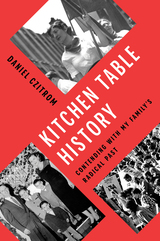
Kitchen Table History
Contending with My Family’s Radical Past
Daniel Czitrom
University of Illinois Press, 2027
Daniel Czitrom learned early on that radical politics was a family affair that stretched across generations and was shared around the kitchen table. In this historical memoir, Czitrom explores how memories and political beliefs shaped his life and his identity as a historian.
Czitrom follows three generations of his family as they fled violence in Eastern Europe, built new lives in America, and committed themselves to radical political movements. Their works and trials included union organizing, volunteering to fight fascism in Spain and elsewhere, harassment by the FBI, and everyday acts of survival. Czitrom describes what he discovered in his years of historical detective work while pondering the still-unanswered questions wrapped in silence and pain. He also recounts his years-long journey to balance loyalty to his family’s values with a desire to succeed, question authority, and become his own person.
An engaging blend of memoir and history, Kitchen Table History is the chronicle of a family and a personal search for the meaning of the past.
Czitrom follows three generations of his family as they fled violence in Eastern Europe, built new lives in America, and committed themselves to radical political movements. Their works and trials included union organizing, volunteering to fight fascism in Spain and elsewhere, harassment by the FBI, and everyday acts of survival. Czitrom describes what he discovered in his years of historical detective work while pondering the still-unanswered questions wrapped in silence and pain. He also recounts his years-long journey to balance loyalty to his family’s values with a desire to succeed, question authority, and become his own person.
An engaging blend of memoir and history, Kitchen Table History is the chronicle of a family and a personal search for the meaning of the past.
[more]
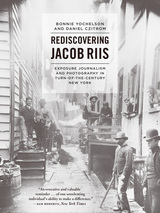
Rediscovering Jacob Riis
Exposure Journalism and Photography in Turn-of-the-Century New York
Bonnie Yochelson and Daniel Czitrom
University of Chicago Press, 2014
Before publishing his pioneering book How the Other Half Lives—a photojournalistic investigation into the poverty of New York’s tenement houses, home to three quarters of the city’s population—Jacob Riis (1849-1914) spent his first years in the United States as an immigrant and itinerant laborer, barely surviving on his carpentry skills until he landed a job as a muckraking reporter. These early experiences provided Riis with an understanding of what it was like to be poor in the immigrant communities that populated New York’s slums, and it was this empathy that would shine through in his iconic photos.
With Rediscovering Jacob Riis, art historian Bonnie Yochelson and historian Daniel Czitrom place Jacob Riis’s images in historical context even as they expose a clear sightline to the present. In the first half of their book, Czitrom explores Riis’s reporting and activism within the gritty specifics of Gilded Age New York: its new immigrants, its political machines, its fiercely competitive journalism, its evangelical reformers, and its labor movement. In delving into Riis’s intellectual education and the lasting impact of How the Other Half Lives, Czitrom shows that though Riis argued for charity, not sociopolitical justice, the empathy that drove his work continues to inspire urban reformers today.
In the second half of the book, Yochelson describes for the first time Riis’s photographic practice: his initial reliance on amateur photographers to take the photographs he needed, his own use of the camera, and then his collecting of photographs by professionals, who by 1900 were documenting social reform efforts for government agencies and charities. She argues that while Riis is rightly considered a revolutionary in the history of photography, he was not a photographic artist. Instead, Riis was a writer and lecturer who first harnessed the power of photography to affect social change.
As staggering inequality continues to be an urgent political topic, this book, illustrated with nearly seventy of Riis’s photographs, will serve as a stunning reminder of what has changed, and what has not.
With Rediscovering Jacob Riis, art historian Bonnie Yochelson and historian Daniel Czitrom place Jacob Riis’s images in historical context even as they expose a clear sightline to the present. In the first half of their book, Czitrom explores Riis’s reporting and activism within the gritty specifics of Gilded Age New York: its new immigrants, its political machines, its fiercely competitive journalism, its evangelical reformers, and its labor movement. In delving into Riis’s intellectual education and the lasting impact of How the Other Half Lives, Czitrom shows that though Riis argued for charity, not sociopolitical justice, the empathy that drove his work continues to inspire urban reformers today.
In the second half of the book, Yochelson describes for the first time Riis’s photographic practice: his initial reliance on amateur photographers to take the photographs he needed, his own use of the camera, and then his collecting of photographs by professionals, who by 1900 were documenting social reform efforts for government agencies and charities. She argues that while Riis is rightly considered a revolutionary in the history of photography, he was not a photographic artist. Instead, Riis was a writer and lecturer who first harnessed the power of photography to affect social change.
As staggering inequality continues to be an urgent political topic, this book, illustrated with nearly seventy of Riis’s photographs, will serve as a stunning reminder of what has changed, and what has not.
[more]
READERS
Browse our collection.
PUBLISHERS
See BiblioVault's publisher services.
STUDENT SERVICES
Files for college accessibility offices.
RECENTLY PUBLISHED



UChicago Accessibility Resources
home | accessibility | search | about | contact us
BiblioVault ® 2001 - 2026
The University of Chicago Press