
 A SCHOLARLY BOOK REPOSITORY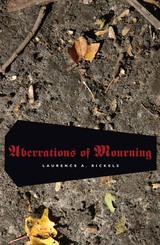
Rickels studies mourning and melancholia within and around psychoanalysis, analyzing the writings of such thinkers as Freud, Nietzsche, Lessing, Heinse, Artaud, Keller, Stifter, Kafka, and Kraus. Rickels maintains that we must shift the way we read literature, philosophy, and psychoanalysis to go beyond traditional Oedipal structures.
Aberrations of Mourning argues that the idea of the crypt has had a surprisingly potent influence on psychoanalysis, and Rickels shows how society’s disturbed relationship with death and dying, our inability to let go of loved ones, has resulted in technology to form more and more crypts for the dead by preserving them—both physically and psychologically—in new ways.
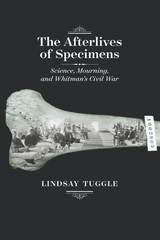
Grounded in archival discoveries, Afterlives traces the origins of nineteenth-century America’s preservation compulsion, illuminating the influences of botanical, medical, spiritualist, and sentimental discourses on Whitman’s work. Tuggle unveils previously unrecognized connections between Whitman and the leading “medical men” of his era, such as the surgeon John H. Brinton, founding curator of the Army Medical Museum, and Silas Weir Mitchell, the neurologist who discovered phantom limb syndrome. Remains from several amputee soldiers whom Whitman nursed in the Washington hospitals became specimens in the Army Medical Museum.
Tuggle is the first scholar to analyze Whitman’s role in medically memorializing the human cadaver and its abandoned parts.
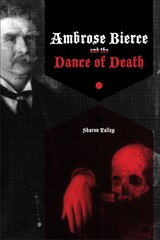
Ambrose Bierce and the Dance of Death uses psychoanalytic theory in combination with historical, cultural, and literary contexts to examine the complex motif of death in a full range of Bierce’s writings. Scholarly interest in Bierce, whose work has long been undervalued, has grown significantly in recent years. This new book contributes to the ongoing reassessment by providing new contexts for joining the texts in his canon in meaningful ways.
Previous attempts to consider Bierce from a psychological perspective have been superficial, often reductive Freudian readings of individual stories such as “An Occurrence at Owl Creek Bridge” and “The Death of Halpin Frayser.” This new volume not only updates these interpretations with insights from post-Freudian theorists but uses contemporary death theory as a framework to analyze the sources and expressions of Bierce’s attitudes about death and dying. This approach makes it possible to discern links among texts that resolve some of the still puzzling ambiguities that have—until now—precluded a fuller understanding of both the man and his writings.
Lively and engaging, Ambrose Bierce and the Dance of Death adds valuable new insights not only to the study of Bierce but to that of nineteenth-century American literature in general.
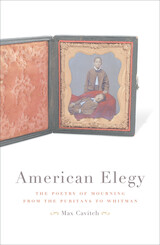
Covering the emergence of English literature from the Old English to the late medieval periods, Arts of Dying argues that the problem of how to designate death produced a long tradition of literature about dying, which continues in the work of Heidegger, Blanchot, and Gillian Rose. Philosophy’s attempt to designate death’s impossibility is part of a literature that imagines a relationship with death, a literature that intensively and self-reflexively supposes that its very terms might solve the problem of the termination of life. A lyrical and elegiac exploration that combines medieval work on the philosophy of language with contemporary theorizing on death and dying, Arts of Dying is an important contribution to medieval studies, literary criticism, phenomenology, and continental philosophy.
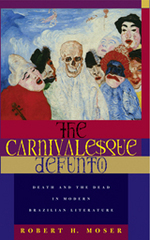
Robert H. Moser details the emergence of a prominent motif in modern Brazilian literature, namely the carnivalesque defunto (the dead) that, in the form of a protagonist or narrator, returns to beseech, instruct, chastise, or even seduce the living. Drawing upon the works of esteemed Brazilian writers such as Machado de Assis, Érico Veríssimo, and Jorge Amado, Moser demonstrates how the defunto, through its mocking laughter and Dionysian resurrection, simultaneously subverts and inverts the status quo, thereby exposing underlying points of tension within Brazilian social and political history.
Incorporating elements of both a celestial advocate and an untrustworthy specter, the defunto also serves as a metaphor for one of modern Brazil’s greatest dilemmas: reconciling the past with the present.
The Carnivalesque Defunto offers a comparative framework by juxtaposing the Brazilian literary ghost with other Latin American, Caribbean, and North American examples. It also presents a cross-disciplinary approach toward understanding the complex relationship forged between Brazil’s spiritual traditions and literary expressions.
This book links the mounting demand for images of violent death with dramatic changes in death-related social rituals. It offers a conceptual framework that connects observations of fictional worlds—including The Twilight Saga, The Vampire Diaries, and the Harry Potter series—with real-world sociocultural practices, analyzing the aesthetic, intellectual, and historical underpinnings of the cult of death. It also places the celebration of death in the context of a longstanding critique of humanism and investigates the role played by 20th-century French theory, posthumanism, transhumanism, and the animal rights movement in shaping the current antihumanist atmosphere.
This timely, thought-provoking book will appeal to scholars of culture, film, literature, anthropology, and American and Russian studies, as well as general readers seeking to understand a defining phenomenon of our age.
By the age of eight, Charlotte Brontë had lost first her mother and then her two older sisters. Later, in a second wave of deaths, her brother and two younger sisters died, leaving her a sole survivor.
With subtlety and imagination, Robert Keefe examines Brontë’s works as the creative response to these losses, particularly the loss of her mother. Terrified and yet fascinated by death, struggling with guilt, remorse, and a deep sense of rejection, Charlotte Brontë found in art a way to come to terms with death through its symbolic reenactment. In her earlier writings she created a fictional world marked by devices that allow her to control or deny death. In her later works these mechanisms evolved into mature expressions of a profound psychological reality.
Brontë’s preoccupation with death is seen in her fiction in the recurring patterns of separation and exile. Keefe traces the development of these motifs in the juvenilia and the four novels: The Professor, Jane Eyre, Shirley, and Villette.
Unique in its emphasis on the maternal relationships in Brontë’s life and art, this study also explores certain aspects of her life that have often puzzled biographers.
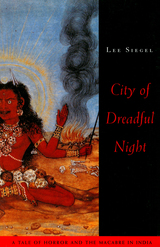
But what started out as a study of other people's stories became a compelling story itself. City of Dreadful Night is an astonishing work of fiction, a tangle of tales that transports the reader from the Medieval India of magicians, witches, and vampires, through the British India of Brahm Kathuwala's childhood, into the chaos and political terror of contemporary India. Vividly recreating Indian literary and oral traditions, Siegel weaves a web of possession, reincarnation, and magical transformation unlike any found in the Western tradition. Flesh-eating demons, Rajiv Gandhi's assassin, even Bram Stoker and Dracula populate the serpentine narrative, which intermingles stories about the characters with the terrifying tales they tell.
Siegel pursues Brahm Kathuwala from the ghastly lights of the cremation ground at Banaras through villages all over north India. Brahm's life story is revealed through countless tales along the way. We learn that he was raised, and abandoned, by two mothers—one the destitute floor sweeper who bore him; the other her employer, a wealthy Irish woman who read and reread to him the story of Dracula. We hear of his marriage to the daughter of a cremation ground attendant, his battles against her demonic possession, and their painful parting. We come to understand the daily life and motivations of this "horror professional," who uses terrifying tales to ward off the evil he himself fears.
This unorthodox book is more than a story; it blends scholarship, fantasy, travelogue, and autobiography—fusing and overlapping historical accounts and newscasts, literary texts and films, dreams and nocturnal tales. Siegel uses imagination to explore the relation of real terror to horror fiction and to contemplate the ways fear and disgust become thrilling elements in stories of the macabre.
This book is the product of Siegel's deep knowledge of both Indian and Western literary and philosophical traditions. It is also an attempt to come to grips with the omnipresence of political and religious terror in contemporary India. Shocking, original, beautifully written, City of Dreadful Night offers readers a captivating immersion in the wonder and terror of India, past and present.
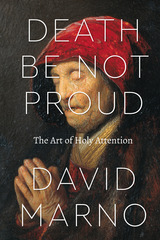
If, in Malebranche’s view, attention is a hidden bond between religion and philosophy, devotional poetry is the area where this bond becomes visible. Marno shows that in works like “Death be not proud,” Donne’s most triumphant poem about the resurrection, the goal is to allow the poem’s speaker to experience a given doctrine as his own thought, as an idea occurring to him. But while the thought must feel like an unexpected event for the speaker, the poem itself is a careful preparation for it. And the key to this preparation is attention, the only state in which the speaker can perceive the doctrine as a cognitive gift. Along the way, Marno illuminates why attention is required in Christian devotion in the first place and uncovers a tradition of battling distraction that spans from ascetic thinkers and Church Fathers to Catholic spiritual exercises and Protestant prayer manuals.

A peculiar necrophilia dominates literary theory. Whether it be under the banner of “anatomy of criticism” or “death of the author,” students of literature seem fated to form a “Dead Poets’ Society.” Can literature ever create or sustain life? What is the cultural mythology of the “dead poet”? In a broad-ranging analysis of modern French and Russian writing—from poems, plays, and essays to revolutionary marches, fashion magazines, and suicide notes—Svetlana Boym reconsiders the making and unmaking of the self in writing on life.
Examining both literal and figurative deaths of poets, the author elaborates alternative strategies for reading text, life, and culture all together. Boym questions the traditional boundaries between literary theory, social psychology, anthropology, and history. She draws on and yet resists ideas advanced by Russian formalists and French and American poststructuralists to develop an authoritative critical vocabulary for the purpose of analyzing modern poetic myths. She brings poets back to life, back to their lives once again, and thereby resuscitates the dying art, the art of dying in words. The result is cultural criticism of a very high order.
The book offers spectacular example of poetic lives. First the author considers the legend of the “pure poet,” focusing on the opposite paths of Mallarmé and Rimbaud. The she investigates the myth of the “revolutionary poet,” stressing the tension between poetry and politics, particularly in the life and work of Mayakovsky. In a third section, she explores the masking image of “poetess” and its fatal entrapment of the woman poet—here, Marina Tsvetaeva. In “The Death of a Critic?” she brings the study to brilliant conclusion, revealing the ironies inherent in the work of Barthes, de Man, and Foucault, the three critics who celebrated the death of the author and yet who, in their own deaths, are subject to biographical speculation.
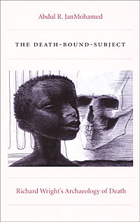
Drawing on psychoanalytic, Marxist, and phenomenological analyses, and on Orlando Patterson’s notion of social death, JanMohamed develops comprehensive, insightful, and original close readings of Wright’s major publications: his short-story collection Uncle Tom’s Children; his novels Native Son, The Outsider, Savage Holiday, and The Long Dream; and his autobiography Black Boy/American Hunger. The Death-Bound-Subject is a stunning reevaluation of the work of a major twentieth-century American writer, but it is also much more. In demonstrating how deeply the threat of death is involved in the formation of black subjectivity, JanMohamed develops a methodology for understanding the presence of the death-bound-subject in African American literature and culture from the earliest slave narratives forward.
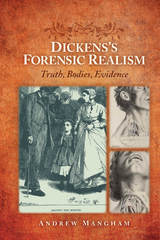
As Mangham shows, forensic medicine grew out of a perceived need to understand things with accuracy, leaning in part on the range of objectivities that inspired the inorganic sciences. At the same time, it had the burden of assisting the law in convicting the guilty and in exonerating the innocent. Practitioners of forensic medicine were uniquely mindful of unwanted variables such as human error and the vagaries of interpretation. In readings of Oliver Twist, Our Mutual Friend, Bleak House, The Pickwick Papers, Great Expectations, and Dickens’s early journalism, Mangham demonstrates that these questions about signification, perception, and reality are central to the stylistic complexities and playful tone often associated with Dickens. Moreover, the medico-legal context of Dickens’s fiction illuminates the richness and profundity, style and impact of Dicken’s narratives.
Examining the works cited above, as well as memoirs by Mitch Albom, Roland Barthes, Jean-Dominique Bauby, Art Buchwald, Randy Pausch, David Rieff, Philip Roth, and Morrie Schwartz, Jeffrey Berman's analysis of this growing genre yields some surprising insights. While the authors have much to say about the loneliness and pain of dying, many also convey joy, fulfillment, and gratitude. Harold Brodkey is willing to die as long as his writings survive. Art Buchwald and Randy Pausch both use the word fun to describe their dying experiences. Dying was not fun for Morrie Schwartz and Tony Judt, but they reveal courage, satisfaction, and fearlessness during the final stage of their lives, when they are nearly paralyzed by their illnesses.
It is hard to imagine that these writers could feel so upbeat in their situations, but their memoirs are authentically affirmative. They see death coming, yet they remain stalwart and focused on their writing. Berman concludes that the contemporary end-of-life memoir can thus be understood as a new form of death ritual, "a secular example of the long tradition of ars moriendi, the art of dying."
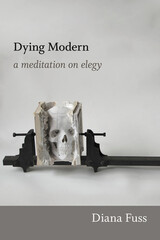
Focusing primarily on American and British poetry written during the past two centuries, Fuss maintains that poetry can still offer genuine ethical compensation, even for the deep wounds and shocking banalities of modern death. As dying, loss, and grief become ever more thoroughly obscured from public view, the dead start chattering away in verse. Through bold, original interpretations of little-known works, as well as canonical poems by writers such as Emily Dickinson, Randall Jarrell, Elizabeth Bishop, Richard Wright, and Sylvia Plath, Fuss explores modern poetry's fascination with pre- and postmortem speech, pondering the literary desire to make death speak in the face of its cultural silencing.
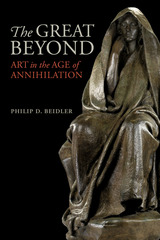
While much about modernism remains up for debate, there can be no dispute about the connection between modernist art and death. The long modern moment was and is an age of war, genocide, and annihilation. Two world wars killed perhaps as many as 100 million people, through combat, famine, holocaust, and ghastly attacks on civilians. The ongoing COVID-19 pandemic is the fifth global pandemic since 1918, with more than a half-million American deaths and counting.
It can hardly come as a surprise, then, that many of the touchstones of modernism reflect on death and devastation. In Philip D. Beidler’s exploration of the modernist canon, he illuminates how these singular voices looked extinction in the eye and tried to reckon with our finitude—and their own. The Great Beyond:Art in the Age of Annihilation catalogs through lively prose an eclectic selection of artists, writers, and thinkers. In 16 essays, Beidler takes nuanced and surprising approaches to well-studied figures—the haunting sculpture by Saint-Gaudens commissioned by Henry Adams for his late wife; Luchino Visconti’s adaptation of Mann’s Death in Venice; and the author’s own long fascination with Beckett’s Waiting for Godot.
The threads and recurring motifs that emerge through Beidler’s analysis bridge the different media, genres, and timeframes of the works under consideration. Protomodernists Crane and Twain connect with near-contemporary voices like Sebald and Morrison. Robert MacFarlane’s 21st-century nonfiction about what lies underneath the earth echoes the Furerbunker and the poetry of Gertrud Kolmar. Learned but lively, somber but not grim, The Great Beyond is not a comfortable read, but it is in a way comforting. In tracing how his subjects confronted nothingness, be it personal or global, Beidler draws a brilliant map of how we see the end of the road.

The refusal to recognize kinship relations among slaves, interracial couples, and same-sex partners is steeped in historical and cultural taboos. In Kindred Specters, Christopher Peterson explores the ways in which non-normative relationships bear the stigma of death that American culture vehemently denies.
Probing Derrida’s notion of spectrality as well as Orlando Patterson’s concept of “social death,” Peterson examines how death, mourning, and violence condition all kinship relations. Through Charles Chesnutt’s The Conjure Woman, Peterson lays bare concepts of self-possession and dispossession, freedom and slavery. He reads Toni Morrison’s Beloved against theoretical and historical accounts of ethics, kinship, and violence in order to ask what it means to claim one’s kin as property. Using William Faulkner’s Absalom, Absalom! he considers the political and ethical implications of comparing bans on miscegenation and gay marriage.
Tracing the connections between kinship and mourning in American literature and culture, Peterson demonstrates how racial, sexual, and gender minorities often resist their social death by adopting patterns of affinity that are strikingly similar to those that govern normative relationships. He concludes that socially dead “others” can be reanimated only if we avow the mortality and mourning that lie at the root of all kinship relations.
Christopher Peterson is visiting assistant professor of literature at Claremont McKenna College.
What interests González is the signature of authorial selfhood in narrative and performance, which he finds willfully and temptingly disfigured in the works he examines: horrific and erotic, subservient and tyrannical, charismatic and repellent. Searching out the personal image and plot, González uncovers two fundamental types of narrative: one that strips character of moral choice; and another in which characters' choices deprive them of personal autonomy and hold them in ritual bondage to a group. Thus The Monstered Self becomes a study of the conflict between individual autonomy and the stereotypes of solidarity.
Written in a characteristically allusive, elliptical style, and drawing on psychoanalysis, religion, mythology, and comparative literature, The Monstered Self is in itself a remarkable performance, one that will engage readers in anthropology, psychology, and cultural history as well as those specifically interested in Latin American narrative.
Published by Bucknell University Press. Distributed worldwide by Rutgers University Press.
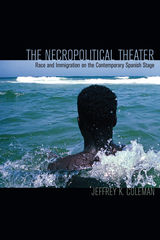
Coleman identifies an inherent racial hierarchy informed by the legacies of colonization and religious intolerance.
Drawing on theatrical texts, performances, legal documents, interviews, and critical reviews, this book challenges Spanish theater to develop a new theatrical space. Jeffrey K. Coleman proposes a “convivial theater” that portrays immigrants as contributors to the Spanish state and better represents the multicultural reality of the nation today.
About the origins of Anglo-American poetic modernism, one thing is certain: it started with a notion of the image, described variously by Ezra Pound as an ideogram and a vortex. We have reason to be less confident, however, about the relation between these puzzling conceptions of the image and the doctrine of literary positivism that is generally held to be the most important legacy of Imagism. No satisfactory account exists, moreover, of what bearing these foundational principles may have on Pound's later engagement with fascism. Nor is it clear how figures such as the vortex and the ideogram might contribute generally to our understanding of modern visual culture and its compulsive appeal.
Radio Corpse addresses these issues and offers a fundamental revision of one of the most powerful and persistent aesthetic ideologies of modernism. Focusing on the necrophilic dimension of Pound's earliest poetry and on the inflections of materiality authorized by the modernist image, Daniel Tiffany establishes a continuum between Decadent practice and the incipient avant-garde, between the prehistory of the image and its political afterlife, between what Pound calls the "corpse language" of late Victorian poetry and a conception of the image that borrows certain "radioactive" qualities from the historical discovery of radium and the development of radiography. Emphasizing the phantasmic effects of translation (and exchange) in Pound's poetry, Tiffany argues that the cadaverous--and radiological--properties of the image culminate, formally and ideologically, in Pound's fascist radio broadcasts during World War II. Ultimately, the invisibility of these "radiant" images places in question basic assumptions regarding the optical character of images--assumptions currently being challenged by imageric technologies such as magnetic resonance imaging and positron emission tomography.
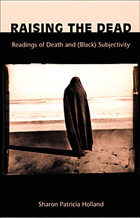
Holland argues that the presence of blacks, Native Americans, women, queers, and other “minorities” in society is, like death, “almost unspeakable.” She gives voice to—or raises—the dead through her examination of works such as the movie Menace II Society, Toni Morrison’s novel Beloved, Leslie Marmon Silko’s Almanac of the Dead, Randall Kenan’s A Visitation of Spirits, and the work of the all-white, male, feminist hip-hop band Consolidated. In challenging established methods of literary investigation by putting often-disparate voices in dialogue with each other, Holland forges connections among African-American literature and culture, queer and feminist theory.
Raising the Dead will be of interest to students and scholars of American culture, African-American literature, literary theory, gender studies, queer theory, and cultural studies.

Recalcitrance, Faulkner, and the Professors is a wonderfully fetching book of criticism that presents fairly, coherently, and forcefully the major critical viewpoints operating in literature studies today and puts them into an invigorating conflict. In the framework of a deliberately artificial plot, characters at an imaginary university present a variety of theoretical and critical points of view in a four-day round table discussion. Centering on Faulker's As I Lay Dying, the discussion has at stake the hand of Eve Birdsong, a student whose distress with the conflicts among her professors had inspired these proceedings. The cast also includes a young hero—assistant professor Charlie Mercer—professors representing a variety of contemporary critical positions, and several extraordinary students.
The discussion, presented in turn by speeches, exchanges in dialogue, and short papers, focuses on the concept of recalcitrance in fiction: the resistance that texts offer to the development of formal structures. Recalcitrance, Faulkner, and the Professors is, variously, a pedagogical text, a critical theory text, and a text about a single novel. But Wright's volume breaks the rules of categorization: it refuses to sit neatly in any genre.

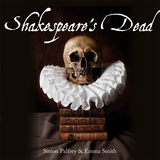
Published to accompany a major exhibition at the Bodleian Library, University of Oxford, Shakespeare’s Dead documents the many ways Shakespeare’s characters meet their demise, from suicide to murder, from death by workaday dagger to the more creative method of being baked and fed to one’s family in a meat pie. Through these examples, Simon Palfrey and Emma Smith show Shakespeare’s mastery at choreographing death as a means of rediscovery. Some characters refuse to go quietly, dying in stages, as in Nick Bottom’s performance as Pyramus killing himself with much flourish in A Midsummer Night’s Dream. Others are remembered in elegies, and still others are resurrected or reappear as ghosts. Shakespeare’s death scenes also often speak to the boundaries between theater and everyday life, with funerals and scenes of mourning that are undercut by their staged inauthenticity.
Extensively illustrated with contemporary drawings and images from stage history, Shakespeare’s Dead takes readers through the playwright’s great death scenes and tragic figures, exploring in them the theme of life in death and delineating the cultural, religious, and social contexts.
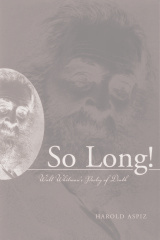
Walt Whitman is unquestionably a great poet of the joys of living. But as Harold Aspiz demonstrates in this study, concerns with death and dying define Whitman’s career as a thinker, a poet, and a person. Through a close reading of Leaves of Grass, its constituent poems, particularly “Song of Myself,” and Whitman’s prose and letters, Aspiz charts how the poet’s exuberant celebration of life—the cascade of sounds, sights, and smells that erupt in his verse—is a consequence of his central concern: the ever-presence of death and the prospect of an afterlife.
Until now no one has studied as systematically the degree to which mortality informs Whitman’s entire enterprise as a poet. So Long! devotes particular attention to Whitman’s language and rich artistry in the context of the poet’s social and intellectual milieus. We see Whitman (and his many personae) as a folk prophet announcing a gospel of democracy and immortality; pondering death in alternating moods of acceptance and terror; fantasizing his own dying and his postmortem selfhood; yearning for mates and lovers while conscious of fallible flesh; agonizing over the omnipresence of death in wartime; patiently awaiting death; and launching imaginary journeys toward immortality and godhood.
So Long! is valuable for American literature collections, students and scholars of Whitman and 19th-century literature, and general readers interested in Whitman and poetry. By exploring Whitman's faith in death as a meaningful experience, we may understand better how the poet—whether personified as representative man, victim, hero, lover, or visionary—lived so completely on the edge of life.
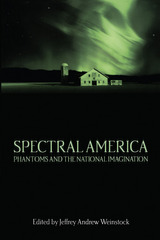
Spectral America asserts that ghosts, whether in oral tradition, literature, or such modern forms as cinema have always been constructions embedded in specific historical contexts and invoked for explicit purposes, often political in nature. The essays address the role of "spectral evidence" during the Salem witch trials, the Puritan belief in good spirits, the convergence of American Spiritualism and technological development in the nineteenth century, the use of the supernatural as a tool of political critique in twentieth-century magic realism, and the "ghosting" of persons living with AIDS. They also discuss ghostly themes in the work of Ambrose Bierce, Edith Wharton, Gloria Naylor, and Stephen King.
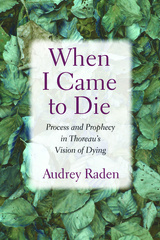
When I Came to Die suggests that throughout his writings, Thoreau communicated that knowing how to die properly is an art and a lifelong study, a perspective that informed his ideas about politics, nature, and individualism. With this insight, Raden opens a dialogue that will engage both Thoreauvians and those interested in American literature and thought.
READERS
Browse our collection.
PUBLISHERS
See BiblioVault's publisher services.
STUDENT SERVICES
Files for college accessibility offices.
RECENTLY PUBLISHED


UChicago Accessibility Resources
home | accessibility | search | about | contact us
BiblioVault ® 2001 - 2024
The University of Chicago Press