
 A SCHOLARLY BOOK REPOSITORY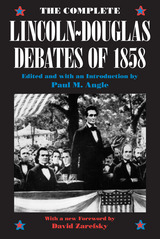
Zarefsky analyzes the rhetoric of the speeches, showing how Lincoln and Douglas chose their arguments and initiated a debate that shook the nation. Their eloquent, statesmanlike discussion of the morality of slavery illustrates the masterful use of rhetorical strategies and tactics in the public forum: a form of discourse that has nearly disappeared from the political scene today.
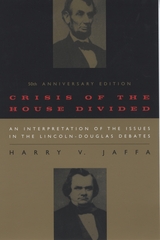
The definitive account of the Lincoln-Douglas debates and their importance to American history
A lasting classic, Crisis of the House Divided offers an unparalleled account of the Lincoln-Douglas debates. Harry Jaffa provides the definitive analysis of the political principles that guided Lincoln from his reentry into politics in 1854 through his Senate campaign against Douglas in 1858.
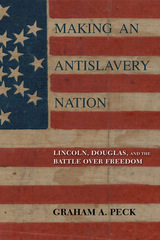
This sweeping narrative presents an original and compelling explanation for the triumph of the antislavery movement in the United States prior to the Civil War. Abraham Lincoln's election as the first antislavery president was hardly preordained. From the country's inception, Americans had struggled to define slavery's relationship to freedom. Most Northerners supported abolition in the North but condoned slavery in the South, while most Southerners denounced abolition and asserted slavery's compatibility with whites' freedom. On this massive political fault line hinged the fate of the nation.
Graham A. Peck meticulously traces the conflict over slavery in Illinois from the Northwest Ordinance in 1787 to Lincoln's defeat of his archrival Stephen A. Douglas in the 1860 election. Douglas's attempt in 1854 to persuade Northerners that slavery and freedom had equal national standing stirred a political earthquake that brought Lincoln to the White House. Yet Lincoln's framing of the antislavery movement as a conservative return to the country's founding principles masked what was in fact a radical and unprecedented antislavery nationalism. It justified slavery's destruction but triggered the Civil War.
Presenting pathbreaking interpretations of Lincoln, Douglas, and the Civil War's origins, Making an Antislavery Nation shows how battles over slavery paved the way for freedom's triumph in America.

For the quarter-century before 1860 Stephen A. Douglas was a dominant
figure on the American political scene, far outshadowing Abraham Lincoln.
This first paperback printing of Robert Johannsen's authoritative biography
features a new preface.
"At once a work of enormous scholarship and of deep insight. Here,
for the first time, is the full story of a great career, told with such
skill that we can now understand why Abraham Lincoln found the 'Little
Giant' the most formidable political rival he ever faced." -- David
H. Donald, author of Lincoln and two-time winner of the Pulitzer
Prize
"Well-organized and marvelously detailed. . . . The book demonstrates
the virtues of large-scale, straightforward narrative biography at its
best. Its completeness and objectivity will make it the standard authority
for many years to come." -- Richard N. Current, The New York Times
Book Review
"Superb. . . . Will doubtless stand as the definitive biography
of Stephen A. Douglas for this generation." -- Hans L. Trefousse,
The Journal of American History
"An impressive work--impressive in scope, in research, and in maturity
of understanding. . . . Johannsen has constructed a biography that is
rich in detail and full of conviction." -- James Z. Rabun, The
Journal of Southern History
"Should take its place in the tradition of magisterial biographies
. . . in which so much of the best writing on American history is to be
found." -- Harry V. Jaffa, National Review
"The research is amazingly exhaustive and the writing is unusually
readable. . . . Outstanding biography of a quality not often matched."
-- LeRoy H. Fischer, Manuscripta
Supported by the Dickerson Fund of the University of Illinois at Urbana-Champaign
READERS
Browse our collection.
PUBLISHERS
See BiblioVault's publisher services.
STUDENT SERVICES
Files for college accessibility offices.
RECENTLY PUBLISHED


UChicago Accessibility Resources
home | accessibility | search | about | contact us
BiblioVault ® 2001 - 2026
The University of Chicago Press