
 A SCHOLARLY BOOK REPOSITORY
Results by Title
3 books about Duke, Benjamin
3 books about Duke, Benjamin
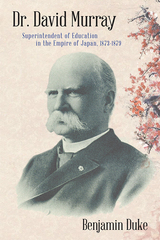
Dr. David Murray
Superintendent of Education in the Empire of Japan, 1873-1879
Duke, Benjamin
Rutgers University Press, 2018
This is the first biography in English of an uncommon American, Dr. David Murray, a professor of mathematics at Rutgers College, who was appointed by the Japanese government as Superintendent of Education in the Empire of Japan in 1873. The founding of the Gakusei—the first public school system launched in Japan—marks the beginning of modern education in Japan, accommodating all children of elementary school age. Murray’s unwavering commitment to its success renders him an educational pioneer in Japan in the modern world.
Benjamin Duke has compiled this comprehensive biography of David Murray to showcase Murray’s work, both in assisting around 100 samurai students in their studies at Rutgers, and in his unprecedented role in early Japanese-American relations. This fascinating story uncovers a little-known link between Rutgers University and Japan, and it is the only book to conclude that Rutgers made a greater contribution to the development of modern education in the early Meiji Era than any other non-Japanese college or university in the world.
Benjamin Duke has compiled this comprehensive biography of David Murray to showcase Murray’s work, both in assisting around 100 samurai students in their studies at Rutgers, and in his unprecedented role in early Japanese-American relations. This fascinating story uncovers a little-known link between Rutgers University and Japan, and it is the only book to conclude that Rutgers made a greater contribution to the development of modern education in the early Meiji Era than any other non-Japanese college or university in the world.
[more]
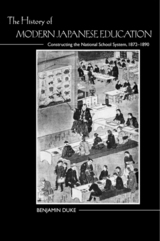
The History of Modern Japanese Education
Constructing the National School System, 1872-1890
Duke, Benjamin
Rutgers University Press, 2014
The History of Modern Japanese Education is the first account in English of the construction of a national school system in Japan, as outlined in the 1872 document, the Gakusei. Divided into three parts tracing decades of change, the book begins by exploring the feudal background for the Gakusei during the Tokugawa era which produced the initial leaders of modern Japan. Next, Benjamin Duke traces the Ministry of Education's investigations of the 1870s to determine the best western model for Japan, including the decision to adopt American teaching methods. He then goes on to cover the eventual "reverse course" sparked by the Imperial Household protest that the western model overshadowed cherished Japanese traditions. Ultimately, the 1890 Imperial Rescript on Education integrated Confucian teachings of loyalty and filial piety with Imperial ideology, laying the moral basis for a western-style academic curriculum in the nation's schools.
[more]

Rutgers Meets Japan
A Trans-Pacific Network of the Late Nineteenth Century
Haruko Wakabayashi
Rutgers University Press, 2026
In 1867 Kusakabe Taro, a young samurai from Fukui, Japan, began studying at Rutgers as its first foreign student. Three years later, in 1870, his former tutor, friend, and Rutgers graduate, William Elliot Griffis, left for Japan to teach English and Science for three and a half years. The year 2020 marked the 150th anniversary of two landmark events in the history of the Rutgers-Japan relationship: the untimely death of Kusakabe only weeks before his graduation, and his friend Griffis’ departure to Japan.
Griffis and Kusakabe were only a small piece of a vast transnational network of leading modernizers of Japan in the 1860s and 70s. The Japanese students in New Brunswick were young and innovative men of samurai and aristocratic lineage, who were sent by reform-minded leaders of Japan, which was undergoing a dramatic transformation. They came to New Brunswick seeking Western knowledge that was much needed for the modernization of a newly forming nation. New Brunswick became the hub of a network of Japanese nationals that extended to the major cities of New York, Philadelphia, and Boston, and from there to the smaller towns of New England. Once in New Brunswick, these Japanese students were embraced by Protestant ministers, educators, and missionaries—both men and women—whose network encompassed Rutgers College and the neighboring New Brunswick Theological Seminary, and which stretched to Dutch Reformed parishes throughout the Eastern seaboard, and westward as far as the Dutch enclave of Holland, Michigan. Meanwhile, the American teachers and missionaries who left for Japan became part of a network of reformist leaders and Japanese returnees that extended to schools, colleges, and missions in Japan, and formed the foundations of Japan’s modern educational system. Through contributions from scholars and archivists in the U.S., Canada, and Japan, Rutgers Meets Japan aims to reconstruct the early Rutgers-Japan connections and examine the role and impact of this transnational network on Japan and the U.S. in the late nineteenth century.
Griffis and Kusakabe were only a small piece of a vast transnational network of leading modernizers of Japan in the 1860s and 70s. The Japanese students in New Brunswick were young and innovative men of samurai and aristocratic lineage, who were sent by reform-minded leaders of Japan, which was undergoing a dramatic transformation. They came to New Brunswick seeking Western knowledge that was much needed for the modernization of a newly forming nation. New Brunswick became the hub of a network of Japanese nationals that extended to the major cities of New York, Philadelphia, and Boston, and from there to the smaller towns of New England. Once in New Brunswick, these Japanese students were embraced by Protestant ministers, educators, and missionaries—both men and women—whose network encompassed Rutgers College and the neighboring New Brunswick Theological Seminary, and which stretched to Dutch Reformed parishes throughout the Eastern seaboard, and westward as far as the Dutch enclave of Holland, Michigan. Meanwhile, the American teachers and missionaries who left for Japan became part of a network of reformist leaders and Japanese returnees that extended to schools, colleges, and missions in Japan, and formed the foundations of Japan’s modern educational system. Through contributions from scholars and archivists in the U.S., Canada, and Japan, Rutgers Meets Japan aims to reconstruct the early Rutgers-Japan connections and examine the role and impact of this transnational network on Japan and the U.S. in the late nineteenth century.
[more]
READERS
Browse our collection.
PUBLISHERS
See BiblioVault's publisher services.
STUDENT SERVICES
Files for college accessibility offices.
RECENTLY PUBLISHED


UChicago Accessibility Resources
home | accessibility | search | about | contact us
BiblioVault ® 2001 - 2026
The University of Chicago Press