
 A SCHOLARLY BOOK REPOSITORY
Bird brings a novel approach to his dissection of Tarkovsky’s wholly original techniques and sensibilities, arranging the films into elemental categories of Water, Fire, Earth, and Air. Solaris, Ivan’s Childhood, Mirror, Nostalgia, Andrei Rublev, and Sacrifice all get their due here; through them, Bird explores how the filmmaker probed the elusive correlation between cinematic representation and a more primeval perception of the world. Though the book also considers Tarkovsky’s work in radio, theatre, and opera—as well as his work as an actor, screenwriter, and film theorist—Bird throughout keeps his focus firmly on Tarkovsky as a consummate filmmaker.

The definition and understanding of "terrorism" is in a state of unprecedented evolution. No longer are acts of terrorism rare and far-flung. Following the horrendous attacks on the World Trade Center and the Pentagon, U.S. citizens have had their eyes opened to a new world where this nightmare stalks the daily news and is never far from consciousness.
Attacking Terrorism brings together some of the world's finest experts, people who have made the study of this rising menace their life's work, to provide a comprehensive picture of the challenges and opportunities of the campaign against international terrorism. Part one, "The Nature of Terrorism," provides an overview and foundation for the current campaign, placing it within the political and historical context of previous threats and responses. Part two, "The Responses to Terrorism," looks at the range of policy instruments required in an effective strategy against terrorism.
The contributors to this volume bring finely honed analyses and nuanced perspectives to the terrorist realities of the twenty-first century—history, analyses, and perspectives that have been too often oversimplified or myopic. They bring a new depth of understanding and myriad new dimensions to the crisis of terrorism. And they reach into aspects of counterterrorism that broaden our grasp on such important tools as diplomacy, intelligence and counterintelligence, psycho-political means, international law, criminal law enforcement, military force, foreign aid, and homeland security, showing not only how these tools are currently being employed but how often they are being underutilized as well.
Attacking Terrorism demonstrates that there are no easy answers—and that the road toward victory will be long and arduous, frightening and dangerous—but as Audrey Kurth Cronin states in her introduction, "As the campaign against international terrorism unfolds, a crucial forward-looking process of strategic reassessment is under way in the United States, and this book is intended to be a part of it."
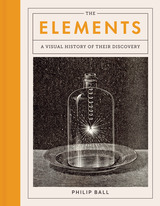
The Elements is a stunning visual journey through the discovery of the chemical building blocks of our universe. By piecing together the history of the periodic table, Ball explores not only how we have come to understand what everything is made of, but also how chemistry developed into a modern science. Ball groups the elements into chronological eras of discovery, covering seven millennia from the first known to the last named. As he moves from prehistory and classical antiquity to the age of atomic bombs and particle accelerators, Ball highlights images and stories from around the world and sheds needed light on those who struggled for their ideas to gain inclusion. By also featuring some elements that aren’t true elements but were long thought to be—from the foundational prote hyle and heavenly aetherof the ancient Greeks to more recent false elements like phlogiston and caloric—The Elements boldly tells the full history of the central science of chemistry.

Elements, Government and Licensing covers three principal domains of phonological representation: melody and segmental structure; tone, prosody, and prosodic structure; and phonological relations, empty categories, and vowel-zero alternations. Theoretical topics covered include the formalization of Element Theory, the hotly debated topic of structural recursion in phonology, and the empirical status of government.
In addition, a wealth of new analyses and empirical evidence sheds new light on empty categories in phonology, the analysis of certain consonantal sequences, phonological and non-phonological alternation, the elemental composition of segments, and many more. Taking up long-standing empirical and theoretical issues informed by the Government Phonology and Element Theory, this book provides theoretical advances while also bringing to light new empirical evidence and analysis challenging previous generalizations.
The insights offered here will be equally exciting for phonologists working on related issues inside and outside the Principles and Parameters program, such as researchers working in Optimality Theory or classical rule-based phonology.
Like its predecessor, this edition of Elements of Acoustic Phonetics will serve as an invaluable textbook and reference for students and practitioners of linguistics and speech science, and for anyone who wants to understand the physics of speech.

In addition to providing the full text, Uihlein and the contributors trace Ricker’s career and delve into his practice of teaching. Subject experts explore specific topics. Thomas Leslie surveys contemporary construction practices in Chicago. Tom F. Peters considers Ricker’s writings in the context of the time while Rachel Will looks at masonry know-how and testing. Donald Friedman examines the teaching of iron and steel construction.
An illuminating look at a field and a legacy, The Elements of Construction rediscovers a figure that shaped the teaching of architecture and trained a generation that forever changed Chicago.
Elements of Discipline is a timely and helpful book for teachers, parents, and day-care professionals that provides a simple set of rules for managing—successfully and humanely—a wide range of discipline situations and challenges. A well-respected child development specialist, Stephen Greenspan outlines his “ABC Theory of Discipline.” He combines an Affective approach, a Behavioral approach, and a Cognitive approach that, when used in a coordinated fashion, will contribute to greater child compliance and family/classroom harmony.
Greenspan suggests that, using his matrix, caregivers can provide the warmth, tolerance, and influence that will help children become competent in three socio-emotional domains—happiness, boldness, and niceness. He recommends caregivers pick and choose from the discipline literature in a manner that best suits their individual style and values.
Elements of Discipline is a lively guide to effective classroom or family management.
Throughout the book the emphasis is on simplification whenever possible, assuming the readers know college algebra and basic calculus. Jan Kmenta explains all methods within the simplest framework, and generalizations are presented as logical extensions of simple cases. And while a relatively high degree of rigor is preserved, every conflict between rigor and clarity is resolved in favor of the latter. Apart from its clear exposition, the book's strength lies in emphasizing the basic ideas rather than just presenting formulas to learn and rules to apply.
The book consists of two parts, which could be considered jointly or separately. Part one covers the basic elements of the theory of statistics and provides readers with a good understanding of the process of scientific generalization from incomplete information. Part two contains a thorough exposition of all basic econometric methods and includes some of the more recent developments in several areas.
As a textbook, Elements of Econometrics is intended for upper-level undergraduate and master's degree courses and may usefully serve as a supplement for traditional Ph.D. courses in econometrics. Researchers in the social sciences will find it an invaluable reference tool.
A solutions manual is also available for teachers who adopt the text for coursework.
Jan Kmenta is Professor Emeritus of Economics and Statistics, University of Michigan.
A new conceptual diagram of Foucault’s original vision of the biopolitical order
The history around the critical reception of Michel Foucault’s published writings is troubled, according to Gregg Lambert, especially in light of the controversy surrounding his late lectures on biopolitics and neoliberal governmentality. In this book, Lambert’s unique approach distills Foucault’s thought into its most basic components in order to more fully understand its method and its own immanent rules of construction.
The Elements of Foucault presents a critical study of Foucault’s concept of method from the earlier History of Sexuality, Volume 1, to his later lectures. Lambert breaks down Foucault’s post-1975 analysis of the idea of biopower into four elements: the method, the conceptual device (i.e., dispositif), the grid of intelligibility, and the notion of “milieu.” Taken together, these elements compose the diagram of Foucault’s early analysis and the emergence of the neoliberal political economy. Lambert further delves into how Foucault’s works have been used and misused over time, challenging the periodization of Foucault’s later thought in scholarship as well as the major and most influential readings of Foucault by other contemporary philosophers—in particular Gilles Deleuze and Giorgio Agamben.
The Elements of Foucault is the first generally accessible, yet rigorous and comprehensive, discussion of lectures and major published works of Foucault’s post-1975 theory of biopower and of the major innovation of the concept of dispositif. It is also the first critical work to address the important influence of French philosopher Georges Canghuilhem on Foucault’s thought.
Elements of German fills a gap in advanced undergraduate and beginning graduate levels of German language study by presenting more advanced concepts of the language in a light intended for practical use rather than theoretical discourse. This text provides a means to improve knowledge and command of grammatically correct German as it is spoken and written. It also introduces methods and tools of linguistic analysis in the areas of phonology and morphology. Unlike books that treat phonology in a cursory way, this text delves into the problems of word formation and the intricacies of inflection and derivation. Exercises are included throughout to help better absorb the rules for real-world language use. This volume provides an in-depth look at the German language from the ground up. Its detailed approach makes this book an excellent complement to the work of less specific grammar textbooks and reviews.
"This inductive method in the teaching of grammar is educationally sound, and in employing it in this text some eighty years ago, the author was certainly far ahead of his time."—William Chomsky, Jewish Bookland
"A treatment of much that is essential in Hebrew grammar. . . .useful tools to the divinity student and instructor in biblical Hebrew."—David Weinstein, Jewish Education

Francis Wayland's The Elements of Moral Science, first published in 1835, was one of the most widely used and influential American textbooks of the nineteenth century. Direct and simple in its presentation, the book was more a didactic manual than a philosophic discussion of ethical problems. But because of its success, and because it set the tone and form for so much educational writing that was to follow, this first important American textbook in moral philosophy is now of great value as a document in the history of education.
The book grew naturally out of the lectures Wayland prepared for the senior course in moral philosophy he taught as President of Brown University beginning in 1827. Courses of this kind were common at the time. As an undergraduate at Union College, Wayland himself had taken one under President Eliphalet Nott, who was to become his lifelong supporter. Loosely organized, such courses gave the college president, most often interested in the training of character rather than in learning for its own sake, an opportunity to impress his personality and moral views on the seniors before turning them out in the world. Wayland's course at Brown, less rambling than many, was described by a former student as "one garden spot in the waste of the curriculum."
In his lectures and, finally, in his book, Wayland stood in opposition to the utilitarian ethics of the eighteenth century which based moral judgments on the consequences of men's acts. He held instead that conscience was a faculty directing man's actions in accordance with moral law. Wayland developed this idea in the first part of his book, called "Theoretical Ethics." In the second part, "Practical Ethics," he established three working principles: the eternal validity of moral law as revealed in the Scriptures, the right of private judgment in accordance with Protestant tradition, and the Jeffersonian republican limitation of the powers of government. These he then applied to moral practice, vindicating and validating the desirable virtues of justice, veracity, chastity, and benevolence.
One section of Wayland's otherwise inoffensive text turned out to be highly controversial. Under the heading "Personal Liberty" he discussed the question of slavery, coming at length to the conclusion that the duty of masters to slaves was to free them, while the duty of slaves to masters was to obey them and be faithful to them. In the climate of that time, his recommendation to leave action to the Christian conscience of the individual master was no more acceptable to the growing abolitionist sentiment of the North than to the defensive, proslavery feeling of the South. The Elements of Moral Science went on, nevertheless, to a long and popular life, going through several revisions (in which the slavery section was progressively altered) as well as translations, and selling 100,000 copies by the end of the century.
Francis Wayland (1796-1865), Mr. Blau writes, stands as 'a central figure in the first great movement for reform of education in the United States." Ordained first as a minister, he served as President of Brown from 1827 to 1855, advocating a wider, more liberal, more practical curriculum at a time when courses of study were still tightly bound to the classics. In politics anti-expansionist, and a pacifist by conviction, he bitterly opposed the Mexican War and the admission of Texas. His opposition to slavery gradually increased until, on the outbreak of the Civil War, he could write, "Can it be doubted on which side God will declare himself?... The best place to meet a difficulty is just where God puts it. If we dodge it, it will come in a worse place..."
This text reproduces the 1837 revision of The Elements of Moral Science. Minor variations from other editions are included as footnotes. Variant versions of longer passages are carried in full in appendices.
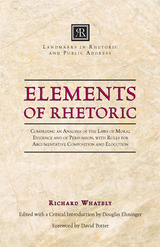
Direct, comprehensive, well organized, simple in statement, Elements of Rhetoric is in all respects well fitted to fulfill its assigned role as a textbook. The remarks on practical problems and the examples and analogies confirm contemporary reports that Whately was himself a talented and stimulating teacher.
The modern field of speech was born near the beginning of the twentieth century, some seventy years after Whately wrote. But influential leaders in the new field endorsed Whately’s judgments, and courses and textbooks in public address have remained strongly influenced by his ideas. Whately’s views on a number of major questions in rhetoric have proved sound and fruitful during many decades of practice, and his book remains one of the most influential works on the subject.
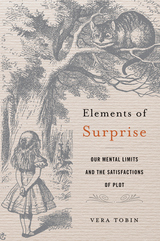
Why do some surprises delight—the endings of Agatha Christie novels, films like The Sixth Sense, the flash awareness that Pip’s benefactor is not (and never was!) Miss Havisham? Writing at the intersection of cognitive science and narrative pleasure, Vera Tobin explains how our brains conspire with stories to produce those revelatory plots that define a “well-made surprise.”
By tracing the prevalence of surprise endings in both literary fiction and popular literature and showing how they exploit our mental limits, Tobin upends two common beliefs. The first is cognitive science’s tendency to consider biases a form of moral weakness and failure. The second is certain critics’ presumption that surprise endings are mere shallow gimmicks. The latter is simply not true, and the former tells at best half the story. Tobin shows that building a good plot twist is a complex art that reflects a sophisticated understanding of the human mind.
Reading classic, popular, and obscure literature alongside the latest research in cognitive science, Tobin argues that a good surprise works by taking advantage of our mental limits. Elements of Surprise describes how cognitive biases, mental shortcuts, and quirks of memory conspire with stories to produce wondrous illusions, and also provides a sophisticated how-to guide for writers. In Tobin’s hands, the interactions of plot and cognition reveal the interdependencies of surprise, sympathy, and sense-making. The result is a new appreciation of the pleasures of being had.
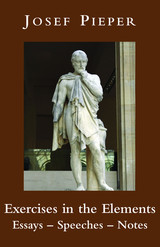
A fundamental issue for Pieper is “createdness.” He sees this as the fundamental truth of our being – all being – and the fundamental virtue we can practise is the striving to live according to our perception of real truth in any given situation.
The strength and attraction of Pieper’s writing is its direct and intuitive character which is independent of abstract systematization. He advocates staying in touch with the “real” as we experience it deep within ourselves. Openness to the totality of being – in no matter what context being reveals itself – and the affirmation of all that is founded in this totality are central pillars of all his thinking. Given the “simplicity” of this stance, it is no surprise that much of it is communicated – and successfully – through his gift for illustration by anecdote. Like Plato, this philosopher is a story-teller and, like him, very readable.
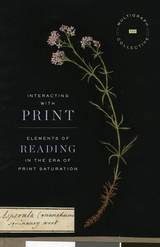
Each entry builds on its term in order to resituate print and book history within a broader media ecology throughout the eighteenth and nineteenth centuries. The central theme is interactivity, in three senses: people interacting with print; print interacting with the non-print media that it has long been thought, erroneously, to have displaced; and people interacting with each other through print. The resulting book will introduce new energy to the field of print studies and lead to considerable new avenues of investigation.

Music as Metaphor was first published in 1960. Minnesota Archive Editions uses digital technology to make long-unavailable books once again accessible, and are published unaltered from the original University of Minnesota Press editions.
A professor of music for many years, Mr. Ferguson here sets forth his theories on how music conveys meaning to its listeners. He identifies and discusses the elements of musical expression - tonal stress and rhythm - and correlates them with the nervous tensions and motor impulses which characterize human emotion. Through this correlation, he shows how music portrays universally understood emotional states and ideas. He relates these principles to music criticism, proposing a new system for such criticism.
The Solutions Manual to Elements of Econometrics, Second Edition provides chapter solutions to the exercises in the college textbook: Elements of Econometrics, Second Edition by Jan Kmenta.
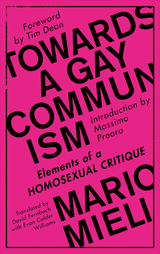
First published in Italian in 1977, Mario Mieli's groundbreaking book is an early landmark of revolutionary queer theory - now available for the first time in a complete and unabridged English translation.
Among the most important works ever to address the relationship between homosexuality, homophobia and capitalism, Mieli's essay continues to pose a radical challenge to today's dominant queer theory and politics.
With extraordinary prescience, Mieli exposes the efficiency with which capitalism co-opts 'perversions' which are then 'sold both wholesale and retail'. In his view the liberation of homosexual desire requires the emancipation of sexuality from both patriarchal sex roles and capital.
Drawing heavily upon Marx and psychoanalysis to arrive at a dazzlingly original vision, Towards a Gay Communism is a hitherto neglected classic that will be essential reading for all who seek to understand the true meaning of sexual liberation under capitalism today.
READERS
Browse our collection.
PUBLISHERS
See BiblioVault's publisher services.
STUDENT SERVICES
Files for college accessibility offices.
RECENTLY PUBLISHED



UChicago Accessibility Resources
home | accessibility | search | about | contact us
BiblioVault ® 2001 - 2024
The University of Chicago Press