
 A SCHOLARLY BOOK REPOSITORY
By bringing listeners’ experiences into the analysis, DiPiero shows how indie rock feminisms have shifted since the 1990s, rejecting overt political messages in favor of sonic catharsis, and reflecting the complex, ambivalent feeling of being young while the world burns. In reprising the sounds of an alt-rock associated in public consciousness with white male pain, Big Feelings doubles down on the stereotypical association between femininity and emotionality to perform whole spectrums of feeling in varied states of overwhelm. In doing so, these artists draw attention to overlooked histories of women and queer musicians who have been forging indie rock all along, while also remaking how the music matters in the present.
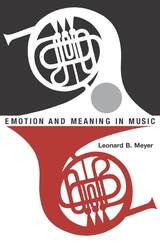
"It is not too much to say that his approach provides a basis for the meaningful discussion of emotion and meaning in all art."—David P. McAllester, American Anthropologist
"A book which should be read by all who want deeper insights into music listening, performing, and composing."—Marcus G. Raskin, Chicago Review
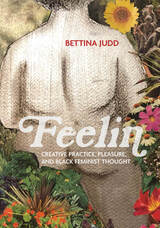
How creativity makes its way through feeling—and what we can know and feel through the artistic work of Black women
Feeling is not feelin. As the poet, artist, and scholar Bettina Judd argues, feelin, in African American Vernacular English, is how Black women artists approach and produce knowledge as sensation: internal and complex, entangled with pleasure, pain, anger, and joy, and manifesting artistic production itself as the meaning of the work. Through interviews, close readings, and archival research, Judd draws on the fields of affect studies and Black studies to analyze the creative processes and contributions of Black women—from poet Lucille Clifton and musician Avery*Sunshine to visual artists Betye Saar, Joyce J. Scott, and Deana Lawson.
Feelin: Creative Practice, Pleasure, and Black Feminist Thought makes a bold and vital intervention in critical theory’s trend toward disembodying feeling as knowledge. Instead, Judd revitalizes current debates in Black studies about the concept of the human and about Black life by considering how discourses on emotion as they are explored by Black women artists offer alternatives to the concept of the human. Judd expands the notions of Black women’s pleasure politics in Black feminist studies that include the erotic, the sexual, the painful, the joyful, the shameful, and the sensations and emotions that yet have no name. In its richly multidisciplinary approach, Feelin calls for the development of research methods that acknowledge creative and emotionally rigorous work as productive by incorporating visual art, narrative, and poetry.
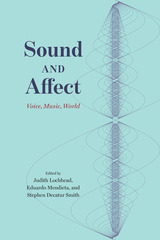
Sound and Affect maps a new territory for inquiry at the intersection of music, philosophy, affect theory, and sound studies. The essays in this volume consider objects and experiences marked by the correlation of sound and affect, in music and beyond: the voice, as it speaks, stutters, cries, or sings; music, whether vocal, instrumental, or machine-made; and our sonic environments, whether natural or artificial, and how they provoke responses in us. Far from being stable, correlations of sound and affect are influenced and even determined by factors as diverse as race, class, gender, and social and political experience. Examining these factors is key to the project, which gathers contributions from a cross-disciplinary roster of scholars, including both established and new voices. This agenda-setting collection will prove indispensable to anyone interested in innovative approaches to the study of sound and its many intersections with affect and the emotions.

In Arab culture, at the ineffable point where music meets emotion, lies ṭarab. Often glossed as the ecstasy experienced and expressed when performing or listening to singing, instrumental works, and recitations of poetry, ṭarab is both a practice and an orienting concept central to musical aesthetics and spirituality characteristic of Middle Eastern cultures.
Gathering fifteen essays by scholars of music, affect, literature, religion, and education, Ṭarab extends the study of ṭarab historically, geographically, and sociologically. Historical essays explore ṭarab’s role in the medieval Middle East and the Ottoman Empire. Turning to the modern era, authors examine ṭarab and related concepts in Egypt, Albania, and Iraq, and among Turkish Roma and Lebanese Maronite Christians. The contributors also address contemporary practitioners and the intersections of ṭarab and maqām, belly dancing, music streaming, and university music ensembles. Situating this unique cultural concept in a global context, these studies enrich the story of ṭarab and provide new insight into music’s powerful emotional appeal.
READERS
Browse our collection.
PUBLISHERS
See BiblioVault's publisher services.
STUDENT SERVICES
Files for college accessibility offices.
RECENTLY PUBLISHED






UChicago Accessibility Resources
home | accessibility | search | about | contact us
BiblioVault ® 2001 - 2025
The University of Chicago Press