
 A SCHOLARLY BOOK REPOSITORY
6 start with F start with F

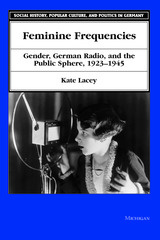
At the heart of the book is an exploration of radio programming for women from the mid-1920s to the end of World War II. Largely through the Frauenfunk, radio transformed women's domestic life, mediated women's experience of modernity and war, and worked to integrate women into the modern consumer culture, the national economy, and eventually the "national community" of the Volksgemeinschaft. At the same time, decisions about how that programming was to operate influenced the way radio was conceived as a broadcast rather than an interactive technology.
Ultimately, the cultural practice and propaganda of the Third Reich were anticipated in and enabled by the legacy of broadcasting in the Weimar Republic. Feminine Frequencies confronts the consequences of a missed opportunity to harness the democratic potential of a new medium of communication.
Based on original archival research, and interdisciplinary in approach, this book will be of great interest to students and scholars in German studies, women's studies, and media studies.
Kate Lacey is Lecturer in Media Studies, School of European Studies, University of Sussex.

Focusing on the menhaden fishermen of the southern coastal regions, The Fish Factory is an engaging and insightful exploration of what work means to different social groups employed within the same industry.
Since the nineteenth century, the menhaden industry in the South has been traditionally split between black crews and white captains. Using life histories, historical research, and anthropological fieldwork in Reedville, Virginia, and Beaufort, North Carolina, Barbara Garrity-Blake examines the relationship between these two groups and how the members of each have defined themselves in terms of their work. The author finds that for the captains and other white officers of the menhaden vessels—men “born and bred” for a life on the water—work is a key source of identity. Black crewmen, however, have insisted on a separation between work and self; they view their work primarily as a means of support rather than an end in itself.
In probing the implications of this contrast, Garrity-Blake describes captain/crew relations within both an occupational context and the context of race relations in the South. She shows how those at the bottom of the shipboard hierarchy have exercised a measure of influence in a relationship at once asymmetrical and mutually dependent. She also explores how each group has reacted to the advent of technology in their industry and, most recently, to the challenges posed by those proclaiming a conservationist ethic.
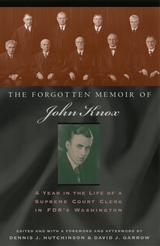
When John Frush Knox (1907-1997) wrote these words, he was in the middle of law school, and his attempt at surpassing Pepys—part scrapbook, part social commentary, and part recollection—had already reached 750 pages. His efforts as a chronicler might have landed in a family attic had he not secured an eminent position after graduation as law clerk to Justice James C. McReynolds—arguably one of the most disagreeable justices to sit on the Supreme Court—during the tumultuous year when President Franklin D. Roosevelt tried to "pack" the Court with justices who would approve his New Deal agenda. Knox's memoir instead emerges as a record of one of the most fascinating periods in American history.
The Forgotten Memoir of John Knox—edited by Dennis J. Hutchinson and David J. Garrow—offers a candid, at times naïve, insider's view of the showdown between Roosevelt and the Court that took place in 1937. At the same time, it marvelously portrays a Washington culture now long gone. Although the new Supreme Court building had been open for a year by the time Knox joined McReynolds' staff, most of the justices continued to work from their homes, each supported by a small staff. Knox, the epitome of the overzealous and officious young man, after landing what he believes to be a dream position, continually fears for his job under the notoriously rude (and nakedly racist) justice. But he soon develops close relationships with the justice's two black servants: Harry Parker, the messenger who does "everything but breathe" for the justice, and Mary Diggs, the maid and cook. Together, they plot and sidestep around their employer's idiosyncrasies to keep the household running while history is made in the Court.
A substantial foreword by Dennis Hutchinson and David Garrow sets the stage, and a gallery of period photos of Knox, McReynolds, and other figures of the time gives life to this engaging account, which like no other recaptures life in Washington, D.C., when it was still a genteel southern town.
Southwest Book Award, Border Regional Library Association, 2008
Association of Latina and Latino Anthropologists Book Award, 2009
Established in 1659 as Misión de Nuestra Señora de Guadalupe de los Mansos del Paso del Norte, Ciudad Juárez is the oldest colonial settlement on the U.S.-Mexico border-and one of the largest industrialized border cities in the world. Since the days of its founding, Juárez has been marked by different forms of conquest and the quest for wealth as an elaborate matrix of gender, class, and ethnic hierarchies struggled for dominance. Juxtaposing the early Spanish invasions of the region with the arrival of late-twentieth-century industrial "conquistadors," Fragmented Lives, Assembled Parts documents the consequences of imperial history through in-depth ethnographic studies of working-class factory life.
By comparing the social and human consequences of recent globalism with the region's pioneer era, Alejandro Lugo demonstrates the ways in which class mobilization is itself constantly being "unmade" at both the international and personal levels for border workers. Both an inside account of maquiladora practices and a rich social history, this is an interdisciplinary survey of the legacies, tropes, economic systems, and gender-based inequalities reflected in a unique cultural landscape. Through a framework of theoretical conceptualizations applied to a range of facets—from multiracial "mestizo" populations to the notions of border "crossings" and "inspections," as well as the recent brutal killings of working-class women in Ciudad Juárez—Fragmented Lives, Assembled Parts provides a critical understanding of the effect of transnational corporations on contemporary Mexico, calling for official recognition of the desperate need for improved working and living conditions within this community.
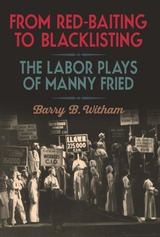
Author Barry B. Witham reclaims the work of Manny Fried, an essential American playwright so thoroughly blacklisted after he defied the House Committee on Un-American Activities in 1954, and again in 1964, that his work all but completely disappeared from the canon. Witham details Manny Fried’s work inside and outside the theatre and examines his three major labor plays and the political climate that both nurtured and disparaged their productions. Drawing on never-before-published interview materials, Witham reveals the details of how the United States government worked to ruin Fried’s career.
From Red-Baiting to Blacklisting includes the complete text of Fried’s major labor plays, all long out of print. In Elegy for Stanley Gorski, Fried depicts one of the many red-baiting campaigns that threatened countless unions in the wake of the Taft-Hartley Act and the collusion of the Catholic Church with these activities. In Drop Hammer, Fried tackles the issues of union dues, misappropriation, and potential criminal activities. In the third play, The Dodo Bird, perhaps his most popular, Fried achieves a remarkable character study of a man outsourced from his job by technology and plant closures.
Manny Fried’s plays portray the hard edges of capitalism and government power and illuminate present-day struggles with hostility to labor unions and the passage in several states of right-to-work laws. Fried had no illusions about the government’s determination to destroy communism and unionism—causes to which he was deeply committed.
READERS
Browse our collection.
PUBLISHERS
See BiblioVault's publisher services.
STUDENT SERVICES
Files for college accessibility offices.
RECENTLY PUBLISHED


UChicago Accessibility Resources
home | accessibility | search | about | contact us
BiblioVault ® 2001 - 2024
The University of Chicago Press