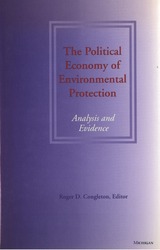
Political Economy of Environmental Protection
Analysis and Evidence
Roger D. Congleton, Editor
University of Michigan Press, 1996
Underlying all the contributions to this volume is the understanding that both political and economic considerations affect environmental outcomes. Political decisions largely determine the feasible uses of natural resources by defining and enforcing fundamental property rights and entitlements over matters with environmental consequences. By determining the rules of the game, political decisions determine the extent to which humanity is empowered to transform the world, the processes used, and the waste products remaining. Environmental policies and thereby environmental outcomes emerge from a complex political process that accommodates a variety of conflicting interests. The essays in this volume examine the links between politics and economic interdependencies, using the modern tools of economics and public choice. Each essay develops a balanced and generally positive analysis of a particular environmental policy area ranging from international treaties on global warming to EPA regulations regarding pesticide usage. Contributors use a variety of mathematical and statistical methods to examine policy formation in such policy areas as global warming, wildlife management, undersea oil rights, and the location of NIMBYs. The volume will be of interest to those who study environmental policy from the perspectives of economics, political science, public policy, and environmental studies.
[more]