
 A SCHOLARLY BOOK REPOSITORY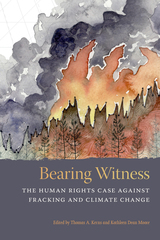
On May 14, 2018, a respected international human-rights court, the Rome-based Permanent Peoples’ Tribunal, began a week-long hearing on the impacts of fracking and climate change on human and Earth rights. In its advisory opinion, the Tribunal ruled that fracking systematically violates substantive and procedural human rights; that governments are complicit in the rights violations; and that to protect human rights and the climate, the practice of fracking should be banned.
The case makes history. It revokes the social license of extreme-extraction industries by connecting environmental destruction to human-rights violations. It affirms that climate change, and the extraction techniques that fuel it, directly violate deeply and broadly accepted moral norms encoded in the Universal Declaration of Human Rights.
Bearing Witness maps a promising new direction in the ongoing struggle to protect the planet from climate chaos. It tells the story of this landmark case through carefully curated court materials, including searing eye-witness testimony, groundbreaking legal testimony, and the Tribunal’s advisory opinion. Essays by leading climate writers such as Winona LaDuke, Robin Wall Kimmerer, and Sandra Steingraber and legal experts such as John Knox, Mary Wood, and Anna Grear give context to the controversy. Framing essays by the editors, experts on climate ethics and human rights, demonstrate that a human-rights focus is a powerful, transformative new tool to address the climate crisis.
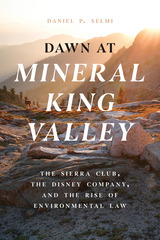
In our current age of climate change–induced panic, it’s hard to imagine a time when private groups were not actively enforcing environmental protection laws in the courts. It wasn’t until 1972, however, that a David and Goliath–esque Supreme Court showdown involving the Sierra Club and Disney set a revolutionary legal precedent for the era of environmental activism we live in today.
Set against the backdrop of the environmental movement that swept the country in the late 1960s and early 1970s, Dawn at Mineral King Valley tells the surprising story of how the US Forest Service, the Disney company, and the Sierra Club each struggled to adapt to the new, rapidly changing political landscape of environmental consciousness in postwar America. Proposed in 1965 and approved by the federal government in 1969, Disney’s vast development plan would have irreversibly altered the practically untouched Mineral King Valley, a magnificently beautiful alpine area in the Sierra Nevada mountains. At first, the plan met with unanimous approval from elected officials, government administrators, and the press—it seemed inevitable that this expanse of wild natural land would be radically changed and turned over to a private corporation. Then the scrappy Sierra Club forcefully pushed back with a lawsuit that ultimately propelled the modern environmental era by allowing interest groups to bring litigation against environmentally destructive projects.
An expert on environmental law and appellate advocacy, Daniel P. Selmi uses his authoritative narrative voice to recount the complete history of this revolutionary legal battle and the ramifications that continue today, almost 50 years later.
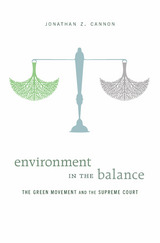
The first Earth Day in 1970 marked environmentalism’s coming-of-age in the United States. More than four decades later, does the green movement remain a transformative force in American life? Presenting a new account from a legal perspective, Environment in the Balance interprets a wide range of U.S. Supreme Court decisions, along with social science research and the literature of the movement, to gauge the practical and cultural impact of environmentalism and its future prospects.
Jonathan Z. Cannon demonstrates that from the 1960s onward, the Court’s rulings on such legal issues as federalism, landowners’ rights, standing, and the scope of regulatory authority have reflected deep-seated cultural differences brought out by the mass movement to protect the environment. In the early years, environmentalists won some important victories, such as the Supreme Court’s 1973 decision allowing them to sue against barriers to recycling. But over time the Court has become more skeptical of their claims and more solicitous of values embodied in private property rights, technological mastery and economic growth, and limited government.
Today, facing the looming threat of global warming, environmentalists struggle to break through a cultural stalemate that threatens their goals. Cannon describes the current ferment in the movement, and chronicles efforts to broaden its cultural appeal while staying connected to its historical roots, and to ideas of nature that have been the source of its distinctive energy and purpose.
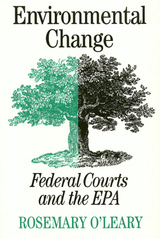
Environmental Change examines the impact of hundreds of federal court decisions on the policies and administration of the EPA since its inception in 1970. Having surveyed over 2,000 federal court decisions, Rosemary O'Leary presents case studies of five important policy areas: water quality, pesticides, toxic substances, air quality, and hazardous wastes.
Compliance with court orders, O'Leary discovered, has become one of the EPA's top priorities, at times overshadowing congressional mandates and the authority of EPA administrators.
For an agency often caught between the White House and Congressional agendas, the competing interests of industry and environmental groups, and turf battles with other federal agencies, O'Leary argues, judicial decision making is crucial in the public policy process.
Environmental Change offers valuable information in the fields of public policy and environmental law.

With Environmental Law for Biologists, ecologist and lawyer Tristan Kimbrell bridges this gap in legal knowledge. Complete with a concise introduction to environmental law and an appendix describing the most important federal and international statutes and treaties discussed, the book is divided into four broad parts: laws that focus on individual species, like invasive species policies, the Endangered Species Act, and international treaties such as CITES; laws that focus on land, from federal public lands to agricultural regulations and urban planning; laws that focus on water, such as the Clean Water Act; and laws that focus on air, such as the Clean Air Act and international measures meant to mitigate global climate change. Written for working biologists and students alike, this book will be a catalyst for both more effective policy and enhanced research, offering hope for the manifold frictions between science and the law.
Scientists and policymakers must work together if solutions to the biodiversity crisis are to be found. Yet all too often, scientific data are unknown or incomprehensible to policymakers, and political realities are not fully appreciated by scientists.
Environmental Policy and Biodiversity addresses that problem by presenting both an overview of important concepts in the field of conservation biology and an examination of the strengths and limitations of the policymaking process. Topics covered include:
- the ethical and scientific bases of conservation biology
- the effectiveness of existing environmental policy in protecting biodiversity
- case studies from California, the Great Lakes region, southern Appalachia, and the Florida panhandle
- an examination of overall environmental policy goals and processes
Law and the Environment: A Multidisciplinary Reader brings together for the first time some of the most important original work on environmental policy by scientists, ecologists, philosophers, historians, economists, and legal scholars. Each of the book's four parts provides a different focus on the nature and scope of environmental problems and attempts to use public policy to address these concerns. Part I examines how ecology, economics, and ethics analyze environmental problems and why they support collective action to respond to them. Part II examines the history and present state of environmental law, from early attempts to engage the government to current debate over the effectiveness of environmental policy. Part III explores the process by which environmental law gets translated into regulatory policy. Part IV considers the future of environmental law at a time when international environmental concerns have become a major force in global diplomacy and international trade agreements.
In drawing together a wide variety of perspectives on these issues, Robert V. Percival and Dorothy C. Alevizatos offer a comprehensive examination of how society has responded to the difficult challenges posed by environmental problems. The selections provide a rich introduction to the complexities of environmental policy disputes.
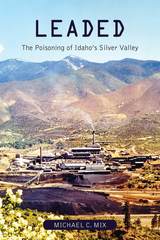
During the first half of the 20th century, industrial mining operations caused severe environmental damage to area waterways and lands from releases of lead and other toxic metals, and sulfur gases. Despite the obvious devastation, no effective federal laws regulating mining and smelting operations were passed until the 1970s, due to the influence of the mine and lead industry in state and federal politics, and scientific uncertainties about pollution effects. Harmful human health effects were evident soon after the smelter opened in 1917, when Bunker Hill workers suffered from lead poisoning, but no federal laws regulating workplace lead were passed until the 1970s.
In 1974, lead smelter emissions from Bunker Hill caused the largest epidemic of childhood lead poisoning in U.S. history. That landmark event ultimately led to the EPA mandating federal air lead standards in 1978 and, at the same time, NIOSH passed national standards reducing occupational lead exposures. Bunker Hill could not meet the new standards; consequently, the company closed in 1981, leaving behind a contaminated geographic area that was classified as the largest Superfund site in the United States in 1983.
Leaded is a deeply researched account of one of the greatest environmental disasters in our history. It belongs on the bookshelf of every student of environmental history, western history, mining history, environmental ethics, and environmental law.

The first listed species to make headlines after the Endangered Species Act was passed in 1973 was the snail darter, a three-inch fish that stood in the way of a massive dam on the Little Tennessee River. When the Supreme Court sided with the darter, Congress changed the rules. The dam was built, the river stopped flowing, and the snail darter went extinct on the Little Tennessee, though it survived in other waterways. A young Al Gore voted for the dam; freshman congressman Newt Gingrich voted for the fish.
A lot has changed since the 1970s, and Joe Roman helps us understand why we should all be happy that this sweeping law is alive and well today. More than a general history of endangered species protection, Listed is a tale of threatened species in the wild—from the whooping crane and North Atlantic right whale to the purple bankclimber, a freshwater mussel tangled up in a water war with Atlanta—and the people working to save them.
Employing methods from the new field of ecological economics, Roman challenges the widely held belief that protecting biodiversity is too costly. And with engaging directness, he explains how preserving biodiversity can help economies and communities thrive. Above all, he shows why the extinction of species matters to us personally—to our health and safety, our prosperity, and our joy in nature.
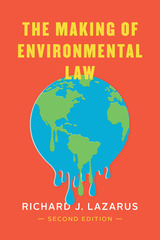
How did environmental law first emerge in the United States? Why has it evolved in the ways that it has? And what are the unique challenges inherent to environmental lawmaking in general and in the United States in particular?
Since its first edition, The Making of Environmental Law has been foundational to our understanding of these questions. For the second edition, Richard J. Lazarus returns to his landmark book and takes stock of developments over the last two decades. Drawing on many years of experience on the frontlines of legal and policy battles, Lazarus provides a theoretical overview of the challenges that environmental protection poses for lawmaking, related to both the distinctive features of US lawmaking institutions and the spatial and temporal dimensions of ecological change. The book explains why environmental law emerged in the manner and form that it did in the 1970s and traces how it developed over sequent decades through key laws and controversies. New chapters, composing more than half of the second edition, examine a host of recent developments. These include how Congress dropped out of environmental lawmaking in the early twenty-first century; the shifting role of the judiciary; long-overdue efforts to provide environmental justice to disadvantaged communities; and the destabilization of environmental law that has resulted from the election of Presidents with dramatically clashing environmental policies.
As the nation’s partisan divide has grown deeper and the challenge of climate change has dramatically raised the perceived stakes for opposing interests, environmental law is facing its greatest challenges yet. This book is essential reading for understanding where we have been and what challenges and opportunities lie ahead.
In The Making of Environmental Law, Richard J. Lazarus offers a new interpretation of the past three decades of this area of the law, examining the legal, political, cultural, and scientific factors that have shaped—and sometimes hindered—the creation of pollution controls and natural resource management laws. He argues that in the future, environmental law must forge a more nuanced understanding of the uncertainties and trade-offs, as well as the better-organized political opposition that currently dominates the federal government. Lazarus is especially well equipped to tell this story, given his active involvement in many of the most significant moments in the history of environmental law as a litigator for the Justice Department's Environment and Natural Resources Division, an assistant to the Solicitor General, and a member of advisory boards of the U.S. Environmental Protection Agency, the World Wildlife Fund, and the Environmental Defense Fund.
Ranging widely in his analysis, Lazarus not only explains why modern environmental law emerged when it did and how it has evolved, but also points to the ambiguities in our current situation. As the field of environmental law "grays" with middle age, Lazarus's discussions of its history, the lessons learned from past legal reforms, and the challenges facing future lawmakers are both timely and invigorating.
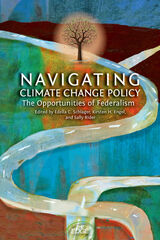
Federalism—the system of government in which power is divided among a national government and state and regional governments—is well-suited to address the challenges of climate change because it permits distinctive policy responses at a variety of scales. The chapters in this book explore questions such as what are appropriate relationships between states, tribes, and the federal government as each actively pursues climate-change policies? How much leeway should states have in designing and implementing climate-change policies, and how extensively should the federal government exercise its preemption powers to constrain state activity? What climate-change strategies are states best suited to pursue, and what role, if any, will regional state-based collaborations and associations play? This book examines these questions from a variety of perspectives, blending legal and policy analyses to provide thought-provoking coverage of how governments in a federal system cooperate, coordinate, and accommodate one another to address this global problem.
Navigating Climate Change Policy is an essential resource for policymakers and judges at all levels of government who deal with questions of climate governance. It will also serve as an important addition to the curriculum on climate change and environmental policy in graduate and undergraduate courses and will be of interest to anyone concerned with how the government addresses environmental issues.
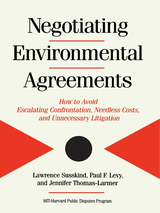
When business leaders, government officials, and other stakeholders come to the table in an environmental, health, or safety dispute, acrimony often results, leading to expensive and time-consuming litigation. Not only does this waste precious resources, but rarely does the process produce the best outcome for any of the parties involved.
For the past five years, the authors of this volume have conducted semi-annual seminars at the Massachussetts Institute of Technology and at Harvard to provide business leaders and regulators with the knowledge and skills they need to more effectively handle environmental, health, and safety negotiations. Their strategy, known as the "mutual gains approach," is a proven method of producing fairer, more efficient, more stable, and wiser results. Negotiating Environmental Agreements provides the first comprehensive introduction to this widely practiced and highly effective approach to environmental regulation.
The book begins with an overview of the mutual gains approach, introducing important concepts and ideas from negotiation theory as well as the theory and practice of mediation. The authors then offer five model negotiations from their MIT-Harvard Public Disputes seminar, followed by a series of real-world negotiated environmental agreements that illustrate the kinds of outcomes possible when the mutual gains approach is employed. A collection of writings by leading experts provide valuable insights into the process, and appendixes offer both instructions for conducting model negotiation sessions and analysis of actual game results from earlier seminars.
This is the only prescriptive text available for the many regulatees and regulators involved in environmental regulatory negotiations each year. Anyone involved with environmental negotiation -- including corporate and public sector managers, students of environmental policy, environmental management, and business management -- will find the book an essential resource.
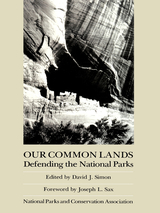
This accessible book explains the complexities of key environmental laws and how they can be used to protect our national parks. It includes discussions of successful and unsuccessful attempts to use the laws and how the courts have interpreted them.

Despite America's pluralistic, fragmented, and generally adversarial political culture, participants in pollution control politics have begun to collaborate to reduce the high costs of developing, implementing, and enforcing regulations. Edward P. Weber uses examples from this traditionally combative policy arena to propose a new model for regulation, "pluralism by the rules," a structured collaborative format that can achieve more effective results at lower costs than typically come from antagonistic approaches.
Weber cites the complexity and high implementation costs of environmental policy as strong but insufficient incentives for collaboration. He shows that cooperation becomes possible when opposing sides agree to follow specific rules that include formal binding agreements about enforcement, commitment to the process by political and bureaucratic leaders, and the ensured access and accountability of all parties involved. Such rules establish trust, create assurances that agreements will be enforced, and reduce the perceived risks of collaboration. Through case studies dealing with acid rain, reformulated gasoline, and oil refinery pollution control, Weber demonstrates the potential of collaboration for realizing a cleaner environment, lower compliance costs, and more effective enforcement.
Challenging the prevailing view that endless conflict in policymaking is inevitable, Pluralism by the Rules establishes a theoretical framework for restructuring the regulatory process.
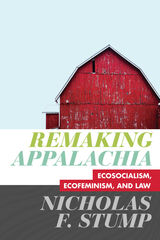
Environmental law has failed spectacularly to protect Appalachia from the ravages of liberal capitalism, and from extractive industries in particular. Remaking Appalachia chronicles such failures, but also puts forth hopeful paths for truly radical change.
Remaking Appalachia begins with an account of how, over a century ago, laws governing environmental and related issues proved fruitless against the rising power of coal and other industries. Key legal regimes were, in fact, explicitly developed to support favored industrial growth. Aided by law, industry succeeded in maximizing profits not just through profound exploitation of Appalachia’s environment but also through subordination along lines of class, gender, and race. After chronicling such failures and those of liberal development strategies in the region, Stump explores true system change beyond law “reform.” Ecofeminism and ecosocialism undergird this discussion, which involves bottom-up approaches to transcending capitalism that are coordinated from local to global scales.
Renewable Resource Policy is a comprehensive volume covering the history, laws, and important national policies that affect renewable resource management. The author traces the history of renewable natural resource policy and management in the United States, describes the major federal agencies and their functions, and examines the evolution of the primary resource policy areas.
The book provides valuable insight into the often neglected legal, administrative, and bureaucratic aspect of natural resource management. It is a definitive and essential source of information covering all facets of renewable resource policy that brings together a remarkable range of information in a coherent, integrated form.
Winner of the Julia Ward Howe Prize
“The gripping story of the most important environmental law case ever decided by the Supreme Court.”
—Scott Turow
“In the tradition of A Civil Action, this book makes a compelling story of the court fight that paved the way for regulating the emissions now overheating the planet. It offers a poignant reminder of how far we’ve come—and how far we still must go.”
—Bill McKibben, author of The End of Nature
On an unseasonably warm October morning, an idealistic young lawyer working on a shoestring budget for an environmental organization no one had heard of hand-delivered a petition to the Environmental Protection Agency, asking it to restrict greenhouse gas emissions from new cars. The Clean Air Act authorized the EPA to regulate “any air pollutant” thought to endanger public health. But could carbon dioxide really be considered a harmful pollutant? And even if the EPA had the authority to regulate emissions, could it be forced to do so?
The Rule of Five tells the dramatic story of how Joe Mendelson and the band of lawyers who joined him carried his case all the way to the Supreme Court. It reveals how accident, infighting, luck, superb lawyering, politics, and the arcane practices of the Supreme Court collided to produce a legal miracle. The final ruling in Massachusetts v. EPA, by a razor-thin 5–4 margin brilliantly crafted by Justice John Paul Stevens, paved the way to important environmental safeguards which the Trump administration fought hard to unravel and many now seek to expand.
“There’s no better book if you want to understand the past, present, and future of environmental litigation.”
—Elizabeth Kolbert, author of The Sixth Extinction
“A riveting story, beautifully told.”
—Foreign Affairs
“Wonderful…A master class in how the Supreme Court works and, more broadly, how major cases navigate through the legal system.”
—Science
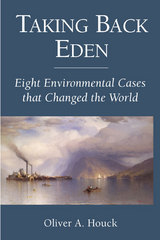
Taking Back Eden is a set of case studies of environmental lawsuits brought in eight countries around the world, including the U.S, beginning in the 1960s. The book conveys what is in fact a revolution in the field of law: ordinary citizens (and lawyers) using their standing as citizens in challenging corporate practices and government policies to change not just the way the environment is defended but the way that the public interest is recognized in law. Oliver Houck, a well-known environmental attorney, professor of law, and extraordinary storyteller, vividly depicts the places protected, as well as the litigants who pursued the cases, their strategies, and the judges and other government officials who ruled on them.
This book will appeal to upperclass undergraduates, graduate students, and to all citizens interested in protecting the environment.

Health, safety, and environmental regulations have been traditionally perceived as distinct entities from trade policy, yet today they have become intertwined on a global scale. In this pioneering work, David Vogel integrates environmental, consumer, and trade policy, and explicitly challenges the conventional wisdom that trade liberalization and agreements to promote free trade invariably undermine national health, safety, and environmental standards. Vogel demonstrates that liberal trade policies often produce precisely the opposite effect: that of strengthening regulatory standards.
The most comprehensive account of trade and regulation on a global scale, this book analyzes the regulatory dimensions of all major international and regional trade agreements and treaties, including GATT, NAFTA, the Free Trade Agreement between Canada and the United States, and the treaties that created the European Community and Union. He explores in depth some of the most important trade and regulatory conflicts, including the GATT tuna-dolphin dispute, the EC's beef hormone ban, the Danish bottle case, and the debate in the United States over the regulatory implications of both NAFTA and GATT.
This timely book unravels the increasingly important and contentious relationship between trade and environmental, health, and safety standards, paying particular attention to the politics that underlie trade and regulatory linkages. Trading Up is essential reading for the business community, policymakers, environmentalists, consumer interest groups, political scientists, lawyers, and economists.
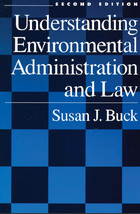
More than any other field of public administration, environmental administration is defined by its legal content. Federal legislation has a direct and immediate impact on state and federal bureaucrats, and citizen groups must constantly adjust to changing standards for environmental protection and regulation.
In Understanding Environmental Administration and Law, Susan J. Buck examines the use of environmental law by exploring the policy process through which such law is made, the political environment in which it is applied, and the statutory and case laws that are critical to working within the regulatory system. The book provides an analytic framework for the legal context of environmental administration and familiarizes readers with the development and implementation of the federal regulatory structure.
A revised and expanded edition of this book was published by Island Press in 1996.
More than any other field of public administration, environmental administration is defined by its legal content. Federal legislation has a direct and immediate impact on state and federal bureaucrats, and citizen groups must constantly adjust to changing standards for environmental protection and regulation.
In Understanding Environmental Administration and Law, Susan J. Buck examines the use of environmental law by exploring the policy process through which such law is made, the political environment in which it is applied, and the statutory and case laws that are critical to working within the regulatory system. The book provides an analytic framework for the legal context of environmental administration and familiarizes readers with the development and implementation of the federal regulatory structure.
A revised and expanded edition of this book was published by Island Press in 1996.
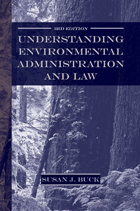
- the Bush Administration and its approach to administering environmental laws
- the continuing evolution of environmentalism and the changing role of environmental regulation in the United States
- the development and implementation of environmental agreements at the international level
- the impacts and implications of globalization
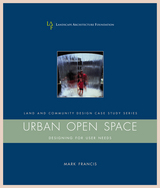
Research has shown that successful public spaces are ones that are responsive to the needs of their users, are democratic in their accessibility, and are meaningful for the larger community and society. While considerable research has been done on needs and conflicts in open space, no one document integrates all this knowledge and makes it available to professionals, students, and researchers.
Based on archival research; published case studies; site visits; and interviews with researchers, open space designers, managers, and users, Urban Open Space looks across several seminal studies to glean significant findings and design implications related to user needs and conflicts. It reviews and identifies those critical user needs that must be considered in the planning, design, and management of outdoor spaces, and synthesizes that knowledge into an accessible and useful document.
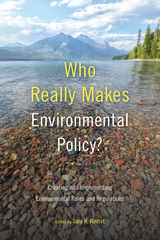
The United States Congress appears to be in perpetual gridlock on environmental policy, notes Sara Rinfret, editor of the significant collection, Who Really Makes Environmental Policy? As she and her contributors explain, however, most environmental policy is not made in the halls of Congress. Instead, it is created by agency experts in federal environmental agencies and it is implemented at the state level. These individuals have been delegated the authority to interpret vague congressional legislation and write rules—and these rules carry the same weight as congressional law.
Who Really Makes Environmental Policy? brings together top scholars to provide an explanation of rulemaking processes and regulatory policy, and to show why this context is important for U.S. environmental policy. Illustrative case studies about oil and gas regulations in Colorado and the regulation of coal ash disposal in southeastern states apply theory to practice. Ultimately, the essays in this volume advance our understanding of how U.S. environmental policy is made and why understanding regulatory policy matters for its future.
READERS
Browse our collection.
PUBLISHERS
See BiblioVault's publisher services.
STUDENT SERVICES
Files for college accessibility offices.
RECENTLY PUBLISHED





UChicago Accessibility Resources
home | accessibility | search | about | contact us
BiblioVault ® 2001 - 2024
The University of Chicago Press