front cover of Arthur Schnitzler in Great Britain
Arthur Schnitzler in Great Britain
An Examination of Power and Translation
Nicole Robertson
University of London Press, 2022
An examination of Austrian writer Arthur Schnitzler’s reception in Great Britain.
 
The “amoral voice” of fin-de-siècle Vienna, Arthur Schnitzler (1862–1931) was one of the major figures of European modernist literature. Throughout his lifetime and after his death, his writing enjoyed substantial domestic and international success, yet the arrival of his dramatic works in Great Britain was plagued by false starts, short runs, and inconsistencies. Only with Tom Stoppard’s adaptations of Das weite Land and Liebelei, as Undiscovered Country and Dalliance respectively, were Schnitzler’s plays finally produced at the National Theatre.

This fascinating book studies the history of Schnitzler’s reception in Great Britain to unearth evidence of power in transcultural and translingual migrations. Surveying the field from the end of the nineteenth century to the present day, Nicole Robertson’s analysis of published translations, critical reviews, correspondence, and unpublished drafts provides expansive insight into the process of translating from page to stage. This book presents exhaustive and detailed scholarship on a fascinating, if far from smooth, journey, raising fundamental questions about the nature of authorship.

[more]

front cover of The Atlantic Divide in Antitrust
The Atlantic Divide in Antitrust
An Examination of US and EU Competition Policy
Daniel J. Gifford and Robert T. Kudrle
University of Chicago Press, 2015
How is it that two broadly similar systems of competition law have reached different results across a number of significant antitrust issues? While the United States and the European Union share a commitment to maintaining competition in the marketplace and employ similar concepts and legal language in making antitrust decisions, differences in social values, political institutions, and legal precedent have inhibited close convergence.
           
With The Atlantic Divide in Antitrust, Daniel J. Gifford and Robert T. Kudrle explore many of the main contested areas of contemporary antitrust, including mergers, price discrimination, predatory pricing, and intellectual property. After identifying how prevailing analyses differ across these areas, they then examine the policy ramifications. Several themes run throughout the book, including differences in the amount of discretion firms have in dealing with purchasers, the weight given to the welfare of various market participants, and whether competition tends to be viewed as an efficiency-generating process or as rivalry. The authors conclude with forecasts and suggestions for how greater compatibility might ultimately be attained.
[more]

logo for Assoc of College & Research Libraries
Creating Leaders
An Examination of Academic and Research Library Leadership Institutes
Irene M. H. Herold
Assoc of College & Research Libraries, 2015

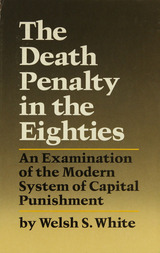
front cover of The Death Penalty in the Eighties
The Death Penalty in the Eighties
An Examination of the Modern System of Capital Punishment
Welsh S. White
University of Michigan Press, 1987
The Death Penalty in the Eighties: An Examination of the Modern System of Capital Punishment by Welsh S. White delivers a probing and accessible analysis of capital punishment in the United States following its reinstatement in 1976. Blending legal scholarship, case studies, and practical insights, White explains the major Supreme Court decisions that have shaped the administration of the death penalty and critically examines whether the modern system has succeeded in reducing the arbitrariness and discrimination of the past.White explores a range of pressing topics within the capital punishment system, including plea bargaining, the intricacies of penalty trials, defendants who choose execution, and the controversial “death-qualified” jury. Throughout, compelling case studies—detailing issues of racial bias, prosecutorial discretion, and the lived experiences of those on death row—offer readers an unflinching look at how the death penalty is applied in practice.Recognized as a leading voice in the field, White meticulously evaluates enduring concerns about fairness and reliability in capital sentencing, the psychological and procedural complexities facing courts and defendants, and the political and public pressures influencing prosecutors and the judiciary. Ultimately, The Death Penalty in the Eighties challenges readers to assess whether reforms have meaningfully improved justice, or whether deep risks of error and inequity remain embedded in the system.A vital resource for legal professionals, policy makers, and anyone interested in the realities of the death penalty in America, this book provides both detailed analysis and an essential historical perspective on one of the nation’s most contentious issues.
[more]

front cover of The Death Penalty in the Nineties
The Death Penalty in the Nineties
An Examination of the Modern System of Capital Punishment
Welsh S. White
University of Michigan Press, 1991
The Death Penalty in the Nineties: An Examination of the Modern System of Capital Punishment by Welsh S. White is a thoroughly updated and incisive assessment of America’s evolving system of capital punishment at the close of the twentieth century. Building on his acclaimed earlier work, White offers readers a clear and in-depth examination of major legal developments, Supreme Court decisions, and practical realities shaping the administration of the death penalty.Addressing dramatic changes in both the law and in patterns of execution, White explores topics such as racial discrimination, plea bargaining, the challenges of presenting mitigating evidence, prosecutorial arguments, and the controversial practice of “death-qualification” of juries. Drawing from interviews with attorneys and close analysis of real cases—such as those of Roosevelt Green and Gary Gilmore—White illuminates how the American justice system works in practice, and exposes the ongoing tensions between fairness, efficiency, public opinion, and political pressure.White’s analysis highlights not only the Supreme Court’s shifting stance—first towards expanding protections for capital defendants and then towards prioritizing expeditious executions and limiting federal review—but also the persistent issues of arbitrariness and error. He critically examines whether modern capital punishment procedures measure up to the standards of justice that a democratic society should demand.Written with clarity and balance, The Death Penalty in the Nineties is essential reading for legal scholars, practitioners, policy makers, and concerned citizens who seek to understand both the letter and the complex reality of the death penalty in the United States.
[more]

front cover of Scrutinizing Feminist Epistemology
Scrutinizing Feminist Epistemology
An Examination of Gender in Science
Pinnick, Cassandra
Rutgers University Press, 2003

This volume presents the first systematic evaluation of a feminist epistemology of sciences’ power to transform both the practice of science and our society. Unlike existing critiques, this book questions the fundamental feminist suggestion that purging science of alleged male biases will advance the cause of both science and by extension, social justice.

The book is divided into four sections: the strange status of feminist epistemology, testing feminist claims about scientific practice, philosophical and political critiques of feminist epistemology, and future prospects of feminist epistemology. Each of the essays¾most of which are original to this text¾ directly confronts the very idea that there could be a feminist epistemology or philosophy of science. Rather than attempting to deal in detail with all of the philosophical views that fall under the general rubric of feminist epistemology, the contributors focus on positions that provide the most influential perspectives on science. Not all of the authors agree amongst themselves, of course, but each submits feminist theories to careful scrutiny. Scrutinizing Feminist Epistemology provides a timely, well-rounded, and much needed examination of the role of gender in scientific research.

[more]


Send via email Share on Facebook Share on Twitter