
 A SCHOLARLY BOOK REPOSITORY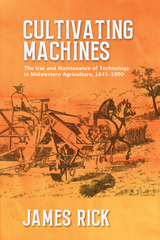
How farmers shaped the development of agricultural machinery
Throughout the second half of the nineteenth century, farmers in the midwestern United States and in Ontario began adopting new agricultural machines: threshers, reapers, and drills for more efficient production of grains, as well as sewing and washing machines for more efficient production within the farm household. By using, maintaining, and altering these machines within the natural and social contexts of their farms, rural people produced new technological systems of industrial agriculture. They also struggled with machine manufacturers and their agents for control of those systems—both individually and through farmers’ organizations. Cultivating Machines contributes to historiographies of capitalism, technology, and agriculture as it demonstrates the importance of everyday know-how and informed tinkering to the mechanization of grain agriculture.
In this study, James Rick moves from the middle decades of the nineteenth century, and the introduction of horse-powered machines, to the end of the century, when mechanized technologies became indispensable and central parts of farms themselves. Ultimately, large-scale wheat production, the increased complexity of machines, the need for replacement parts, and the efforts of manufacturers and their agents to assert themselves as authorities over industrial agriculture diminished the technological independence of farming people.
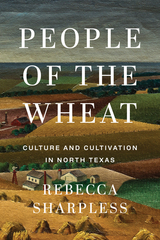
How wheat growing, milling, and baking shaped the people and culture of North Texas.
In the national imaginary, America’s amber fields of grain lie in the country’s center, but for more than a century, they also grew across one pocket of the South: North Texas. From the 1840s to the 1970s, the state's agriculture, dominated in lore by cotton in the east and livestock in the open range, was heavily invested in the cultivation, processing, sale, and consumption of wheat. Recalling a forgotten history, Rebecca Sharpless shows how the rhythms of the wheat harvest—and the evolution of the milling, distribution, and baking industries—governed daily life in what is now known as the Dallas–Fort Worth Metroplex.
In the 1840s, Anglo settlers discovered that grain flourished in North Texas and quickly built an economy that included wheat in fields, mills, and kitchens. After the Civil War, hand labor gave way to mechanization, greatly increasing production. Commercial bakeries churned out novel confections, and big cities were built on the bounty of the countryside. In the second half of the twentieth century, as production moved northward, industrial milling and baking declined, but home baking boomed, flour advertising supported regional music, and wheat fortunes financed the region’s cultural life. Sharpless covers 150 years of wheat’s very human history and shows how the labor that cultivated it, the sustenance it provided, and the prosperity it generated left an indelible mark on the people and institutions of Texas.
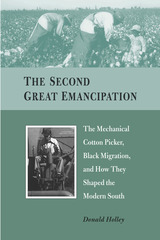
In The Second Great Emancipation, Donald Holley uses statistical and narrative analysis to demonstrate that farm mechanization occurred in the Delta region of Arkansas, Louisiana, and Mississippi after the region’s population of farm laborers moved away for new opportunities. Rather than pushing labor off the land, Holley argues, the mechanical cotton picker enabled the continuation of cotton cultivation in the post-plantation era, opening the door for the civil rights movement, while ushering a period of prosperity into the South.
READERS
Browse our collection.
PUBLISHERS
See BiblioVault's publisher services.
STUDENT SERVICES
Files for college accessibility offices.
RECENTLY PUBLISHED







UChicago Accessibility Resources
home | accessibility | search | about | contact us
BiblioVault ® 2001 - 2026
The University of Chicago Press