
 A SCHOLARLY BOOK REPOSITORY
13 start with I start with I

Based on three years of research on the racial and ethnic priorities of the San Francisco Foundation and the Cleveland Foundation, Shiao demonstrates the geographically uneven impact of the national transition to diversification. The demographics of the regions served by the foundations in San Francisco and Cleveland are quite different, and paradoxically, the foundation in Cleveland—which serves an area with substantially fewer immigrants—has had greater institutional opportunities for implementing diversity policies. Shiao connects these regional histories with the national philanthropic field by underscoring the prominent role of the Ford Foundation, the third largest private foundation in the country, in shaping diversity policies. Identifying Talent, Institutionalizing Diversity reveals philanthropic diversity policy as a lens through which to focus on U.S. race relations and the role of the private sector in racial politics.

Deepening disaffection with conventional public schools has inspired flight to private schools, home schooling, and new alternatives, such as charter schools. Barely a decade old, the charter school movement has attracted a colorful band of supporters, from presidential candidates, to ethnic activists, to the religious Right. At present there are about 1,700 charter schools, with total enrollment estimated to reach one million early in the century. Yet, until now, little has been known about the inner workings of these small, inventive schools that rely on public money but are largely independent of local school boards.
Inside Charter Schools takes readers into six strikingly different schools, from an evangelical home-schooling charter in California to a back-to-basics charter in a black neighborhood in Lansing, Michigan. With a keen eye for human aspirations and dilemmas, the authors provide incisive analysis of the challenges and problems facing this young movement.
Do charter schools really spur innovation, or do they simply exacerbate tribal forms of American pluralism? Inside Charter Schools provides shrewd and illuminating studies of the struggles and achievements of these new schools, and offers practical lessons for educators, scholars, policymakers, and parents.
Institutional Foundations of Public Finance integrates economic and legal perspectives on taxation and fiscal policy, offering a provocative assessment of the most important issues in public finance today.
Part I, an in-depth look at the tax reform debate, examines the differences between an income and a consumption tax and poses significant questions about the systematic transition from one to the other, as well as about its implementation. Part II takes a focused look at a broad range of fiscal topics, including fiscal federalism, corporate finance, and fiscal language. As a whole, the volume reflects a keen interest in analyzing real-world problems, including fiscal regimes and institutions, that have major policy implications.
The studies analyze national fiscal policies within the context of the international economic order. Malcolm D. Knight and Paul R. Masson use an empirical model to show that fiscal changes in recent years in the United States, West Germany, and Japan have caused major disturbances in net savings and investment flows. Linda S. Kole uses a two-country simulation model to examine the effects of a large nation's expansion on exchange rates, interest rates, and the balance of payments. In other studies, Warwick J. McKibbin and Jeffrey D. Sachs discuss the influences of different currency regimes on the international transmission of inflation; Kent P. Kimbrough analyzes the interaction between optimal tax policies and international trade; Sweder van Wijnbergen investigates the interrelation of fiscal policies, trade intervention, and world interest rates; and Willem H. Buiter uses an analytical model to look at fiscal interdependence and optimal policy design. David Backus, Michael Devereux, and Douglas Purvis develop a theoretical model to investigate effects of different fiscal policies in an open economy. Alan C. Stockman looks at the influence of policy anticipation in the private sector, while Lawrence H. Summers shows the effects of differential tax policy on international competitiveness.
With International Bankruptcy, Jodie Adams Kirshner explores the issues involved in determining which courts should have jurisdiction and which laws should apply in addressing problems within. Kirshner brings together theory with the discussion of specific cases and legal developments to explore this developing area of law. Looking at the key issues that arise in cross-border proceedings, International Bankruptcy offers a guide to this legal environment. In addition, she explores how globalization has encouraged the creation of new legal practices that bypass national legal systems, such as the European Insolvency Framework and the Model Law on Cross-Border Insolvency of the United Nations Commission on International Trade Law. The traditional comparative law framework misses the nuances of these dynamics. Ultimately, Kirshner draws both positive and negative lessons about regulatory coordination in the hope of finding cleaner and more productive paths to wind down or rehabilitate failing international companies.
But, as was underscored recently by the economic and financial crises in several Asian countries, capital flows can also bring risks. Although there is no simple explanation of the currency crisis in Asia, it is clear that fixed exchange rates and chronic deficits increased the likelihood of a breakdown. Similarly, during the 1970s, the United States and other industrial countries loaned OPEC surpluses to borrowers in Latin America. But when the U.S. Federal Reserve raised interest rates to control soaring inflation, the result was a widespread debt moratorium in Latin America as many countries throughout the region struggled to pay the high interest on their foreign loans.
International Capital Flows contains recent work by eminent scholars and practitioners on the experience of capital flows to Latin America, Asia, and eastern Europe. These papers discuss the role of banks, equity markets, and foreign direct investment in international capital flows, and the risks that investors and others face with these transactions. By focusing on capital flows' productivity and determinants, and the policy issues they raise, this collection is a valuable resource for economists, policymakers, and financial market participants.
After a guided tour by the editor and a historical exploration, some of the world's leading theorists and policy analysts examine the benefits and pitfalls of capital movements and controls. In the second portion, papers examine the recent experiences of Argentina and Mexico, with Charles Calomiris—whose proposals for a new world financial architecture have elicited wide attention—contributing a response. The volume concludes with a roundtable discussion of the report of the International Financial Institutions Advisory Commission, in which the chair of the commission, Allan H. Meltzer, both comments on the report and responds to questions about it.
The material presented here will become a standard reference for analysts, policymakers, and the interested general public.
Contributors:
Leonardo Auernheimer, Matthew Bishop, Michael D. Bordo, Charles Calomiris, Guillermo A. Calvo, Augustin Carstens, Michael P. Dooley, Pablo E. Guidotti, T. Britton Harris, John P. Lipsky, Guillermo Ortiz Martinez, Allan H. Meltzer, Andrew Powell, Rene Stulz, Carl E. Walsh
College education is one of the most important investments a family will make. But between the viewbooks, websites, insider gossip, and magazine rankings, students and their worried parents face a dizzying array of options. What do the rankings really mean? Is it wise to choose the most prestigious school a student can get into? What are the payoffs of higher education, and, by the way, how do we pay for them?
In a unique approach to these conundrums, an economist and award-winning teacher walks readers through the opportunities, risks, and rewards of heading off to college. Warning against the pitfalls of numerical rankings, Malcolm Getz poses questions to guide a student toward not necessarily the best college but the right one. Famous professors suggest quality--but do they teach undergraduates? Are smaller classes always better? When is a state university the best deal around?
In a concise overview of decades of research, Getz reviews findings on the long-term returns of college education in different careers, from law to engineering, from nursing to financial management. Sorting through personal, professional, and institutional variables, he helps families determine when paying $40,000 a year might make sense, and when it merely buys an expensive rear window decal. He breaks down the formidable admissions game into strategies to improve the odds of acceptance, and he offers tips on tax breaks, subsidized loans, federal grants, 529 accounts, merit scholarships, and much more.
Shrewd and sensible, Investing in College is an invaluable resource and a beacon of sanity for college-bound students and the families who support them.
In 2004, U.S. consumers spent $5.2 billion purchasing bottled water while the government only invested 5 percent of that amount to purchase critical watersheds, parks, and wildlife refuges-systems vital to clean water and healthy environments. How can we reverse the direction of such powerful economic forces?
A group of dedicated business-people-turned-environmental-entrepreneurs is pioneering a new set of tools for land conservation deals and other market-based strategies. These pragmatic visionaries have already used these methods to protect millions of acres of land and to transform the practices of entire industries. They are transforming the very nature of conservation by making it profitable.
Drawing on his vast experience in both business and land conservation at The Nature Conservancy (TNC), William Ginn offers a practical guide to these innovative methods and a road map to the most effective way to implement them. From conservation investment banking, to emerging markets for nature's goods and services, to new tax incentives that encourage companies to do the "right" thing, Ginn goes beyond the theories to present real-world applications and strategies. And, just as importantly, he looks at the lessons learned from what has not worked, including his own failed efforts in Papua New Guinea and TNC's controversial compatible development approach in Virginia. In an era of dwindling public resources and scarce charitable dollars, these tools reveal a new, and perhaps the only, pathway to achieving biodiversity goals and protecting our lands.
Conservation professionals, students of land conservation, and entrepreneurs interested in green business will find Ginn's tales of high-finance deals involving vast tracts of pristine land both informative and exciting. More than just talk, Investing in Nature will teach you how to think big about land conservation.
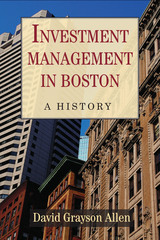
It was not until the twentieth century that Boston became better known for its role in investment management. In 1924, local financiers created the first mutual fund, an innovation almost a century in the making. After World War II, Boston originated venture capital with the founding of American Research & Development. This was soon followed by the development of private equity, the growth of the mutual fund industry, the pension "revolution" that changed and strengthened money management, the evolution in management of institutional endowments, and the rise of new family offices and hedge funds. The contributions of fiduciaries and investment managers have played an important part in the rise of the "New Boston" and made the city one of the most vibrant financial capitals in the world.
Investment Management in Boston is published in association with Massachusetts Historical Society.
In Investment, Profit, and Tenancy Dennis P. Kehoe defines the economic mentality of upper-class Romans by analyzing the assumptions that Roman jurists in the Digest of Justinian made about investment and profit in agriculture as they addressed legal issues involving private property. In particular the author analyzes the duties of guardians in managing the property of their wards, and the bequeathing of agricultural property. He bases his analysis on Roman legal sources, which offer a comprehensive picture of the economic interests of upper-class Romans. Farm tenancy was crucial to these interests, and Kehoe carefully examines how Roman landowners contended with the legal, social, and economic institutions surrounding farm tenancy as they pursued security from their agricultural investments.
Kehoe argues that Roman jurists offer a consistent picture of agriculture as a form of investment that was grounded in upper-class conceptions of the Roman economy. In the eyes of the jurists, agriculture represented the only form of investment capable of providing upper-class Romans with economic security, and this situation had important implications for the relationship between landowners and tenants. Landowners who sought economic stability from their agricultural holdings preferred to simplify the task of managing their estates by delegating the work and costs to their tenants. This tended to make landowners depend on the expertise and resources of tenants, which in turn gave the tenants significant bargaining power. This dynamic relationship is traced in the jurists' regulation of farm tenancy, as the jurists adapted Roman law to the economic realities of the Roman empire.
Investment, Profit, and Tenancy will be of interest to classicists as well as to scholars of preindustrial comparative economics.
Dennis P. Kehoe is Professor of Classical Studies, Tulane University.
The papers in this volume cover such issues as the interaction of pension-funding decisions and corporate finances; the role of pensions in providing adequate and secure retirement income, including the integration of pension plans with social security and significant drops in the U.S. saving rate; and the incentive effects of pension plans on labor market behavior and the implications of plans on labor market behavior and the implications of plans for different demographic groups.
Issues in Pension Economics offers important empirical studies and makes valuable theoretical contributions to current thinking in an area that will most likely continue to be a source of controversy and debate for some time to come. The volume should prove useful to academics and policymakers, as well as to members of the business and labor communities.
READERS
Browse our collection.
PUBLISHERS
See BiblioVault's publisher services.
STUDENT SERVICES
Files for college accessibility offices.
RECENTLY PUBLISHED






UChicago Accessibility Resources
home | accessibility | search | about | contact us
BiblioVault ® 2001 - 2024
The University of Chicago Press