
 A SCHOLARLY BOOK REPOSITORY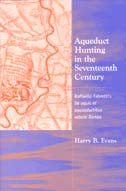
Fabretti's treatise, De aquis et aquaeductibus veteris Romae dissertationes tres, is cited as a matter of course by all later scholars working in the area of Roman topography. Its findings--while updated and supplemented by more recent archaeological efforts--have never been fully superseded. Yet despite its enormous importance and impact on scholarly efforts, the De aquis has never yet been translated from the original Latin. Aqueduct Hunting in the Seventeenth Century provides a full translation of and commentary on Fabretti's writings, making them accessible to a broad audience and carefully assessing their scholarly contributions.
Harry B. Evans offers his reader an introduction to Fabretti and his scholarly world. A complete translation and a commentary that focuses primarily on the topographical problems and Fabretti's contribution to our understanding of them are also provided. Evans also assesses the contributions and corrections of later archaeologists and topographers and places the De aquis in the history of aqueduct studies.
Evans demonstrates that Fabretti's conclusions, while far from definitive, are indeed significant and merit wider attention than they have received to date. This book will appeal to classicists and classical archaeologists, ancient historians, and readers interested in the history of technology, archaeology, and Rome and Italy in the seventeenth century.
Harry B. Evans is Professor of Classics, Fordham University.
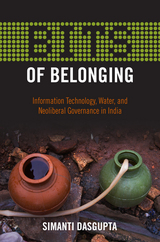
India’s global success in the Information Technology industry has also prompted the growth of neoliberalism and the re-emergence of the middle class in contemporary urban areas, such as Bangalore. In her significant study, BITS of Belonging, Simanti Dasgupta shows that this economic shift produces new forms of social inequality while reinforcing older ones. She investigates this economic disparity by looking at IT and water privatization to explain how these otherwise unrelated domains correspond to our thinking about citizenship, governance, and belonging.
Dasgupta’s ethnographic study shows how work and human processes in the IT industry intertwine to meet the market stipulations of the global economy. Meanwhile, in the recasting of water from a public good to a commodity, the middle class insists on a governance and citizenship model based upon market participation. Dasgupta provides a critical analysis of the grassroots activism involved in a contested water project where different classes lay their divergent claims to the city.
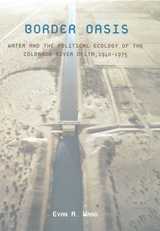
Evan Ward explores the rapid development of this region, examining the ways in which regional politics and international relations created a garden in the Mexicali, Yuma, and Imperial Valleys while simultaneously threatening the life of the Colorado River. Tracing the transformation of the delta by irrigated agribusiness through the twentieth century, he draws on untapped archival resources from both sides of the border to offer a new look at one of the world's most contested landscapes.
Border Oasis tells how two very different nations developed the delta into an agricultural oasis at enormous environmental cost. Focusing on the years 1940 to 1975—including the disastrous salinity crisis of the 1960s and 1970s—it combines Mexican, Native American, and U.S. perspectives to demonstrate that the political and diplomatic influences on the delta played as much a part in the region's transformation as did irrigation. Ward reveals how mistrust among political and economic participants has been fueled by conflict between national and local officials on both sides of the border, by Mexican nationalism, and by a mutual recognition that water is the critical ingredient for regional economic development.
With overemphasis on development in both nations leading to an ecological breaking point, Ward demonstrates that conflicting interests have made sound binational management of the delta nearly impossible. By weaving together all of these threads that have produced the fabric of today's lower Colorado, his study shows that the environmental history of the delta must be understood as a whole, not from the standpoint of only one of many competing interests.
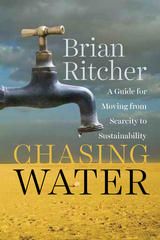
International water expert Brian Richter argues that sustainable water sharing in the twenty-first century can only happen through open, democratic dialogue and local collective action. In Chasing Water, Richter tells a cohesive and complete story of water scarcity: where it is happening, what is causing it, and how it can be addressed. Through his engaging and nontechnical style, he strips away the complexities of water management to its bare essentials, providing information and practical examples that will empower community leaders, activists, and students to develop successful and long-lasting water programs.
Chasing Water will provide local stakeholders with the tools and knowledge they need to take an active role in the watershed-based planning and implementation that are essential for water supplies to remain sustainable in perpetuity.

Precisely because they lived in a midsize, midwestern city, Columbus residents could learn from the earlier experiences of their counterparts in older, larger coastal metropolises, and then go beyond them. Not having large sunk costs in pre-existing water systems, Columbus residents could, for instance, develop new, world-class, state-of-the-art methods for treating water and sewage, steps essential for urban expansion. Columbus, Ohio explores how city residents approached urban challenges—especially economic and environmental ones—and how they solved them.
Columbus, Ohio: Two Centuries of Business and Environmental Change concludes that scholars and policy makers need to pay much more attention to environmental issues in the shaping of cities, and that they need to look more closely at what midwestern metropolises accomplished, as opposed to simply examining coastal cities.
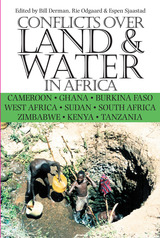
This is an examination of the broader context for the re-emergence of land reform and resource conflicts in Africa. Efforts to change the race based systems of land ownership and land tenure in Namibia, South Africa, and Zimbabwe have pushed land issues to the forefront of social and economic discourses in Africa. This collection examines the broader context for the re-emergence of land reform and resource conflicts.
The case studies examine the links between identity maintenance, tenurial changes, state intervention, and forms and modes of conflict. The authors emphasize the need for a deeper understanding of local histories, cultures, and motivations if efforts to attain a more just distribution of resources are to succeed. The book contributes to a field that has been developing rapidly in the decade since the publication of Melissa Leach and Robin Mearns' collection The Lie of the Land and Mahmood Mamdani's Citizen and Subject. Those two books started a wide ranging discussion of the political reasons for failed development in Africa, as well as the environmental and natural resource dimensions of that failure.
-From the conclusion
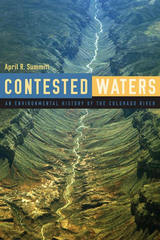
The Colorado River is a vital resource to urban and agricultural communities across the Southwest, providing water to 30 million people. Contested Waters tells the river's story-a story of conquest, control, division, and depletion.
Beginning in prehistory and continuing into the present day, Contested Waters focuses on three important and often overlooked aspects of the river's use: the role of western water law in its over-allocation, the complexity of power relationships surrounding the river, and the concept of sustainable use and how it has been either ignored or applied in recent times. It is organized in two parts, the first addresses the chronological history of the river and long-term issues, while the second examines in more detail four specific topics: metropolitan perceptions, American Indian water rights, US-Mexico relations over the river, and water marketing issues. Creating a complete picture of the evolution of this crucial yet over-utilized resource, this comprehensive summary will fascinate anyone interested in the Colorado River or the environmental history of the Southwest.

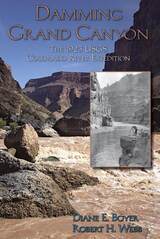
In 1923, America paid close attention, via special radio broadcasts, newspaper headlines, and cover stories in popular magazines, as a government party descended the Colorado to survey Grand Canyon. Fifty years after John Wesley Powell's journey, the canyon still had an aura of mystery and extreme danger. At one point, the party was thought lost in a flood.
Something important besides adventure was going on. Led by Claude Birdseye and including colorful characters such as early river-runner Emery Kolb, popular writer Lewis Freeman, and hydraulic engineer Eugene La Rue, the expedition not only made the first accurate survey of the river gorge but sought to decide the canyon's fate. The primary goal was to determine the best places to dam the Grand. With Boulder Dam not yet built, the USGS, especially La Rue, contested with the Bureau of Reclamation over how best to develop the Colorado River. The survey party played a major role in what was known and thought about Grand Canyon.
The authors weave a narrative from the party's firsthand accounts and frame it with a thorough history of water politics and development and the Colorado River. The recommended dams were not built, but the survey both provided base data that stood the test of time and helped define Grand Canyon in the popular imagination.
Also by Robert Webb: Lee's Ferry

Winner, Book Prize in Latin American Studies, Colonial Section of Latin American Studies Association (LASA), 2016
ALAA Book Award, Association for Latin American Art/Arvey Foundation, 2016
The capital of the Aztec empire, Tenochtitlan, was, in its era, one of the largest cities in the world. Built on an island in the middle of a shallow lake, its population numbered perhaps 150,000, with another 350,000 people in the urban network clustered around the lake shores. In 1521, at the height of Tenochtitlan’s power, which extended over much of Central Mexico, Hernando Cortés and his followers conquered the city. Cortés boasted to King Charles V of Spain that Tenochtitlan was “destroyed and razed to the ground.” But was it?
Drawing on period representations of the city in sculptures, texts, and maps, The Death of Aztec Tenochtitlan, the Life of Mexico City builds a convincing case that this global capital remained, through the sixteenth century, very much an Amerindian city. Barbara E. Mundy foregrounds the role the city’s indigenous peoples, the Nahua, played in shaping Mexico City through the construction of permanent architecture and engagement in ceremonial actions. She demonstrates that the Aztec ruling elites, who retained power even after the conquest, were instrumental in building and then rebuilding the city. Mundy shows how the Nahua entered into mutually advantageous alliances with the Franciscans to maintain the city's sacred nodes. She also focuses on the practical and symbolic role of the city’s extraordinary waterworks—the product of a massive ecological manipulation begun in the fifteenth century—to reveal how the Nahua struggled to maintain control of water resources in early Mexico City.
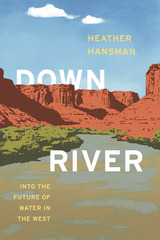
The Green River, the most significant tributary of the Colorado River, runs 730 miles from the glaciers of Wyoming to the desert canyons of Utah. Over its course, it meanders through ranches, cities, national parks, endangered fish habitats, and some of the most significant natural gas fields in the country, as it provides water for 33 million people. Stopped up by dams, slaked off by irrigation, and dried up by cities, the Green is crucial, overused, and at-risk, now more than ever.
Fights over the river’s water, and what’s going to happen to it in the future, are longstanding, intractable, and only getting worse as the West gets hotter and drier and more people depend on the river with each passing year. As a former raft guide and an environmental reporter, Heather Hansman knew these fights were happening, but she felt driven to see them from a different perspective—from the river itself. So she set out on a journey, in a one-person inflatable pack raft, to paddle the river from source to confluence and see what the experience might teach her. Mixing lyrical accounts of quiet paddling through breathtaking beauty with nights spent camping solo and lively discussions with farmers, city officials, and other people met along the way, Downriver is the story of that journey, a foray into the present—and future—of water in the West.
The four works selected (Animal Dreams, The Monkey Wrench Gang, The Grapes of Wrath, and The Ford) present a composite portrait of reclamation, which the author argues is one of the most important cultural and ecological phenomena in the nation's history. The tensions and contradictions presented by the novels underscore the compelling need for an ecocritique of the relationship between literature and politics. David N. Cassuto deciphers the myths of reclamation and restoration and presents a third alternative--sustainability--in their stead. The challenge is a large one, because of the size and complexity of the region and because nature continues to evolve and create itself, a process involving language, ideology, and the land.
The book is designed to be an interdisciplinary contribution both to the emerging field of literature and the environment, as well as to environmental studies. It will be welcomed by scholars as well as general readers interested in new approaches to literature and environmental issues, and by those interested in the geography and literature of the western United States.
David N. Cassuto, formerly of the English Department of the University of Missouri-Rolla, is a practicing attorney in San Francisco, specializing in environmental issues.

Water is in the air we breathe and beneath the ground we walk on. The very substance of life, it makes up as much as 60 percent of the human body. And yet, for one billion people there is such a thing as life without water. These are the people we meet in Dry--those who live in the dry lands of Africa, Asia, the Pacific, and the Americas, eking out an existence at once remarkable and mundane between craggy mountains, near oases, or close to well-springs surrounded by cracked earth or shifting sands.
From the ingenuity of the highland people of Chile's Atacama desert who use giant nets to capture water from clouds of fog, to the ancient wisdom that protects the grazing lands of Kenya's Masai, this beautifully illustrated book tells the diverse stories about people in very hot, very cold, or very high places, who spend their lives collecting, chasing, piping, and trapping the water that life requires--all the while taking great care that no form of life, plant or animal, benefits at the expense of another.
In a world of finite resources, where the struggle for shrinking sources of water intensifies daily, these stories--collected over three years by photographers, writers, and scientists from four continents--are a source of hope and wonder. This book contains a wealth of information and images designed to further awareness of the vast array of life that is carried on precariously yet proudly on the earth's dryest lands.
Seventeen contributors—representing history, geography, ethnography, political science, law, and urban studies—provide an interdisciplinary perspective on the many dimensions of water in the West: Spanish colonial water law, Native American water rights, agricultural concerns, and dam building. A concluding essay looks toward the future by examining the impact of cities on water and of water marketing on the western economy.
As farmers and ranchers from Kansas to California compete for water with powerful urban economies, the West will continue to be reshaped by this scarce and precious resource. Fluid Arguments clearly shows that many of the current disputes over water take place without a real appreciation for the long history of the debate. By shedding new light on how water allocation is established—and who controls it—this book makes a vital contribution to our understanding of water and growth in the region.
CONTENTS
Divining the Past: An Introduction / Char Miller
Part 1. Land and Water on New Spain’s Frontiers
1. "Only Fit for Raising Stock": Spanish and Mexican Land and Water Rights in the Tamaulipan Cession / Jesús F. de la Teja
2. Water, the Gila River Pimas, and the Arrival of the Spanish / Shelly C. Dudley
3. "Between This River and That": Establishing Water Rights in the Chama Basin of New Mexico / Sandra K. Mathews-Lamb
Part 2. The Native American Struggle for Water
4. Maggot Creek and Other Tales: Kiowa Identity and Water, 1870-1920 / Bonnie Lynn-Sherow
5. The Dilemmas of Indian Water Policy, 1887-1928 / Donald J. Pisani
6. First in Time: Tribal Reserved Water Rights and General Adjudications in New Mexico / Alan S. Newell
7. Winters Comes Home to Roost / Daniel McCool
Part 3. Agricultural Conundrums
8. Water, Sun, and Cattle: The Chisholm Trail as an Ephemeral Ecosystem / James E. Sherow
9. Private Irrigation in Colorado’s Grand Valley / Brad F. Raley
10. A Rio Grande "Brew": Agriculture, Industry, and Water Quality in the Lower Rio Grande Valley / John P. Tiefenbacher
11. Specialization and Diversification in the Agricultural System of Southwestern Kansas, 1887-1980 / Thomas C. Schafer
12. John Wesley Powell Was Right: Resizing the Ogallala High Plains / John Opie
Part 4. Dam those Waters!
13. Private Initiative, Public Works: Ed Fletcher, the Santa Fe Railway, and Phoenix’s Cave Creek Flood Control Dam / Donald C. Jackson
14. The Changing Fortunes of the Big Dam Era in the American West / Mark Harvey
15. Building Dams and Damning People in the Texas-Mexico Border Region: Mexico’s El Cuchillo Dam Project / Raúl M. Sánchez
Part 5. The Coming Fight
16. Water and the Western Service Economy: A New Challenge / Hal K. Rothman
Maria Lane’s Fluid Geographies traces New Mexico’s transition from a community-based to an expert-led system of water management during the pre-statehood era. To understand this major shift, Lane carefully examines the primary conflict of the time, which pitted Indigenous and Nuevomexicano communities, with their long-established systems of irrigation management, against Anglo-American settlers, who benefitted from centralized bureaucratic management of water. The newcomers’ system eventually became settled law, but water disputes have continued throughout the district courts of New Mexico’s Rio Grande watershed ever since.
Using a fine-grained analysis of legislative texts and nearly two hundred district court cases, Lane analyzes evolving cultural patterns and attitudes toward water use and management in a pivotal time in New Mexico’s history. Illuminating complex themes for a general audience, Fluid Geographies helps readers understand how settler colonialism constructed a racialized understanding of scientific expertise and legitimized the dispossession of nonwhite communities in New Mexico.
During the nineteenth century, upstream diversions from the Gila River decreased the arable land on the Gila River Indian Reservation to only a few thousand acres. As a result the Pima Indians, primarily an agricultural people, fell into poverty. Many Pima farmers and leaders lamented this suffering and in 1914 the United States Indian Irrigation Service assigned a 33-year-old engineer named Clay “Charles” Southworth to oversee the Gila River adjudication. As part of that process, Southworth interviewed 34 Pima elders, thus putting a face on the depth of hardships facing many Indians in the late nineteenth century.
This interdisciplinary study of Frontinus' work addresses the questions that lie between the lines of his text. How large a work force was required to build an aqueduct, and how did they go about doing it? What did such an undertaking cost, and who was responsible for paying? Who decided which route should be followed? Why did Frontinus feel a need to write this book? Who was his audience?
To date, Frontinus has been subjected to very little critical scrutiny. Deane R. Blackman and A. Trevor Hodge have gathered here a wide range of recognized authorities--in classics, hydraulics engineering, surveying, financing, and the formation of calcium carbonate deposits in the water conduits-- to examine the puzzle Frontinus has left us.
Deane R. Blackman is Associate Professor of Engineering, Monash University. A. Trevor Hodge is Distinguished Research Professor of Classics, Carleton University.
Fuel for Growth describes and interprets the history of water resource development and its relationship to urban development in Arizona's three signature cities: Phoenix, Tucson, and Flagstaff. These three urban areas could hardly be more different: a growth-oriented metropolis, an environmentally conscious city with deep cultural roots, and an outdoor-friendly mountain town. Despite these differences, their community leaders and public officials have taken similar approaches to developing water resources with varying degrees of success and acceptance.
Douglas Kupel has created a new vision of water history based on the Arizona experience. He challenges many of the traditional assumptions of environmental history by revealing that the West's aridity has had relatively little impact on the development of municipal water infrastructure in these cities. While urban growth in the West is often characterized as the product of an elite group of water leaders, the development of Arizona's cities is shown to reflect the broad aspirations of all their citizens.
The book traces water development from the era of private water service to municipal ownership of water utilities and examines the impact of the post-World War II boom and subsequent expansion. Taking in the Salt River Project, the Central Arizona Project, and the Groundwater Management Act of 1980, Kupel explores the ongoing struggle between growth and environmentalism. He advocates public policy measures that can sustain a water future for the state.
As the urban West enters a new century of water management, Arizona's progress will increasingly be tied to that of its ever-expanding cities. Fuel for Growth documents an earlier era of urban water use and provides important recommendations for the future path of water development in the West's key population centers.
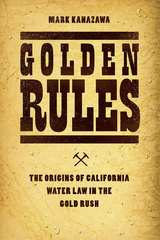
For Golden Rules, Mark Kanazawa draws on previously untapped historical sources to trace the emergence of the current framework for resolving water-rights issues to California in the 1850s, when Gold Rush miners flooded the newly formed state. The need to circumscribe water use on private property in support of broader societal objectives brought to light a number of fundamental issues about how water rights ought to be defined and enforced through a system of laws. Many of these issues reverberate in today’s contentious debates about the relative merits of government and market regulation. By understanding how these laws developed across California’s mining camps and common-law courts, we can also gain a better sense of the challenges associated with adopting new property-rights regimes in the twenty-first century.
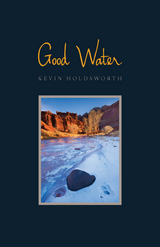
In essays that combine memoir with biography of place, Kevin Holdsworth creates a public history of the land he calls home: Good Water, Utah. The high desert of south-central Utah is at the heart of the stories he tells here—about the people, the “survivors and casualties” of the small, remote town—and is at the heart of his own story.
Holdsworth also explores history at a personal level: how Native American history is preserved by local park officials; how Mormon settlers adapted to remote, rugged places; how small communities attract and retain those less likely to thrive closer to population centers; and how he became involved in local politics. He confronts the issues of land use and misuse in the West, from the lack of water to greed and corruption over natural resources, but also considers life’s simple pleasures like the value of scenery and the importance of occasionally tossing a horseshoe.
Good Water’s depiction of modern-day Utah and exploration of friendships and bonding on the Western landscape will fascinate and entice readers in the West and beyond.
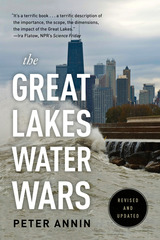
Journalist Peter Annin delves deeply into the fraught history of water use in the Great Lakes region and recaps the story of the Chicago River diversion, which reversed the flow of the river, fundamentally transforming the Great Lakes ecosystem. A century later it remains “the poster child of bad behavior in the Great Lakes.” Today, with growing communities and a warming climate, tensions over water use are high, and controversies on the perimeter of the Great Lakes Basin are on the rise. In this new and expanded edition of The Great Lakes Water Wars, Annin shares the stories of New Berlin and Waukesha, two Wisconsin communities straddling the Basin boundary whose recent legal battles have tested the legislative strength of the newly signed Compact. Annin devotes a new chapter to the volatile issue of the invasive Asian carp—a voracious species that reproduces at a disturbing rate—which is transforming the ecology of the river as it makes its way through the Chicago River diversion and ever closer to Lake Michigan.
With three new chapters and significant revisions to existing chapters that bring the story up-to-date over the past decade, this is the definitive behind-the-scenes account of the people and stories behind hard-fought battles to protect this precious resource that makes the region so special for the millions who call it home.
Hydraulic Societies explores the linked themes of water, power, state-building, and hydraulic control. Bringing together a range of ecological, geographical, chronological, and methodological perspectives, the essays in this book address the how humans have long harnessed water and sought to contain its destructive power for political, economic and social ends. Water defines every aspect of life and remains at the center of human activity: in irrigation and agriculture; waste and sanitation; drinking and disease; floods and droughts; religious beliefs and practices; fishing and aquaculture; travel and discovery; scientific study; water pollution and conservation; multi-purpose dam building; boundaries and borders; politics and economic life; and wars and diplomacy.
From the earliest large irrigation works thousands of years ago, control over water has involved control over people, as the essays in this volume reflect. The intersections of water and political, economic, and social power historically span international as well as domestic politics and operate at scales ranging from the local to the global. The authors consider the role of water in national development schemes, water distribution as a tool of political power, international disputes over waterways and water supplies, and the place of water in armed conflicts. They explore the ways in which political power and social hierarchies have themselves been defined and redefined by water and its control, how state leaders legitimized their rule both culturally and economically through the control of water, and how water management schemes were a means to impose and refine colonial power.
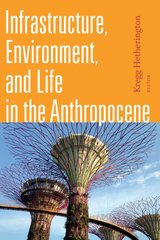
Contributors. Nikhil Anand, Andrea Ballestero, Bruce Braun, Ashley Carse, Gastón R. Gordillo, Kregg Hetherington, Casper Bruun Jensen, Joseph Masco, Shaylih Muehlmann, Natasha Myers, Stephanie Wakefield, Austin Zeiderman
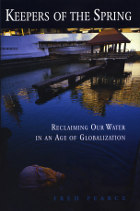
Water has long been the object of political ambition and conflict. Recent history is full of leaders who tried to harness water to realize national dreams. Yet the people who most need water-farmers, rural villages, impoverished communities-are too often left, paradoxically, with desiccated fields, unfulfilled promises, and refugee status.
It doesn't have to be this way, according to Fred Pearce. A veteran science news correspondent, Pearce has for over fifteen years chronicled the development of large-scale water projects like China's vast Three Gorges dam and India's Sardar Sarovar. But, as he and numerous other authors have pointed out, far from solving our water problems, these industrial scale projects, and others now in the planning, are bringing us to the brink of a global water crisis.
Pearce decided there had to be a better way.
To find it, he traveled the globe in search of alternatives to mega-engineering projects. In Keepers of the Spring, he brings back intriguing stories from people like Yannis Mitsis, an ethnic Greek Cypriot, who is the last in his line to know the ways and whereabouts of a network of underground tunnels that have for centuries delivered to farming communities the water they need to survive on an arid landscape. He recounts the inspiring experiences of small-scale water stewards like Kenyan Jane Ngei, who reclaimed for her people a land abandoned by her government as a wasteland. And he tells of many others who are developing new techniques and rediscovering ancient ones to capture water for themselves.
In so doing, Pearce documents that these "keepers" are not merely isolated examples, but collectively constitute an entire alternative tradition of working with natural flows rather than trying to reengineer nature to provide water for human needs.
The solution to our water problems, he finds, may not lie in new technologies-though they will play a role-but in recovering ancient traditions, using water more efficiently, and better understanding local hydrology. Are these approaches adequate to serve the world's growing populations? The answer remains unclear. But we ignore them at our own peril.
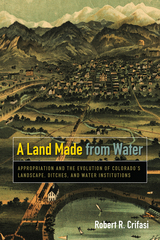
A Land Made from Water chronicles how the appropriation and development of water and riparian resources in Colorado changed the face of the Front Range—an area that was once a desert and is now an irrigated oasis suitable for the habitation and support of millions of people. This comprehensive history of human intervention in the Boulder Creek and Lefthand Creek valleys explores the complex interactions between environmental and historical factors to show how thoroughly the environment along the Front Range is a product of human influence.
Author Robert Crifasi examines the events that took place in nineteenth-century Boulder County, Colorado, and set the stage for much of the water development that occurred throughout Colorado and the American West over the following century. Settlers planned and constructed ditches, irrigation systems, and reservoirs; initiated the seminal court decisions establishing the appropriation doctrine; and instigated war to wrest control of the region from the local Native American population. Additionally, Crifasi places these river valleys in the context of a continent-wide historical perspective.
By examining the complex interaction of people and the environment over time, A Land Made from Water links contemporary issues facing Front Range water users to the historical evolution of the current water management system and demonstrates the critical role people have played in creating ecosystems that are often presented to the public as “natural” or “native.” It will appeal to students, scholars, professionals, and general readers interested in water history, water management, water law, environmental management, political ecology, or local natural history.
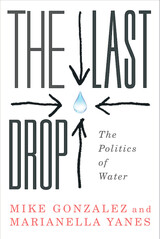
This book looks at how we got here and what we can and should do next. Laying out the complex arguments surrounding water, its ownership and access to it, Mike Gonzalez and Marianella Yanes make the technical and scientific aspects of the discussion clear and accessible—and thereby enable themselves to make the political questions more urgent. Pushing back against the market fundamentalists, the authors argue that it is both possible and necessary that considerations of equity and social justice prevail in the debates about water. Powerful and polemical, The Last Drop will be a vital resource for water activists worldwide.
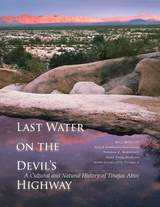
Now an expert cast of authors describes, narrates, and explains the human and natural history of this special place in a thorough and readable account. Addressing the latest archaeological and historical findings, they reveal why Tinajas Altas was so important and how it related to other waterholes in the arid borderlands. Readers can feel like pioneers, following in the footsteps of early Native Americans, Spanish priests and soldiers, gold seekers and borderland explorers, tourists, and scholars.
Combining authoritative writing with a rich array of more than 180 illustrations and maps as well as detailed appendixes providing up-to-date information on the wildlife and plants that live in the area, Last Water on the Devil’s Highway allows readers to uncover the secrets of this fascinating place, revealing why it still attracts intrepid tourists and campers today.
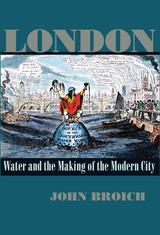
As people crowded into British cities in the nineteenth century, industrial and biological waste byproducts and then epidemic followed. Britons died by the thousands in recurring plagues. Figures like Edwin Chadwick and John Snow pleaded for measures that could save lives and preserve the social fabric.
The solution that prevailed was the novel idea that British towns must build public water supplies, replacing private companies. But the idea was not an obvious or inevitable one. Those who promoted new waterworks argued that they could use water to realize a new kind of British society—a productive social machine, a new moral community, and a modern civilization. They did not merely cite the dangers of epidemic or scarcity. Despite many debates and conflicts, this vision won out—in town after town, from Birmingham to Liverpool to Edinburgh, authorities gained new powers to execute municipal water systems.
But in London local government responded to environmental pressures with a plan intended to help remake the metropolis into a collectivist society. The Conservative national government, in turn, sought to impose a water administration over the region that would achieve its own competing political and social goals. The contestants over London’s water supply matched divergent strategies for administering London’s water with contending visions of modern society. And the matter was never pedestrian. The struggle over these visions was joined by some of the most colorful figures of the late Victorian period, including John Burns, Lord Salisbury, Bernard Shaw, and Sidney and Beatrice Webb.
As Broich demonstrates, the debate over how to supply London with water came to a head when the climate itself forced the endgame near the end of the nineteenth century. At that decisive moment, the Conservative party succeeded in dictating the relationship between water, power, and society in London for many decades to come.
“Never before has the case been more compellingly made that America’s dependence on a free and abundant water supply has become an illusion. Cynthia Barnett does it by telling us the stories of the amazing personalities behind our water wars, the stunning contradictions that allow the wettest state to have the most watered lawns, and the thorough research that makes her conclusions inescapable. Barnett has established herself as one of Florida’s best journalists and Mirage is a must-read for anyone who cares about the future of the state.”
—Mary Ellen Klas, Capital Bureau Chief, Miami Herald
“Mirage is the finest general study to date of the freshwater-supply crisis in Florida. Well-meaning villains abound in Cynthia Barnett’s story, but so too do heroes, such as Arthur R. Marshall Jr., Nathaniel Reed, and Marjorie Harris Carr. The author’s research is as thorough as her prose is graceful. Drinking water is the new oil. Get used to it.”
—Michael Gannon, Distinguished Professor of history, University of Florida, and author of Florida: A Short History
“With lively prose and a journalist’s eye for a good story, Cynthia Barnett offers a sobering account of water scarcity problems facing Florida—one of our wettest states—and the rest of the East Coast. Drawing on lessons learned from the American West, Mirage uses the lens of cultural attitudes about water use and misuse to plead for reform. Sure to engage and fascinate as it informs.”
—Robert Glennon, Morris K. Udall Professor of Law and Public Policy, University of Arizona, and author of Water Follies: Groundwater Pumping and the Fate of America’s Fresh Waters
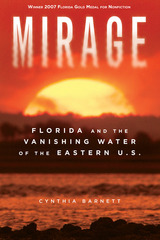
Part investigative journalism, part environmental history, Mirage reveals how the eastern half of the nation—historically so wet that early settlers predicted it would never even need irrigation—has squandered so much of its abundant freshwater that it now faces shortages and conflicts once unique to the arid West.
Florida’s parched swamps and supersized residential developments set the stage in the first book to call attention to the steady disappearance of freshwater in the American East, from water-diversion threats in the Great Lakes to tapped-out freshwater aquifers along the Atlantic seaboard.
Told through a colorful cast of characters including Walt Disney, Jeb Bush and Texas oilman Boone Pickens, Mirage ferries the reader through the key water-supply issues facing America and the globe: water wars, the politics of development, inequities in the price of water, the bottled-water industry, privatization, and new-water-supply schemes.
From its calamitous opening scene of a sinkhole swallowing a house in Florida to its concluding meditation on the relationship between water and the American character, Mirage is a compelling and timely portrait of the use and abuse of freshwater in an era of rapidly vanishing natural resources.
In contrast to this fantasy of abundance, Sevigny explores acts of restoration. From a dismantled dam in Arizona to an accidental wetland in Mexico, she examines how ecologists, engineers, politicians, and citizens have attempted to secure water for desert ecosystems. In a place scarred by conflict, she shows how recognizing the rights of rivers is a path toward water security. Ultimately, Sevigny writes a new map for the future of the American Southwest, a vision of a society that accepts the desert’s limits in exchange for an intimate relationship with the natural world.
Over the past 300 years, settlement patterns, geography, and climate have greatly affected the ecology of the south Texas landscape. Drawing on a variety of interests and perspectives, the contributors to <I>On the Border</I> probe these evolving relationships in and around San Antonio, the country’s ninth-largest city.
Spanish, Mexican, and American settlers required open expanses of land for agriculture and ranching, displacing indigenous inhabitants. The high poverty traditionally felt by many residents, combined with San Antonio’s environment, has contributed to the development of the city’s unusually complex public health dilemmas. The national drive to preserve historic landmarks and landscapes has been complicated by the blight of homogenous urban sprawl. But no issue has been more contentious than that of water, particularly in a city entirely dependent on a single aquifer in a region of little rain. Managing these environmental concerns is the chief problem facing the city in the new century.
This volume focuses on women in Latin America as stakeholders in water resources management. It makes their contributions to grassroots efforts more visible, explains why doing so is essential for effective public policy and planning in the water sector, and provides guidelines for future planning and project implementation.
After an in-depth review of gender and water management policies and issues in relation to domestic usage, irrigation, and sustainable development, the book provides a series of case studies prepared by an interdisciplinary group of scholars and activists. Covering countries throughout the hemisphere, and moving freely from impoverished neighborhoods to the conference rooms of international agencies, the book explores the various ways in which women are-and are not-involved in local water initiatives across Latin America. Insightful analyses reveal what these case studies imply for the success or failure of various regional efforts to improve water accessibility and usability, and suggest new ways of thinking about gender and the environment in the context of specific policies and practices.
Holocaust denial can be viewed as another form of hatred against the Jews and preventing it can be understood as a form of warding off hate speech. Germany has made it a crime punishable by law. Other European countries have similar laws. While the rationale for such laws seems reasonable, Lewy asks readers to look again and to consider carefully the dangers that these laws could present. His discussion neither dismisses the ramifications of genocide denial nor justifies it; he instead looks closely at the possible risks of government-enforced interpretations of history.
Outlawing genocide denial sets a precedent of allowing governments to dictate historical truth and how events should be interpreted. Such government restrictions can be counterproductive in a democratic society which values freedom of speech. Lewy examines these and related ideas through the analysis of historical and current examples. He posits his own conclusion but leaves it up to readers to view the evidence and arguments and form their own opinions.
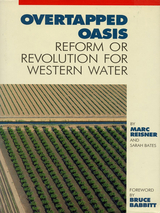
Overtapped Oasis analyzes the West's water allocation system from top to bottom and offers dozens of revolutionary proposals for increased efficiency and policy reform. Marc Reisner and Sarah Bates argue that the West's underlying problem is not a shortage of water but the inefficient use of it, a problem caused by a bewildering tangle of federal subsidy programs, restrictive state water codes, anachronistic irrigation practices and -- perhaps most important -- resistance to reform.
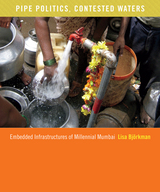
Despite Mumbai's position as India's financial, economic, and cultural capital, water is chronically unavailable for rich and poor alike. Mumbai's dry taps are puzzling, given that the city does not lack for either water or financial resources. In Pipe Politics, Contested Waters, Lisa Björkman shows how an elite dream to transform Mumbai into a "world class" business center has wreaked havoc on the city’s water pipes. In rich ethnographic detail, Pipe Politics explores how the everyday work of getting water animates and inhabits a penumbra of infrastructural activity—of business, brokerage, secondary markets, and sociopolitical networks—whose workings are reconfiguring and rescaling political authority in the city. Mumbai’s increasingly illegible and volatile hydrologies, Björkman argues, are lending infrastructures increasing political salience just as actual control over pipes and flows becomes contingent on dispersed and intimate assemblages of knowledge, power, and material authority. These new arenas of contestation reveal the illusory and precarious nature of the project to remake Mumbai in the image of Shanghai or Singapore and gesture instead toward the highly contested futures and democratic possibilities of the actually existing city.
Monterrey is Mexico’s second most important industrial city, emerging in this era of free trade as a cornerstone of Mexico’s economic development. But development has been uneven and has taken a toll: As recently as the early 1980s, nearly a quarter of the city’s almost three million inhabitants did not have running water in their homes. At the same time, heavy industry - especially steel, iron, chemical, and paper works - were major users of water in their production processes.
Extensive industrialization coupled with a lack of infrastructure development astonishing in a major industrial city raises serious questions about the process of planning urban services in Mexico. Bennett uses the water crisis of the 1980s as a lens through which to reveal this planning process and the provision of public services in Monterrey. She finds three groups who were central to the evolution of the city’s water system: federal and state government leaders, the regional private sector elite (the Grupo Monterrey), and women living in the low-income neighborhoods of the city.
Bennett unravels the politics of water in Monterrey by following three threads of inquiry. First, she examines the water services themselves - what was built, when, why, and who paid for them. She then reveals the response of poor women to the water crisis, analyzing who participated in protests, the strategies they used, and how the government responded. And, finally, she considers the dynamics of planning water services for the private sector and the government in investment and management. In the end, Monterrey’s water services improved because power relations shifted and because poor women in Monterrey used protests to make national news out of the city’s water crisis.
The Politics of Water makes a significant contribution to the emerging scholarship on regional politics in Mexico and to a deeper understanding of the Monterrey region in particular. Until recently, most scholarly writing on Mexico spoke of the national political system as a monolithic whole. Scholars such as Vivienne Bennett are now recognizing the power of local citizens and the significant differences among regions when it comes to politics, policy making, and governmental investment decisions.
As an essential resource, water has been the object of warfare, political wrangling, and individual and corporate abuse. It has also become an object of commodification, with multinational corporations vying for water supply contracts in many countries. In Precious Commodity, Martin V. Melosi examines water resources in the United States and addresses whether access to water is an inalienable right of citizens, and if government is responsible for its distribution as a public good.
Melosi provides historical background on the construction, administration, and adaptability of water supply and wastewater systems in urban America. He cites budgetary constraints and the deterioration of existing water infrastructures as factors leading many municipalities to seriously consider the privatization of their water supply. Melosi also views the role of government in the management of, development of, and legal jurisdiction over America’s rivers and waterways for hydroelectric power, flood control, irrigation, and transportation access. Looking to the future, he compares the costs and benefits of public versus private water supply, examining the global movement toward privatization.
Precolumbian Water Management examines water management from both economic and symbolic perspectives. Water management facilities, settlement patterns, shrines, and water-related imagery associated with civic-ceremonial and residential architecture provide evidence that water systems pervade all aspects of ancient society. Through analysis of such data, the contributors seek to combine an understanding of imagery and the religious aspects of water with its functional components, thereby presenting a unified perspective of how water was conceived, used, and represented in ancient greater Mesoamerica. The collection boasts broad chronological and geographical coverage—from the irrigation networks of Teotihuacan to the use of ritual water technology at Casas Grandes—that shows how procurement and storage systems were adapted to local conditions.
The articles consider the mechanisms that were used to build upon the sacredness of water to enhance political authority through time and space and show that water was not merely an essential natural resource but an important spiritual one as well, and that its manipulation was socially far more complex than might appear at first glance. As these papers reveal, an understanding of materials associated with water can contribute much to the ways that archaeologists study ancient cultural systems. Precolumbian Water Management underscores the importance of water management research and the need to include it in archaeological projects of all types.
"Remarkable." —New York Times Book Review
"Clear-eyed treatise...Postel makes her case eloquently." —Booklist, starred review
"An informative, purposeful argument." —Kirkus
We have disrupted the natural water cycle for centuries in an effort to control water for our own prosperity. Yet every year, recovery from droughts and floods costs billions of dollars, and we spend billions more on dams, diversions, levees, and other feats of engineering. These massive projects not only are risky financially and environmentally, they often threaten social and political stability. What if the answer was not further control of the water cycle, but repair and replenishment?
Sandra Postel takes readers around the world to explore water projects that work with, rather than against, nature’s rhythms. In New Mexico, forest rehabilitation is safeguarding drinking water; along the Mississippi River, farmers are planting cover crops to reduce polluted runoff; and in China, “sponge cities” are capturing rainwater to curb urban flooding.
Efforts like these will be essential as climate change disrupts both weather patterns and the models on which we base our infrastructure. We will be forced to adapt. The question is whether we will continue to fight the water cycle or recognize our place in it and take advantage of the inherent services nature offers. Water, Postel writes, is a gift, the source of life itself. How will we use this greatest of gifts?
The movement to implement market-based approaches to allocating water is gaining ground across California and in other western states. Proponents argue that markets offer an efficient and cost-effective means of promoting conservation -- those who need water would pay for it on the open market, while others would conserve rather than pay increased prices.
Rivers of Gold takes a new look at California's water-reallocation challenge. The author explains the concept of water markets and the economic theory undergirding them. He shows how some water markets have worked -- and others have failed -- and gives the reader the analytic tools necessary to understand why. The book:
- provides an overview of water-supply issues in California
- compares the situation in California with that of other western states
- considers the different property rights regimes governing current use and their fit with water market institutions
- explains how water markets would work and their benefits and drawbacks as an allocation mechanism
- presents a series of case studies of water markets currently in effect in California
- offers a list of principles for water market design
Rivers of Gold offers a balanced understanding of both the role that markets can play in reallocating water and the limitations of the market mechanism. In the end, the author offers a comprehensive assessment of the institutional design features that any water market should incorporate if it is to reallocate water effectively, in California or in any other region where water is scarce.
Rivers of Gold is the first book to provide a detailed examination of water markets and the institutional design issues associated with them. It is the only book available that presents in-depth case studies of actual water-market transactions, and will be essential reading for water resource professionals and resource economists, as well as for students and scholars of environmental policy, environmental economics, and resource economics.
Arguing that the science of the early twentieth century can shed new light on the mistakes at the heart of the over-allocation of the Colorado River, authors Eric Kuhn and John Fleck delve into rarely reported early studies, showing that scientists warned as early as the 1920s that there was not enough water for the farms and cities boosters wanted to build. Contrary to a common myth that the authors of the Colorado River Compact did the best they could with limited information, Kuhn and Fleck show that development boosters selectively chose the information needed to support their dreams, ignoring inconvenient science that suggested a more cautious approach.
Today water managers are struggling to come to terms with the mistakes of the past. Focused on both science and policy, Kuhn and Fleck unravel the tangled web that has constructed the current crisis. With key decisions being made now, including negotiations for rules governing how the Colorado River water will be used after 2026, Science Be Dammed offers a clear-eyed path forward by looking back.
Understanding how mistakes were made is crucial to understanding our contemporary problems. Science Be Dammed offers important lessons in the age of climate change about the necessity of seeking out the best science to support the decisions we make.
Science Magazine's State of the Planet 2006-2007 is a unique contribution that brings together leading environmental scientists and researchers to give readers a comprehensive yet accessible overview of current issues. Included are explanatory essays from Science magazine editor-in-chief Donald Kennedy that tie together the issues and explore the relationships among them. Each of the book's 18 chapters is written by the world's leading experts, such as:
Joel Cohen on population
Peter Gleick on water
Daniel Pauly on fisheries
Thomas Karl on climate change science
Paul Portney on energy and development
Elinor Ostrom and Thomas Dietz on commons management
Interspersed throughout are Science news pieces that highlight particular issues and cases relevant to the main scientific findings. An added feature is the inclusion of definitions of key terms and concepts that help students and nonspecialists understand the issues. Published biennially, State of the Planet is a clear, accessible guide for readers of all levels-from students to professionals.
To the uninitiated, water policy seems a complicated, hypertechnical, and incomprehensible subject: a tangle of engineering jargon and legalese surrounding a complex, delicate, and interrelated structure. Decisions concerning the public's waters involve scant public participation, and in such a context, reform seems risky at best.
Searching Out the Headwaters addresses that precarious situation by providing a thorough and straightforward analysis of western water use and the outmoded rules that govern it. The authors begin by tracing the history and evolution of the uses of western water. They describe the demographic and economic changes now occurring in the region, and identify the many communities of interest involved in all water-use issues. After an examination of the central precepts of current water policy, along with their original rationale and subsequent evolution, they consider the reform movement that has recently begun to emerge. In the end, the authors articulate the foundations for a water policy that can meet the needs of the new West and discuss the various means for effectively implementing such a policy, including market economics, regulation, the broad-based use of scientific knowledge, and open and full public participation.
Tim Palmer weaves natural history into a comprehensive account of the complex problems that plague natural resource management throughout the West, as well as the practical solutions that are available.
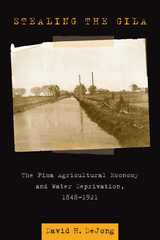
This economic vitality did not last, however. As immigrants settled upstream from the Pima villages, they deprived the Indians of the water they needed to sustain their economy. DeJong traces federal, territorial, and state policies that ignored Pima water rights even though some policies appeared to encourage Indian agriculture. This is a particularly egregious example of a common story in the West: the flagrant local rejection of Supreme Court rulings that protected Indian water rights. With plentiful maps, tables, and illustrations, DeJong demonstrates that maintaining the spreading farms and growing towns of the increasingly white population led Congress and other government agencies to willfully deny Pimas their water rights.
Had their rights been protected, DeJong argues, Pimas would have had an economy rivaling the local and national economies of the time. Instead of succeeding, the Pima were reduced to cycles of poverty, their lives destroyed by greed and disrespect for the law, as well as legal decisions made for personal gain.
Ancient expertise on water and warfare.
Frontinus, Sextus Iulius, ca. AD 35–103, was a capable Roman civil officer and military commander. Praetor of the city in 70 and consul in 73 or 74, 98 and 100, he was, about the year 76, sent to Britain as governor. He quelled the Silures of Wales, and began to build a road through their territory; his place was taken by Agricola in 78. In 97 he was given the highly esteemed office of Manager of Aqueducts at Rome. He is known to have been an augur, being succeeded by his friend Pliny the Younger.
The two sides of Frontinus’ public career are reflected in his two surviving works. Stratagems, written after 84, gives examples of military stratagems from Greek and Roman history, for the instruction of Roman officers, in three books; the fourth book is concerned largely with military discipline. The Aqueducts of Rome, written in 97–98, gives some historical details and a description of the aqueducts for the water supply of the city, with laws relating to them. Frontinus aimed at being useful and writes in a rather popular style which is both simple and clear.
In the 1970s, the three groups most intimately involved in the Orme Dam—younger Bureau of Reclamation employees committed to "rational choice" decision making, older Bureau engineers committed to the dam, and the Yavapai community—all found themselves and their values transformed by their struggles. Wendy Nelson Espeland lays bare the relations between interests and identities that emerged during the conflict, creating a contemporary tale of power and colonization, bureaucracies and democratic practice, that asks the crucial question of what it means to be "rational."

The volume focuses primarily on the Precolumbian Maya but offers several analogous case studies outside the ancient Maya world that illustrate the pervasiveness of water’s role in sustainability, including an ethnographic study of the sustainability of small-scale, farmer-managed irrigation systems in contemporary New Mexico and the environmental consequences of Angkor’s growth into the world’s most extensive preindustrial settlement. The archaeological record offers rich data on past politics of climate change, while epigraphic and ethnographic data show how integrated the ideological, political, and environmental worlds of the Maya were.
While Sustainability and Water Management in the Maya World and Beyond stresses how lessons from the past offer invaluable insight into current approaches of adaptation, it also advances our understanding of those adaptations by making the inevitable discrepancies between past and present climate change less daunting and emphasizing the sustainable negotiations between humans and their surroundings that have been mediated by the changing climate for millennia. It will appeal to students and scholars interested in climate change, sustainability, and water management in the archaeological record.
Contributors: Mary Jane Acuña, Wendy Ashmore, Timothy Beach, Jeffrey Brewer, Christopher Carr, Adrian S. Z. Chase, Arlen F. Chase, Diane Z. Chase, Carlos R. Chiriboga, Jennifer Chmilar, Nicholas Dunning, Maurits W. Ertsen, Roland Fletcher, David Friedel, Robert Griffin, Joel D. Gunn, Armando Anaya Hernández, Christian Isendahl, David Lentz, Sheryl Luzzadder-Beach, Dan Penny, Kathryn Reese-Taylor, Michelle Rich, Cynthia Robin, Sylvia Rodríguez, William Saturno, Vernon Scarborough, Payson Sheets, Liwy Grazioso Sierra, Michael Smyth, Sander van der Leeuw, Andrew Wyatt

Water is an endangered resource, imperiled by population growth, mega-urbanization, and climate change. Scientists project that by 2050, freshwater shortages will affect 75 percent of the global population. Steven Mithen puts our current crisis in historical context by exploring 10,000 years of humankind’s management of water. Thirst offers cautionary tales of civilizations defeated by the challenges of water control, as well as inspirational stories about how technological ingenuity has sustained communities in hostile environments.
As in his acclaimed, genre-defying After the Ice and The Singing Neanderthals, Mithen blends archaeology, current science, and ancient literature to give us a rich new picture of how our ancestors lived. Since the Neolithic Revolution, people have recognized water as a commodity and source of economic power and have manipulated its flow. History abounds with examples of ambitious water management projects and hydraulic engineering—from the Sumerians, whose mastery of canal building and irrigation led to their status as the first civilization, to the Nabataeans, who created a watery paradise in the desert city of Petra, to the Khmer, who built a massive inland sea at Angkor, visible from space.
As we search for modern solutions to today’s water crises, from the American Southwest to China, Mithen also looks for lessons in the past. He suggests that we follow one of the most unheeded pieces of advice to come down from ancient times. In the words of Li Bing, whose waterworks have irrigated the Sichuan Basin since 256 BC, “Work with nature, not against it.”
As a changing climate threatens the whole country with deeper droughts and more furious floods that put ever more people and property at risk, Texas has become a bellwether state for water debates. Will there be enough water for everyone? Is there the will to take the steps necessary to defend ourselves against the sea? Is it in the nature of Americans to adapt to nature in flux?
The most comprehensive—and comprehensible—book on contemporary water issues, A Thirsty Land delves deep into the challenges faced not just by Texas but by the nation as a whole, as we struggle to find a way to balance the changing forces of nature with our own ever-expanding needs. Part history, part science, part adventure story, and part travelogue, this book puts a human face on the struggle to master that most precious and capricious of resources, water. Seamus McGraw goes to the taproots, talking to farmers, ranchers, businesspeople, and citizen activists, as well as to politicians and government employees. Their stories provide chilling evidence that Texas—and indeed the nation—is not ready for the next devastating drought, the next catastrophic flood. Ultimately, however, A Thirsty Land delivers hope. This deep dive into one of the most vexing challenges facing Texas and the nation offers glimpses of the way forward in the untapped opportunities that water also presents.

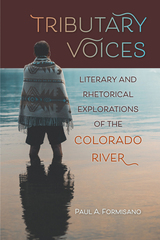
Through literary, rhetorical, and historical analysis of some of the Colorado River’s lesser-known stakeholders, Tributary Voices considers a more comprehensive approach to river management on the eve of the one-hundredth anniversary of the signing of the Colorado River Compact, which governs the allocation of water rights to the seven states in the region. Ranging from the early twentieth century to the present, Tributary Voices examines nature writing, women’s narratives, critiques of dam development, the Latina/o communities’ appeals for river restoration, American Indian authors’ and tribal nations’ claims of water sovereignty, and teachings about environmental stewardship and provident living. This innovative study models an interdisciplinary approach to water governance and reinvigorates our imagination in achieving a more sustainable water ethic.
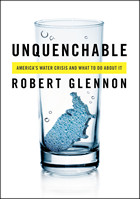
Robert Glennon captures the irony—and tragedy—of America’s water crisis in a book that is both frightening and wickedly comical. From manufactured snow for tourists in Atlanta to trillions of gallons of water flushed down the toilet each year, Unquenchable reveals the heady extravagances and everyday inefficiencies that are sucking the nation dry.
The looming catastrophe remains hidden as government diverts supplies from one area to another to keep water flowing from the tap. But sooner rather than later, the shell game has to end. And when it does, shortages will threaten not only the environment, but every aspect of American life: we face shuttered power plants and jobless workers, decimated fi sheries and contaminated drinking water.
We can’t engineer our way out of the problem, either with traditional fixes or zany schemes to tow icebergs from Alaska. In fact, new demands for water, particularly the enormous supply needed for ethanol and energy production, will only worsen the crisis. America must make hard choices—and Glennon’s answers are fittingly provocative. He proposes market-based solutions that value water as both a commodity and a fundamental human right.
One truth runs throughout Unquenchable: only when we recognize water’s worth will we begin to conserve it.
Most of the world’s population lives in cities in developing countries, where access to basic public services, such as water, electricity, and health clinics, is either inadequate or sorely missing. Water and Politics shows how politicians benefit politically from manipulating public service provision for electoral gain. In many young democracies, politicians exchange water service for votes or political support, rewarding allies or punishing political enemies. Surprisingly, the political problem of water provision has become more pronounced, as water service represents a valuable political currency in resource-scarce environments.
Water and Politics finds that middle-class and industrial elites play an important role in generating pressure for public service reforms.
Winner of the Asia Society's Bernard Schwartz 2012 Book Award
The battles of yesterday were fought over land. Those of today are over energy. But the battles of tomorrow may be over water. Nowhere is that danger greater than in water-distressed Asia.
Water stress is set to become Asia’s defining crisis of the twenty-first century, creating obstacles to continued rapid economic growth, stoking interstate tensions over shared resources, exacerbating long-time territorial disputes, and imposing further hardships on the poor. Asia is home to many of the world's great rivers and lakes, but its huge population and exploding economic and agricultural demand for water make it the most water-scarce continent on a per capita basis. Many of Asia’s water sources cross national boundaries, and as less and less water is available, international tensions will rise. The potential for conflict is further underscored by China’s unrivaled global status as the source of transboundary river flows to the largest number of countries, ranging from India and Vietnam to Russia and Kazakhstan; yet a fast-rising China has declined to enter into water-sharing or cooperative treaties with these states, even as it taps the resources of international rivers.
Water: Asia’s New Battleground is a pioneering study of Asia’s murky water politics and the relationships between fresh water, peace, and security. In this unique and highly readable book, Brahma Chellaney expertly paints a larger picture of water across Asia, highlights the security implications of resource-linked territorial disputes, and proposes real strategies to avoid conflict and more equitably share Asia’s water resources.
In Water Brings No Harm, Matthew V. Bender explores the history of community water management on Mount Kilimanjaro in Tanzania. Kilimanjaro’s Chagga-speaking peoples have long managed water by employing diverse knowledge: hydrological, technological, social, cultural, and political. Since the 1850s, they have encountered groups from beyond the mountain—colonial officials, missionaries, settlers, the independent Tanzanian state, development agencies, and climate scientists—who have understood water differently. Drawing on the concept of waterscapes—a term that describes how people “see” water, and how physical water resources intersect with their own beliefs, needs, and expectations—Bender argues that water conflicts should be understood as struggles between competing forms of knowledge.
Water Brings No Harm encourages readers to think about the origins and interpretation of knowledge and development in Africa and the global south. It also speaks to the current global water crisis, proposing a new model for approaching sustainable water development worldwide.
Building on these cultural critiques, Freyfogle takes up the issue of private property rights, highlighting the longstanding flexibility of this key American institution as well as the moral imperative to ensure that property rights aren’t used in ways that harm communities. Outdated understandings about private property, he concludes, have further confused our understanding and made sensible solutions to water problems even harder to imagine. Water-policy reform won’t happen, Freyfogle argues, until we reconsider how we understand nature and take charge of the institution of ownership, recasting it so as to increase the benefits it generates for everyone. If we can do that, solutions to water troubles could prove easier than we expect. The work concludes with an original, sweeping policy proposal to resolve the West’s water shortages and meet environmental needs in ways fair to all.
This lecture was presented on March 22, 2017, at the 22nd annual symposium sponsored by the Wallace Stegner Center for Land, Resources and the Environment at the S. J. Quinney College of Law, University of Utah.
According to some estimates, at least 1.7 billion people do not have an adequate supply of drinking water and as many as 40% of the world's population face chronic shortages. Yet water scarcity is more than a matter of terrain, increased population, and climate. It can also be a byproduct or end result of water management, where the building of dams, canals, and complicated delivery systems provide water for some at the cost of others, and result in short-term gains that wreak long-term ecological havoc. Water scarcity can also be a product of the social systems in which we live.
Water, Culture, and Power presents a series of case studies from around the world that examine the complex culture and power dimensions of water resources and water resource management. Chapters describe highly contested and contentious cases that span the continuum of water management concerns from dam construction and hydroelectric power generation to water quality and potable water systems. Sections examine: impact of water resource development on indigenous peoples varied cultural meanings of water and water resources political process of funding and building water resource projects tensions between culture and power as they structure perceptions and experiences of water scarcity, transforming water from natural resource to social constructio.
Case studies include Lummi nation challenges to water rights in the northwest United States; drinking water quality issues in Oaxaca de Juarez, Mexico; the effects of tourism development in the Bay Islands, Honduras; water scarcity on St. Thomas, the Virgin Islands; the role of water in the Arab-Israeli conflict; and other national and regional situations including those from Zimbabwe, Japan, and Bangladesh.
While places and cases vary, all chapters address the values and meanings associated with water and how changes in power result in changes in both meaning and in patterns of use, access, and control. Water, Culture, and Power provides an important look at water conflicts and crises and is essential reading for students, researchers, and anyone interested in the role of cultural factors as they affect the political economy of natural resource use and control.
According to the editors of this collection of foundational essays, questions surrounding water are inherently ethical. Peter Brown and Jeremy Schmidt contend that all approaches to managing water, no matter how grounded in empirical data, involve value judgments and cultural assumptions. Each of the six sections of the book discuses a different approach to thinking about the relationship between water and humanity, from utilitarianism to eco-feminism to religious beliefs, including Islam, Hinduism, and Christianity. Contributors range from Bartholemew, Ecumenical Patriarch of the Orthodox Church to Nobel Laureate economist Elinor Ostrom and water policy expert Sandra Postel. Each section is framed by an original introductory essay written by the editors.
Water Ethics will help readers understand how various moral perspectives, even when unstated, have guided and will continue to guide water policy around the globe.
The Santa Cruz River that once flowed through Tucson, Arizona is today a sad mirage of a river. Except for brief periods following heavy rainfall, it is bone dry. The cottonwood and willow trees that once lined its banks have died, and the profusion of birds and wildlife recorded by early settlers are nowhere to be seen. The river is dead. What happened? Where did the water go.
As Robert Glennon explains in Water Follies, what killed the Santa Cruz River -- and could devastate other surface waters across the United States -- was groundwater pumping. From 1940 to 2000, the volume of water drawn annually from underground aquifers in Tucson jumped more than six-fold, from 50,000 to 330,000 acre-feet per year. And Tucson is hardly an exception -- similar increases in groundwater pumping have occurred across the country and around the world. In a striking collection of stories that bring to life the human and natural consequences of our growing national thirst, Robert Glennon provides an occasionally wry and always fascinating account of groundwater pumping and the environmental problems it causes.
Robert Glennon sketches the culture of water use in the United States, explaining how and why we are growing increasingly reliant on groundwater. He uses the examples of the Santa Cruz and San Pedro rivers in Arizona to illustrate the science of hydrology and the legal aspects of water use and conflicts. Following that, he offers a dozen stories -- ranging from Down East Maine to San Antonio's River Walk to Atlanta's burgeoning suburbs -- that clearly illustrate the array of problems caused by groundwater pumping. Each episode poses a conflict of values that reveals the complexity of how and why we use water. These poignant and sometimes perverse tales tell of human foibles including greed, stubbornness, and, especially, the unlimited human capacity to ignore reality.
As Robert Glennon explores the folly of our actions and the laws governing them, he suggests common-sense legal and policy reforms that could help avert potentially catastrophic future effects. Water Follies, the first book to focus on the impact of groundwater pumping on the environment, brings this widespread but underappreciated problem to the attention of citizens and communities across America.
No natural resource issue has greater significance for the future of Texas than water. The state's demand for water for municipal, industrial, agricultural, and recreational uses continues to grow exponentially, while the supply from rivers, lakes, aquifers, and reservoirs is limited. To help Texans manage their water resources today and plan for future needs, one of Texas's top water experts has compiled this authoritative overview of water issues in Texas.
Water in Texas covers all the major themes in water management and conservation:
- Living with a Limited Resource
- The Molecule that Moves Mountains
- A Texas Water Journey
- The Gulf Shores of Texas
- Who's Who in Water
- Texas Water Law: A Blend of Two Cultures
- Does Texas Have Enough Water?
- Planning for the Future
- What's in Your Water?
- How Much is Water Worth?
- Water is Our Legacy
Illustrated with color photographs and maps, Water in Texas will be the essential resource for landowners, citizen activists, policymakers, and city planners.
This set of eleven essays addresses the tightening water resource problems of the Arab region’s twenty countries. The authors discuss themes of water conflict and provide detailed looks at four sub-areas: the Maghreb, the Nile countries, the Arabian Peninsula, and the Mashrek.
This century has seen a technological drive to enlarge traditional surface and groundwater supplies and to expand irrigated farming for rapidly growing and progressively more prosperous populations. But now the region is facing absolute limits on its fresh water. Water in the Arab World focuses on today’s need to move toward rationalized new patterns of using water within the national economies, a transition often described as moving from supply to demand management. The change calls for intensified national legislative and planning efforts concerning water, with serious consideration of desalination and conservation, as well as of pricing and market approaches to the allocation of a very constrained supply.
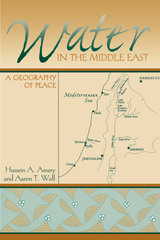
Finding "streams in the desert" has never been more urgent for the peoples of the Middle East. Rapid population growth and a rising standard of living are driving water demand inexorably upward, while the natural supply has not increased since Biblical times. Ensuring a fair and adequate distribution of water in the region is vitally important for building a lasting peace among the nations of the Middle East.
Addressing water needs from a geographical perspective, the contributors to this book analyze and assess the impact of scarce water resources in the Jordan River basin countries and territories (Israel, Jordan, Lebanon, Palestine, and Syria) as these long-time antagonists work toward peace. After geographical and historical overviews, the authors envision the future-what the water issues may be when Israel and Syria begin negotiating, the "hydro-security" needs of each nation, and the difficulties of planning for uncertainty. Without proposing any one ideal scheme, they discuss the possibilities for cooperative sharing of water resources, while honestly acknowledging the political constraints that may limit such projects. The final essay speaks to the needs of the one party so rarely represented at the negotiating table—the Jordan River itself.

WIRED's Required Science Reading 2016
When we think of water in the West, we think of conflict and crisis. In recent years, newspaper headlines have screamed, “Scarce water and the death of California farms,” “The Dust Bowl returns,” “A ‘megadrought’ will grip U.S. in the coming decades.” Yet similar stories have been appearing for decades and the taps continue to flow. John Fleck argues that the talk of impending doom is not only untrue, but dangerous. When people get scared, they fight for the last drop of water; but when they actually have less, they use less.
Having covered environmental issues in the West for a quarter century, Fleck would be the last writer to discount the serious problems posed by a dwindling Colorado River. But in that time, Fleck has also seen people in the Colorado River Basin come together, conserve, and share the water that is available. Western communities, whether farmers and city-dwellers or US environmentalists and Mexican water managers, have a promising record of cooperation, a record often obscured by the crisis narrative.
In this fresh take on western water, Fleck brings to light the true history of collaboration and examines the bonds currently being forged to solve the Basin’s most dire threats. Rather than perpetuate the myth “Whiskey's for drinkin', water's for fightin' over," Fleck urges readers to embrace a new, more optimistic narrative—a future where the Colorado continues to flow.
Water Politics in Northern Nevada examines the Newlands Project, its unintended consequences, and decades of litigation over the abatement of these problems and fair allocation of water. Negotiations and federal legislation brought about the Truckee River Operating Agreement in 2008. This revised edition brings the reader up to date on the implementation of the agreement, including ongoing efforts to preserve and enhance Pyramid Lake. The second edition now also includes a discussion of the Walker River basin, following a major project undertaken to address concerns about the health and viability of Walker Lake. The approaches taken to save these two desert treasures, Pyramid Lake and Walker Lake, are offered as models for resolving similar water-resource conflicts in the West.
Leah J. Wilds’s study is crucial reading for students and scholars of water politics and environmental issues, not just in Nevada but throughout the western United States.
In the past, water development has often proceeded in a single-sector fashion, with each group of users implementing its own plans without coordination with other groups, resulting in both conflict and inefficiency. Now, Anisfeld writes, the challenge of water management is figuring out how to balance all the different demands for water, from sanitation to energy generation to ecosystem protection.
For inquiring students of any level, Water Resources provides a comprehensive one-volume guide to a complex but vital field of study.
Directed by UN Secretary General Ban Ki-Moon at the 2008 Davos Annual Meeting, the World Economic Forum assembled the world’s foremost group of public, private, non-governmental-organization and academic experts to examine the water crisis issue from all perspectives. The result of their work is this forecast—a stark, non-technical overview of where we will be by 2025 if we take a business-as-usual approach to (mis)managing our water resources. The findings are shocking. Perhaps equally stunning are the potential solutions and the recommendations that the group presents. All are included in this landmark publication.
Water Security contains compelling commentary from leading decision-makers, past and present. The commentary is supported by analysis from leading academics of how the world economy will be affected if world leaders cannot agree on solutions. The book suggests how business and politics need to manage the energy-food-water-climate axis as leaders negotiate the details of the climate regime that replace Kyoto Protocols.
As Francis H. Chapelle reveals in this delightful and informative volume, a complex story of geology, hydrology, and history lies behind every bottle of spring water. The book chronicles the history of the bottled water industry in America from its beginnings in Europe hundreds of years ago to the present day. Subsequent chapters describe the chemical characteristics that make some waters desirable, and provide an overview of the geologic circumstances that produce them. Wellsprings explains how these geologic conditions vary throughout the country, and how this affects the kinds and quality of bottled water that are available. Finally, Chapelle shows how the bottled water industry uses this natural history, together with the perceived health benefits of spring waters, to market their products.
Accessibly written and well illustrated, Wellsprings is both a revealing account and a user’s guide to natural spring waters. Regardless of your drinking preference, this timely exploration will make your next drink of water refreshingly informed.
Organized as a collection of terms, the book addresses the most salient water issues and provides helpful background information regarding their origins and implications. Photographs serve a vital role in the cultural dialogue on water and stand as an equal partner to the text. Each subject is covered in about one page and is accompanied by one or two striking images from famous photographers like Margaret Bourke-White, Carleton E. Watkins, Arthur Rothstein, William Henry Jackson, and Dorothea Lang as well as Crifasi’s own work. Water often finds itself at the center of our cultural discourse in art, cinema, and literature, which play essential roles in shaping our understanding and experience of Western water. Crifasi also engages personalities that are nearly synonymous with Western water—John Wesley Powell, Elwood Mead, and Floyd Dominy, among others—to show how their lives intertwined with and often influenced the course of water development across the region.
Travelers, adventurers, students, and anyone interested in water will find Western Water A to Z a handy and entertaining reference guide.

Where fresh water appears to be abundant and generally accessible, chronic pollution may be relatively ignored as a public issue. Yet there are those whose lives, livelihoods, and traditions are touched directly by the destructive albeit essential relationship between humans and water.
In her passionate and persuasively argued Where Rivers Meet the Sea, Stephanie Kane compares two cities and nations—Salvador, Brazil and Buenos Aires, Argentina—as she tells the stories of those who organize in the streets, petition the courts, and challenge their governments to implement and enforce existing laws designed to protect springs, lakes, harbors, and rivers.
Illuminating the complex and distinctive cultural forces in the South Atlantic that shape conflicts and collaborations pertaining to particular waterfront settings, Kane shows the dilemmas, inventiveness, and persistence that provide the foundation for environmental and social justice movements writ large.
READERS
Browse our collection.
PUBLISHERS
See BiblioVault's publisher services.
STUDENT SERVICES
Files for college accessibility offices.
RECENTLY PUBLISHED






UChicago Accessibility Resources
home | accessibility | search | about | contact us
BiblioVault ® 2001 - 2024
The University of Chicago Press