
 A SCHOLARLY BOOK REPOSITORY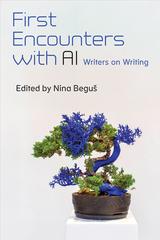
First Encounters with AI gathers some of today’s most original literary minds to explore one of the central artistic and cultural questions of our era: What happens to writing when language is no longer used only by humans? As large language models enter the public imagination and everyday creative practice, writers across genres—novelists, poets, screenwriters, essayists, translators, scholars, technologists, language artists—are grappling with profound shifts in how stories are conceived, crafted, and shared.
Allison Parrish, Ted Chiang, Annelyse Gelman, Sasha Stiles, James Yu, Hannes Bajohr, Ken Liu, Qiufan Chen, Joseph Dumit, Gerardo Con Diaz, Iain S. Thomas, Sheila Heti, Nicholas Nardini, Jasmin B. Frelih, Katy Ilonka Gero, and Alex Saum-Pascual reflect on their early, intimate encounters with generative text at a moment when artificial intelligence feels at once thrilling, unsettling, and unavoidable. Their essays portray AI not as a monolith, but as a dynamic field of possibility and tension between creativity and computation, where longstanding human questions about intention, desire, authorship, labor, and value gain new urgency. Ranging from deeply personal meditations to critical provocations, from philosophical investigations to playful experiments, these writers reveal how writing tools shape writing itself—and what is at stake when those tools begin to imitate us. Curated and introduced by editor Nina Beguš, First Encounters with AI offers readers an essential guide to navigating this new literary landscape. Together, these essays map the terrain of our first contact zone with AI, offering clarity, insight, and imaginative depth at a moment of radical change.

What this intriguing—and unsettling—apex predator reveals about Americans’ attempts to control and connect with the natural world.
Both a flesh-and-blood critter and the stuff of legend, the alligator inspires as much awe as it does fear. While this apex predator survives mainly on fish, birds, snakes, turtles, and small mammals, it will consume almost anything, including pets, livestock, and—in rare cases—humans. Though dreaded as a man-eater, the alligator has also been cast as a lucrative commodity, a popular roadside attraction, a prized hunting trophy, and even an unlikely household pet.
Gator! tells the riveting story of this iconic predator. Historian Mark V. Barrow, Jr.—a native of Florida, a state famous for its alligators—traces the reptile’s ancient lineage from the age of the dinosaurs to its current status as a cherished mascot and regional icon. He explores its role as a surrogate species, offering vital clues about the health of ecosystems, as well as its profound cultural weight as a totem for Indigenous communities, a mythical sewer-dweller in New York lore, and a disturbing tool of racial oppression used to dehumanize African Americans. Once over-hunted, the alligator has long been celebrated as a triumph of the federal Endangered Species Act. Barrow delves into the nuances of this comeback, one that offers both a cautionary tale of market-driven exploitation and a conservation success story.
An entertaining history of one of North America’s most charismatic animals, Gator! explores how this reptile became a Florida emblem and a national enigma, transforming humans and alligators in the process.
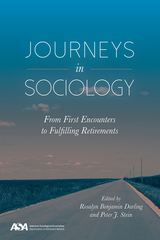
For most sociologists, their life’s work does not end with retirement. Many professors and practitioners continue to teach, publish, or explore related activities after leaving academia. They also connect with others in the field to lessen the isolation they sometimes feel outside the ivory tower or an applied work setting.
The editors and twenty contributors to the essential anthology Journeys in Sociology use a life-course perspective to address the role of sociology in their lives. The power of their personal experiences—during the Great Depression, World War II, or the student protests and social movements in the 1960s and ‘70s—magnify how and why social change prompted these men and women to study sociology. Moreover, all of the contributors include a discussion of their activities in retirement.
From Bob Perrucci, Tuck Green, and Wendell Bell, who write about issues of class, to Debra Kaufman and Elinore Lurie, who explain how gender played a role in their careers, the diverse entries in Journeys in Sociology provide a fascinating look at both the influence of their lives on the discipline and the discipline on these sociologists’ lives.
Contributors include: David J. Armor, Wendell Bell, Glen H. Elder, Jr., Henry W. Fischer, Janet Zollinger Giele, Charles S. (Tuck) Green, Peter Mandel Hall, Elizabeth Higginbotham, Debra Renee Kaufman, Corinne Kirchner, Elinore E. Lurie, Gary T. Marx, Robert Perrucci, Fred Pincus, Thomas Scheff, Arthur Shostak, David Simon, Natalie J. Sokoloff, Edward Tiryakian, Joyce E. Williams, and the editors.
Published in collaboration with the American Sociological Association Opportunities in Retirement Network.
READERS
Browse our collection.
PUBLISHERS
See BiblioVault's publisher services.
STUDENT SERVICES
Files for college accessibility offices.
RECENTLY PUBLISHED



UChicago Accessibility Resources
home | accessibility | search | about | contact us
BiblioVault ® 2001 - 2026
The University of Chicago Press