
 A SCHOLARLY BOOK REPOSITORY
6 start with C start with C
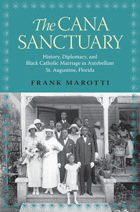
In the late seventeenth century a group of about a dozen escaped African slaves from the English colony of Carolina reached the Spanish settlement of St. Augustine. In a diplomatic bid for sanctuary, to avoid extradition and punishment, they requested the sacrament of Catholic baptism from the Spanish Catholic Church. Their negotiations brought about their baptism and with it their liberation. The Cana Sanctuary focuses on what author Frank Marotti terms “folk diplomacy”—political actions conducted by marginalized, non-state sectors of society—in this instance by formerly enslaved African Americans in antebellum East Florida. The book explores the unexpected transformations that occurred in seventeenth- and eighteenth-century St. Augustine as more and more ex-slaves arrived to find their previously disregarded civil rights upheld under sacred codes by an international, nongovernmental, authoritative organization.
With the Catholic Church acting as an equalizing, empowering force for escaped African slaves, the Spanish religious sanctuary policy became part of popular historical consciousness in East Florida. As such, it allowed for continual confrontations between the law of the Church and the law of the South. Tensions like these survived, ultimately lending themselves to an “Afro-Catholicism” sentiment that offered support for antislavery arguments.
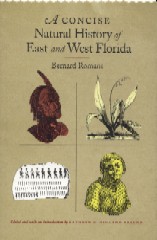
Braund presents the only annotated edition of Bernard Romans's rare and valuable 18th-century account of his observations in the southeastern United States.
Bernard Romans's A Concise Natural History of East and West Florida, William Bartram's Travels, and James Adair's History of the American Indian are the three most significant accounts of the southeastern United States published during the late 18th century. This new edition of Romans's Concise Natural History, edited by historian Kathryn Braund, provides the first fully annotated edition of this early and rare description of both the European settled areas and the adjoining Indian lands in what are now the states of Florida, Georgia, Alabama, Mississippi, and Louisiana.
Romans's purpose in producing his Concise Natural History was twofold: to aid navigators and shippers by detailing the sailing passages of the region and to promote trade and settlement in the region. To those ends, he provided detailed scientific observations on the natural history of the area, a summary of the region's political history, and an assessment of the potential for economic growth in the Floridas based on the area's natural resources.
A trained surveyor and cartographer and a self-taught naturalist, Romans supplied detailed descriptions of the region's topography and environment, including information about the climate and weather patterns, plants, animals, and diseases. He provided information about the state of scientific inquiry in the South and touched on many of the most important intellectual arguments of the day, such as the origin of the races, the practice of slavery, and the benefits and drawbacks of monopoly on trade.
In addition, Concise Natural History can be placed firmly in the genre of colonial promotional literature. Romans's book was an enthusiastic guide aimed at those seeking to establish modest holdings in the region:
"What a field is open here! . . . No country ever had such inexhaustible resources; no empire had ever half so many advantages combining in its behalf!" Romans explained how settlers should travel to the area, what they would need in terms of provisions and tools, and what it would cost to have their land surveyed. In addition to providing an abundance of practical advice, Romans also offered information about the history of earlier settlements, including the earliest and most complete account of New Smyrna near St. Augustine.
Romans also presented unique information about the various Indian tribes he encountered. In fact, historians agree that among the most useful portions of the book are Romans's descriptions of the largest Indian tribes in the 18th-century Southeast: the Creeks, Choctaws, and Chickasaws. Romans's account of the diet of the Creeks and Choctaws is one of the most complete available. And his description of the location of Choctaw village sites is one of the best sources for this information.

For two centuries, Cuban exiles have found their way to the United States, especially to Florida. But since Castro's victory in 1959, Miami has seen almost one million Cubans arrive by sea and air. The impact on this area has been enormous. Miami---known as the "Exile Capital"---has a greater cultural affinity to Havana and the rest of Latin America than to Tallahassee, Florida's capital.
Cuban Miami is the first analytical, photographic record of Cuban migration to south Florida. Robert M. Levine and Moises Asis have interviewed members of every sector of the Cuban exile community, from the first pioneers to the mass waves in the early 1960s to those who arrived by raft during the late 1990s. In their wide-ranging investigation of Cuban-U.S. history, they touch upon all aspects of Cuban influence: politics, cuisine, music, assimilation, discrimination, and institution buildings. Miami has more Cuban food establishments than the nearby island does. The city has been fertile ground for germinating a unique synthesis of Cuban and Americans are the most prosperous immigrant group in the United States today, this success has come at a price---living in exile can exact a personal toll.
Cuban Miami is a feast for the eyes, including 180 photographs and original cartoons drawn for the book by Jose M. Varela, a well-known member of the Cuban-American community.
READERS
Browse our collection.
PUBLISHERS
See BiblioVault's publisher services.
STUDENT SERVICES
Files for college accessibility offices.
RECENTLY PUBLISHED




UChicago Accessibility Resources
home | accessibility | search | about | contact us
BiblioVault ® 2001 - 2024
The University of Chicago Press