
 A SCHOLARLY BOOK REPOSITORY
A rare and crucial perspective on Latina/o/x people in the Midwest, Building Sustainable Worlds reveals how expressive culture contributes to, and sustains, a sense of place in an uncertain era.
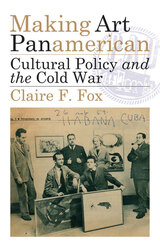
Among the buildings on the National Mall in Washington, D.C., only the Pan American Union (PAU) houses an international organization. The first of many anticipated “peace palaces”constructed in the early twentieth century, the PAU began with a mission of cultural diplomacy, and after World War II its Visual Arts Section became a leader in the burgeoning hemispheric arts scene, proclaiming Latin America’s entrée into the international community as it forged connections between a growing base of middle-class art consumers on one hand and concepts of supranational citizenship and political and economic liberalism on the other.
Making Art Panamerican situates the ambitious visual arts programs of the PAU within the broader context of hemispheric cultural relations during the cold war. Focusing on the institutional interactions among aesthetic movements, cultural policy, and viewing publics, Claire F. Fox contends that in the postwar years, the PAU Visual Arts Section emerged as a major transfer point of hemispheric American modernist movements and played an important role in the consolidation of Latin American art as a continental object of study.
As it traces the careers of individual cultural policymakers and artists who intersected with the PAU in the two postwar decades—such as Concha Romero James, Charles Seeger, José Gómez Sicre, José Luis Cuevas, and Rafael Squirru—the book also charts the trajectories and displacements of sectors of the U.S. and Latin American intellectual left during a tumultuous interval that spans the Mexican Revolution, the Spanish Civil War, the New Deal, and the early cold war. Challenging the U.S. bias of conventional narratives about Panamericanism and the postwar shift in critical values from realism to abstraction, Making Art Panamerican illuminates the institutional dynamics that helped shape aesthetic movements in the critical decades following World War II.
READERS
Browse our collection.
PUBLISHERS
See BiblioVault's publisher services.
STUDENT SERVICES
Files for college accessibility offices.
RECENTLY PUBLISHED




UChicago Accessibility Resources
home | accessibility | search | about | contact us
BiblioVault ® 2001 - 2026
The University of Chicago Press