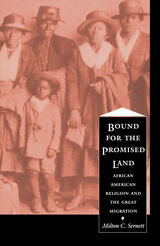
front cover of Bound For the Promised Land
Bound For the Promised Land
African American Religion and the Great Migration
Milton C. Sernett
Duke University Press, 1997
Bound for the Promised Land is the first extensive examination of the impact on the American religious landscape of the Great Migration—the movement from South to North and from country to city by hundreds of thousands of African Americans following World War I. In focusing on this phenomenon’s religious and cultural implications, Milton C. Sernett breaks with traditional patterns of historiography that analyze the migration in terms of socioeconomic considerations.
Drawing on a range of sources—interviews, government documents, church periodicals, books, pamphlets, and articles—Sernett shows how the mass migration created an institutional crisis for black religious leaders. He describes the creative tensions that resulted when the southern migrants who saw their exodus as the Second Emancipation brought their religious beliefs and practices into northern cities such as Chicago, and traces the resulting emergence of the belief that black churches ought to be more than places for "praying and preaching." Explaining how this social gospel perspective came to dominate many of the classic studies of African American religion, Bound for the Promised Land sheds new light on various components of the development of black religion, including philanthropic endeavors to "modernize" the southern black rural church. In providing a balanced and holistic understanding of black religion in post–World War I America, Bound for the Promised Land serves to reveal the challenges presently confronting this vital component of America’s religious mosaic.
[more]

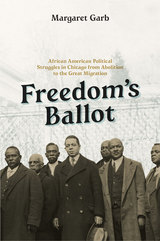
front cover of Freedom's Ballot
Freedom's Ballot
African American Political Struggles in Chicago from Abolition to the Great Migration
Margaret Garb
University of Chicago Press, 2014
In the spring of 1915, Chicagoans elected the city’s first black alderman, Oscar De Priest. In a city where African Americans made up less than five percent of the voting population, and in a nation that dismissed and denied black political participation, De Priest’s victory was astonishing. It did not, however, surprise the unruly group of black activists who had been working for several decades to win representation on the city council.

Freedom’s Ballot is the history of three generations of African American activists—the ministers, professionals, labor leaders, clubwomen, and entrepreneurs—who transformed twentieth-century urban politics. This is a complex and important story of how black political power was institutionalized in Chicago in the half-century following the Civil War. Margaret Garb explores the social and political fabric of Chicago, revealing how the physical makeup of the city was shaped by both political corruption and racial empowerment—in ways that can still be seen and felt today.
[more]

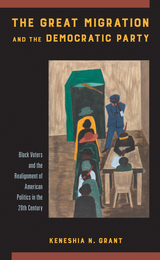
front cover of The Great Migration and the Democratic Party
The Great Migration and the Democratic Party
Black Voters and the Realignment of American Politics in the 20th Century
Keneshia N. Grant
Temple University Press, 2020

Where Black people live has long been an important determinant of their ability to participate in political processes. The Great Migration significantly changed the way Democratic Party elites interacted with Black communities in northern cities, Detroit, New York, and Chicago. Many white Democratic politicians came to believe the growing pool of Black voters could help them reach their electoral goals—and these politicians often changed their campaign strategies and positions to secure Black support. Furthermore, Black migrants were able to participate in politics because there were fewer barriers to Black political participations outside the South.

The Great Migration and the Democratic Party frames the Great Migration as an important economic and social event that also had serious political consequences. Keneshia Grant created one of the first listings of Black elected officials that classifies them based on their status as participants in the Great Migration. She also describes some of the policy/political concerns of the migrants. The Great Migration and the Democratic Party lays the groundwork for ways of thinking about the contemporary impact of Black migration on American politics.
[more]

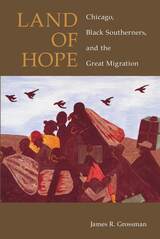
front cover of Land of Hope
Land of Hope
Chicago, Black Southerners, and the Great Migration
James R. Grossman
University of Chicago Press, 1989
Grossman’s rich, detailed analysis of black migration to Chicago during World War I and its aftermath brilliantly captures the cultural meaning of the movement.
[more]

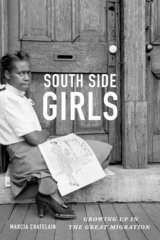
front cover of South Side Girls
South Side Girls
Growing Up in the Great Migration
Marcia Chatelain
Duke University Press, 2015
In South Side Girls Marcia Chatelain recasts Chicago's Great Migration through the lens of black girls. Focusing on the years between 1910 and 1940, when Chicago's black population quintupled, Chatelain describes how Chicago's black social scientists, urban reformers, journalists and activists formulated a vulnerable image of urban black girlhood that needed protecting. She argues that the construction and meaning of black girlhood shifted in response to major economic, social, and cultural changes and crises, and that it reflected parents' and community leaders' anxieties about urbanization and its meaning for racial progress. Girls shouldered much of the burden of black aspiration, as adults often scrutinized their choices and behavior, and their well-being symbolized the community's moral health. Yet these adults were not alone in thinking about the Great Migration, as girls expressed their views as well. Referencing girls' letters and interviews, Chatelain uses their powerful stories of hope, anticipation and disappointment to highlight their feelings and thoughts, and in so doing, she helps restore the experiences of an understudied population to the Great Migration's complex narrative.
[more]

front cover of Swallows and Settlers
Swallows and Settlers
The Great Migration from North China to Manchuria
Thomas R. Gottschang and Diana Lary
University of Michigan Press, 2000
Between the 1890s and the Second World War, twenty-five million people traveled from the densely populated North China provinces of Shandong and Hebei to seek employment in the growing economy of China's three northeastern provinces, the area known as Manchuria. This was the greatest population movement in modern Chinese history and ranks among the largest migrations in the world.
Swallows and Settlers is the first comprehensive study of that migration. Drawing methods from their respective fields of economics and history, the coauthors focus on both the broad quantitative outlines of the movement and on the decisions and experiences of individual migrants and their families. In readable narrative prose, the book lays out the historical relationship between North China and the Northeast (Manchuria) and concludes with an examination of ongoing population movement between these regions since the founding of the People's Republic in 1949.
[more]


Send via email Share on Facebook Share on Twitter