
 A SCHOLARLY BOOK REPOSITORY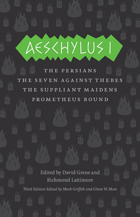
The most engaging and authoritative translation of some of the foundational works of Western culture
This volume collects careful, readable translations of some of the key works of Aeschylus by experts in the language and culture of the ancient Greek world in which he lived and wrote. Aeschylus I contains “The Persians,” translated by Seth Benardete; “The Seven Against Thebes,” translated by David Grene; “The Suppliant Maidens,” translated by Seth Benardete; and “Prometheus Bound,” translated by David Grene.
For this edition, series editors Mark Griffith and Glenn W. Most have carefully updated the translations to bring them even closer to the ancient Greek while retaining the vibrancy for which our English versions are famous.New introductions for each play offer essential information about its first production, plot, and reception in antiquity and beyond. In addition, each volume includes an introduction to the life and work of its tragedian, as well as notes addressing textual uncertainties and a glossary of names and places mentioned in the plays.
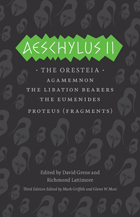
Aeschylus II contains “The Oresteia,” translated by Richmond Lattimore, and fragments of “Proteus,” translated by Mark Griffith.
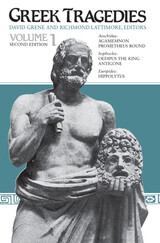
Many years ago, the University of Chicago Press undertook a momentous project: a new translation of the Greek tragedies that would be the ultimate resource for teachers, students, and readers. They succeeded. Under the expert management of eminent classicists David Grene and Richmond Lattimore, those translations combined accuracy, poetic immediacy, and clarity of presentation to render the surviving masterpieces of Aeschylus, Sophocles, and Euripides in an English so lively and compelling that they remain the standard translations. The updated third editions of these classic works were designed to ensure that our Greek tragedies remain the leading English-language versions throughout the twenty-first century.
In this highly anticipated third edition, Mark Griffith and Glenn W. Most have carefully updated the translations to bring them even closer to the ancient Greek while retaining the vibrancy for which our English versions are famous. This edition also includes brand-new translations of Euripides’ Medea, The Children of Heracles, Andromache, and Iphigenia among the Taurians, fragments of lost plays by Aeschylus, and the surviving portion of Sophocles’s satyr-drama The Trackers. New introductions for each play offer essential information about its first production, plot, and reception in antiquity and beyond. In addition, each volume includes an introduction to the life and work of its tragedian, as well as notes addressing textual uncertainties and a glossary of names and places mentioned in the plays.
In addition to the new content, the volumes have been reorganized both within and between volumes to reflect the most up-to-date scholarship on the order in which the plays were originally written. The result is a set of handsome paperbacks destined to introduce new generations of readers to these foundational works of Western drama, art, and life.
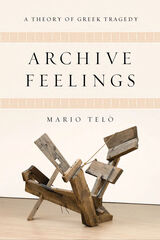
With bold readings of thirteen plays by Aeschylus, Sophocles, and Euripides, including the Oedipus cycle, the Oresteia,Medea, and Bacchae; an eclectic synthesis of Freud, Lacan, Derrida, Žižek, Deleuze, and other critical theorists; and an engagement with art, architecture, and film, Mario Telò’s Archive Feelings: A Theory of Greek Tragedy locates Greek tragedy’s aesthetic allure beyond catharsis in a vertiginous sense of giddy suspension, in a spiral of life and death that resists equilibrium, stabilization, and all forms of normativity. In so doing, Telò forges a new model of tragic aesthetics.
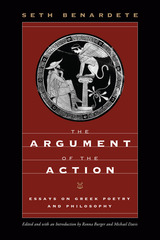
This volume brings together Seth Benardete’s studies of Hesiod, Homer, and Greek tragedy, eleven Platonic dialogues, and Aristotle’s Metaphysics.
The Argument of the Action spans four decades of Seth Benardete’s work, documenting its impressive range. Benardete’s philosophic reading of the poets and his poetic reading of the philosophers share a common ground, guided by the key he found in the Platonic dialogue: probing the meaning of speeches embedded in deeds, he uncovers the unifying intention of the work by tracing the way it unfolds through a movement of its own. Benardete’s original interpretations of the classics are the fruit of this discovery of the “argument of the action.”
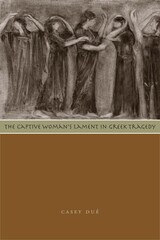
The laments of captive women found in extant Athenian tragedy constitute a fundamentally subversive aspect of Greek drama. In performances supported by and intended for the male citizens of Athens, the songs of the captive women at the Dionysia gave a voice to classes who otherwise would have been marginalized and silenced in Athenian society: women, foreigners, and the enslaved. The Captive Woman's Lament in Greek Tragedy addresses the possible meanings ancient audiences might have attached to these songs. Casey Dué challenges long-held assumptions about the opposition between Greeks and barbarians in Greek thought by suggesting that, in viewing the plight of the captive women, Athenian audiences extended pity to those least like themselves. Dué asserts that tragic playwrights often used the lament to create an empathetic link that blurred the line between Greek and barbarian.
After a brief overview of the role of lamentation in both modern and classical traditions, Dué focuses on the dramatic portrayal of women captured in the Trojan War, tracing their portrayal through time from the Homeric epics to Euripides' Athenian stage. The author shows how these laments evolved in their significance with the growth of the Athenian Empire. She concludes that while the Athenian polis may have created a merciless empire outside the theater, inside the theater they found themselves confronted by the essential similarities between themselves and those they sought to conquer.
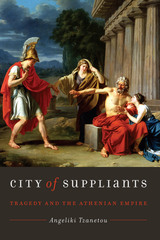
After fending off Persia in the fifth century BCE, Athens assumed a leadership position in the Aegean world. Initially it led the Delian League, a military alliance against the Persians, but eventually the league evolved into an empire with Athens in control and exacting tribute from its former allies. Athenians justified this subjection of their allies by emphasizing their fairness and benevolence towards them, which gave Athens the moral right to lead. But Athenians also believed that the strong rule over the weak and that dominating others allowed them to maintain their own freedom. These conflicting views about Athens’ imperial rule found expression in the theater, and this book probes how the three major playwrights dramatized Athenian imperial ideology.
Through close readings of Aeschylus’ Eumenides, Euripides’ Children of Heracles, and Sophocles’ Oedipus at Colonus, as well as other suppliant dramas, Angeliki Tzanetou argues that Athenian tragedy performed an important ideological function by representing Athens as a benevolent and moral ruler that treated foreign suppliants compassionately. She shows how memorable and disenfranchised figures of tragedy, such as Orestes and Oedipus, or the homeless and tyrant-pursued children of Heracles were generously incorporated into the public body of Athens, thus reinforcing Athenians’ sense of their civic magnanimity. This fresh reading of the Athenian suppliant plays deepens our understanding of how Athenians understood their political hegemony and reveals how core Athenian values such as justice, freedom, piety, and respect for the laws intersected with imperial ideology.
This handbook provides students and scholars with a highly readable yet detailed analysis of all surviving Greek tragedies and satyr plays. John Ferguson places each play in its historical, political, and social context—important for both Athenian and modern audiences—and he displays a keen, discriminating critical competence in dealing with the plays as literature.
Ferguson is sensitive to the meter and sound of Greek tragedy, and, with remarkable success, he manages to involve even the Greekless reader in an actual encounter with the Greek as poetry. He examines language and metrics in relation to each tragedian's dramatic purpose, thus elucidating the crucial dimension of technique that other handbooks, mostly the work of philologists, renounce in order to concentrate on structure and plot. The result is perceptive criticism in which the quality of Ferguson's scholarship vouches for what he sees in the plays.
The book is prefaced with a general introduction to ancient Greek theatrical production, and there is a brief biographical sketch of each tragedian. Footnotes are avoided: the object of this handbook is to introduce readers to the plays as dramatic poetry, not to detail who said what about them. There is an extensive bibliography for scholars and a glossary of Greek words to assist the student with the operative moral and stylistic terms of Greek tragedy.

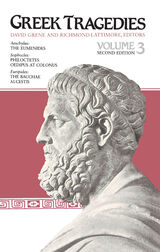
For the Centennial Edition two of the original translations have been replaced. In the original publication David Grene translated only one of the three Theban plays, Oedipus the King. Now he has added his own translations of the remaining two, Oedipus at Colonus and Antigone, thus bringing a new unity of tone and style to this group. Grene has also revised his earlier translation of Prometheus Bound and rendered some of the former prose sections in verse. These new translations replace the originals included in the paperback volumes Sophocles I (which contains all three Theban plays), Aeschylus II, Greek Tragedies, Volume I, and Greek Tragedies, Volume III, all of which are now being published in second editions.
All other volumes contain the translations of the tragedies of Aeschylus, Sophocles, and Euripides for the most part from the original versions first published in the 1940s and 1950s. These translations have been the choice of generations of teachers and students, selling in the past forty years over three million copies.
For the Centennial Edition two of the original translations have been replaced. In the original publication David Grene translated only one of the three Theban plays, Oedipus the King. Now he has added his own translations of the remaining two, Oedipus at Colonus and Antigone, thus bringing a new unity of tone and style to this group. Grene has also revised his earlier translation of Prometheus Bound and rendered some of the former prose sections in verse. These new translations replace the originals included in the paperback volumes Sophocles I (which contains all three Theban plays), Aeschylus II, Greek Tragedies, Volume I, and Greek Tragedies, Volume III, all of which are now being published in second editions.
All other volumes contain the translations of the tragedies of Aeschylus, Sophocles, and Euripides for the most part from the original versions first published in the 1940s and 1950s. These translations have been the choice of generations of teachers and students, selling in the past forty years over three million copies.
For the Centennial Edition two of the original translations have been replaced. In the original publication David Grene translated only one of the three Theban plays, Oedipus the King. Now he has added his own translations of the remaining two, Oedipus at Colonus and Antigone, thus bringing a new unity of tone and style to this group. Grene has also revised his earlier translation of Prometheus Bound and rendered some of the former prose sections in verse. These new translations replace the originals included in the paperback volumes Sophocles I (which contains all three Theban plays), Aeschylus II, Greek Tragedies, Volume I, and Greek Tragedies, Volume III, all of which are now being published in second editions.
All other volumes contain the translations of the tragedies of Aeschylus, Sophocles, and Euripides for the most part from the original versions first published in the 1940s and 1950s. These translations have been the choice of generations of teachers and students, selling in the past forty years over three million copies.
For the Centennial Edition two of the original translations have been replaced. In the original publication David Grene translated only one of the three Theban plays, Oedipus the King. Now he has added his own translations of the remaining two, Oedipus at Colonus and Antigone, thus bringing a new unity of tone and style to this group. Grene has also revised his earlier translation of Prometheus Bound and rendered some of the former prose sections in verse. These new translations replace the originals included in the paperback volumes Sophocles I (which contains all three Theban plays), Aeschylus II, Greek Tragedies, Volume I, and Greek Tragedies, Volume III, all of which are now being published in second editions.
All other volumes contain the translations of the tragedies of Aeschylus, Sophocles, and Euripides for the most part from the original versions first published in the 1940s and 1950s. These translations have been the choice of generations of teachers and students, selling in the past forty years over three million copies.
The Birth of Tragedy is a rethinking of art at the
limit of metaphysics. His close reading focuses on the
complexity of the Apollinian/Dionysian dyad and on the
crossing of these basic art impulses in tragedy.
"Sallis effectively calls into question some commonly
accepted and simplistic ideas about Nietzsche's early
thinking and its debt to Schopenhauer, and proposes
alternatives that are worth considering."—Richard
Schacht, Times Literary Supplement
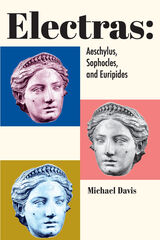
Davis accomplishes much more than an exegetical bridge as he connects us with ancient memory and wisdom. "When we cannot resist the temptation to recoil morally from their terminology, we risk the tragedy of losing their profound thoughts about our humanity––their philosophical anthropology." Davis has remarkably made of a niche study a stunning source material for more universal questions. This is a book that is as timely as it is ageless.
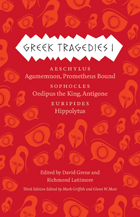
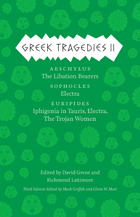
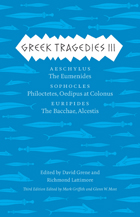
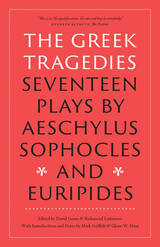
Drawn from the authoritative third editions of David Grene and Richmond Lattimore’s collections of the complete Greek tragedies, expertly updated by Mark Griffith and Glenn W. Most, this collection brings together seventeen of the greatest surviving plays of ancient Greece. Combining accuracy, poetic immediacy, and clarity of presentation, the masterpieces of Aeschylus, Sophocles, and Euripides have been rendered so compellingly in English that they remain the definitive translations. Each text has been carefully updated to bring it even closer to the ancient Greek original while retaining the vibrancy for which Chicago’s versions are famous.
Alongside the plays, this edition includes an introduction to the life and work of each tragedian; an introduction to each play offering essential information about its first production, plot, and reception through the centuries; and notes addressing textual uncertainties. Featuring lively translations by eminent classicists and authors including Anne Carson, Robert Fitzgerald, David Grene, Richmond Lattimore, Oliver Taplin, Emily Townsend Vermeule, and Elizabeth Wyckoff, this is an indispensable anthology for any reader of the foundational works of Western drama, art, and life.
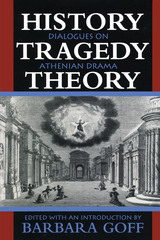
Greek tragedy has held sway over the imagination of audiences for well over two millennia. This collection of essays on Athenian drama, the proceedings of a conference held at the University of Texas at Austin in 1992, demonstrates that Greek tragedy still retains its power to provoke debate and to engage the interest of specialists and non-classicists alike.
The book includes essays by seven of the foremost scholars of Greek drama—Helene Foley, Michelle Gellrich, Peter W. Rose, David Rosenbloom, Richard Seaford, Bernd Seidensticker, and Froma I. Zeitlin. These writers explore the work of all three great tragedians, Aeschylus, Sophocles, and Euripides, and approach them from a variety of perspectives on history and theory, including poststructuralism and Marxism. They investigate the possibilities for coordinating theoretically informed readings of tragedy with a renewed attention to the pressure of material history within those texts. The collection thus represents a response within classics to "New Historicism" and the debates it has generated within related literary disciplines.

In crisp and spirited prose, Goldhill explains how Aeschylus, Euripides, and Sophocles conceived their works in performance and then summarizes everything we know about how their tragedies were actually staged. The heart of his book tackles the six major problems facing any company performing these works today: the staging space and concept of the play; the use of the chorus; the actor’s role in an unfamiliar style of performance; the place of politics in tragedy; the question of translation; and the treatment of gods, monsters, and other strange characters of the ancient world. Outlining exactly what makes each of these issues such a pressing difficulty for modern companies, Goldhill provides insightful solutions drawn from his nimble analyses of some of the best recent productions in the United States, Britain, and Continental Europe.
One of the few experts on both Greek tragedy and contemporary performance, Goldhill uses his unique background and prodigious literary skill to illuminate brilliantly what makes tragedy at once so exciting and so tricky to get right. The result will inspire and enlighten all directors and performers—not to mention the growing audiences—of ancient Greek theater.
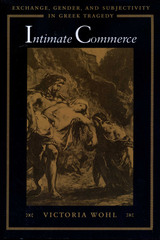
Exchanges of women between men occur regularly in Greek tragedy—and almost always with catastrophic results. Instead of cementing bonds between men, such exchanges rend them. They allow women, who should be silent objects, to become monstrous subjects, while men often end up as lifeless corpses. But why do the tragedies always represent the transferal of women as disastrous?
Victoria Wohl offers an illuminating analysis of the exchange of women in Sophocles' Trachiniae, Aeschylus' Agamemnon, and Euripides' Alcestis. She shows how the attempts of women in these plays to become active subjects rather than passive objects of exchange inevitably fail. While these failures seem to validate male hegemony, the women's actions, however futile, blur the distinction between male subject and female object, calling into question the very nature of the tragic self. What the tragedies thus present, Wohl asserts, is not only an affirmation of Athens' reigning ideologies (including its gender hierarchy) but also the possibility of resistance to them and the imagination of alternatives.
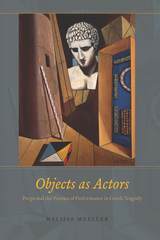
As Mueller shows, props such as weapons, textiles, and even letters were often fully integrated into a play’s action. They could provoke surprising plot turns, elicit bold viewer reactions, and provide some of tragedy’s most thrilling moments. Whether the sword of Sophocles’s Ajax, the tapestry in Aeschylus’s Agamemnon, or the tablet of Euripides’s Hippolytus, props demanded attention as a means of uniting—or disrupting—time, space, and genre.
Insightful and original, Objects as Actors offers a fresh perspective on the central tragic texts—and encourages us to rethink ancient theater as a whole.
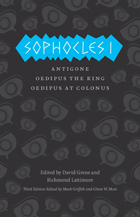
Sophocles I contains the plays “Antigone,” translated by Elizabeth Wyckoff; “Oedipus the King,” translated by David Grene; and “Oedipus at Colonus,” translated by Robert Fitzgerald.
Many years ago, the University of Chicago Press undertook a momentous project: a new translation of the Greek tragedies that would be the ultimate resource for teachers, students, and readers. They succeeded. Under the expert management of eminent classicists David Grene and Richmond Lattimore, those translations combined accuracy, poetic immediacy, and clarity of presentation to render the surviving masterpieces of Aeschylus, Sophocles, and Euripides in an English so lively and compelling that they remain the standard translations. The updated third editions of these classic works were designed to ensure that our Greek tragedies remain the leading English-language versions throughout the twenty-first century.
In this highly anticipated third edition, Mark Griffith and Glenn W. Most have carefully updated the translations to bring them even closer to the ancient Greek while retaining the vibrancy for which our English versions are famous. This edition also includes brand-new translations of Euripides’ Medea, The Children of Heracles, Andromache, and Iphigenia among the Taurians, fragments of lost plays by Aeschylus, and the surviving portion of Sophocles’s satyr-drama The Trackers. New introductions for each play offer essential information about its first production, plot, and reception in antiquity and beyond. In addition, each volume includes an introduction to the life and work of its tragedian, as well as notes addressing textual uncertainties and a glossary of names and places mentioned in the plays.
In addition to the new content, the volumes have been reorganized both within and between volumes to reflect the most up-to-date scholarship on the order in which the plays were originally written. The result is a set of handsome paperbacks destined to introduce new generations of readers to these foundational works of Western drama, art, and life.
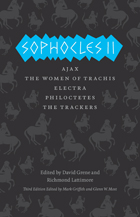
Sophocles II contains the plays “Ajax,” translated by John Moore; “The Women of Trachis,” translated by Michael Jameson; “Electra,” translated by David Grene; “Philoctetes,” translated by David Grene; and “The Trackers,” translated by Mark Griffith.
Many years ago, the University of Chicago Press undertook a momentous project: a new translation of the Greek tragedies that would be the ultimate resource for teachers, students, and readers. They succeeded. Under the expert management of eminent classicists David Grene and Richmond Lattimore, those translations combined accuracy, poetic immediacy, and clarity of presentation to render the surviving masterpieces of Aeschylus, Sophocles, and Euripides in an English so lively and compelling that they remain the standard translations. The updated third editions of these classic works were designed to ensure that our Greek tragedies remain the leading English-language versions throughout the twenty-first century.
In this highly anticipated third edition, Mark Griffith and Glenn W. Most have carefully updated the translations to bring them even closer to the ancient Greek while retaining the vibrancy for which our English versions are famous. This edition also includes brand-new translations of Euripides’ Medea, The Children of Heracles, Andromache, and Iphigenia among the Taurians, fragments of lost plays by Aeschylus, and the surviving portion of Sophocles’s satyr-drama The Trackers. New introductions for each play offer essential information about its first production, plot, and reception in antiquity and beyond. In addition, each volume includes an introduction to the life and work of its tragedian, as well as notes addressing textual uncertainties and a glossary of names and places mentioned in the plays.
In addition to the new content, the volumes have been reorganized both within and between volumes to reflect the most up-to-date scholarship on the order in which the plays were originally written. The result is a set of handsome paperbacks destined to introduce new generations of readers to these foundational works of Western drama, art, and life.

Norman Austin brings both keen insight and a life-long engagement with his subject to this study of Sophocles’ late tragedy Philoctetes, a fifth-century BCE play adapted from an infamous incident during the Trojan War. In Sophocles’ “Philoctetes” and the Great Soul Robbery, Austin examines the rich layers of text as well as context, situating the play within the historical and political milieu of the eclipse of Athenian power. He presents a study at once of interest to the classical scholar and accessible to the general reader. Though the play, written near the end of Sophocles’ career, is not as familiar to modern audiences as his Theban plays, Philoctetes grapples with issues—social, psychological, and spiritual—that remain as much a part of our lives today as they were for their original Athenian audience.
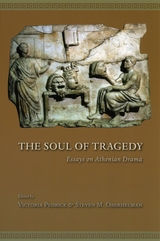
Exemplary of the nature and scope of this book, the essays range from Simon Goldhill's comparative study of music, gender, and culture to Martha Nussbaum's inspection of "the comic soul." Through the critical lenses of psychoanalysis, gender, social history, and philology, this compilation looks at Greek tragedy's peculiar power to illuminate the workings of the human soul. Structures of tragic meaning, the relationship between character desire and spectator experience, and investigations of tragedy's extraordinary preoccupation with gender reveal the form's emotional core and explain its rapid ascent through the hierarchy of cultural practices in classical Greece. The Soul of Tragedy is a celebration and a model of collaboration that will be essential reading for scholars in classics, literature, and drama.

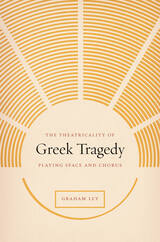
Drawing on evidence from the surviving texts of tragedies by Aeschylus, Sophocles, and Euripides, Ley explains how scenes with actors were played in the open ground of the orchestra, often considered as exclusively the dancing place of the chorus. In reviewing what is known of the music and dance of Greek antiquity, Ley goes on to show that in the original productions the experience of the chorus—expressed in song and dance and in interaction with the characters—remained a vital characteristic in the performance of tragedy.
Combining detailed analysis with broader reflections about the nature of ancient Greek tragedy as an art form, this volume—supplemented with a series of illustrative drawings and diagrams—will be a necessary addition to the bookshelf of anyone interested in literature, theater, or classical studies.
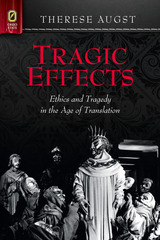
Tragic Effects: Ethics and Tragedy in the Age of Translation confronts the peculiar fascination with Greek tragedy as it shapes the German intellectual tradition, with particular focus on the often controversial practice of translating the Greeks. Whereas the tradition of emulating classical ideals in German intellectual life has generally emerged from the impulse to identify with models, the challenge of translating the Greeks underscores the linguistic and historical discontinuities inherent in the recourse to ancient material and inscribes that experience of disruption as fundamental to modernity.
Friedrich Hölderlin’s translations are a case in point. Regarded in his own time as the work of a madman, his renditions of Sophoclean tragedy intensify dramatic effect with the unsettling experience of familiar language slipping its moorings. His attention to marking the distances between ancient source text and modern translation has granted his Oedipus and Antigone a distinct longevity as objects of discussion, adaptation, and even retranslation. Cited by Walter Benjamin, Martin Heidegger, Bertolt Brecht, and others, Hölderlin’s Sophocles project follows a path both marked by various contexts and tinged by persistent quandaries of untranslatability.
Tragedy has long functioned as a cornerstone for questions about ethical life. By placing emphasis on processes of translation and adaptation, however, Tragic Effects approaches the question of ethics from a perspective informed by recent discourse in translation studies. Reconstructing an ancient text in this context requires negotiating the difficult tension between comprehending the distant past and preserving its radical singularity.
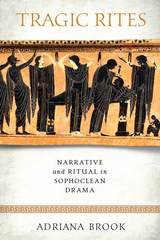
Employing both modern ritual theory and Aristotle's Poetics, Brook exposes the deep structural analogies between ritual and narrative, the parallels between mistakes in ritual and deviations from the expected in the plot, and the relationship between ritual content and dramatic closure.

Three plays by ancient Greece’s third great tragedian.
One of antiquity's greatest poets, Euripides has been prized in every age for the pathos, terror, and intellectual probing of his dramatic creations. The new Loeb Classical Library edition of his plays is in six volumes.
Three plays are in Volume IV. Trojan Women concerns the tragic unpredictability of life; Iphigenia among the Taurians and Ion exhibit tragic themes and situations but end happily with joyful reunions.
READERS
Browse our collection.
PUBLISHERS
See BiblioVault's publisher services.
STUDENT SERVICES
Files for college accessibility offices.
RECENTLY PUBLISHED



UChicago Accessibility Resources
home | accessibility | search | about | contact us
BiblioVault ® 2001 - 2025
The University of Chicago Press