
 A SCHOLARLY BOOK REPOSITORY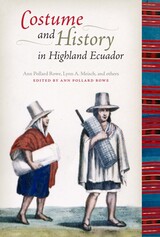
The traditional costumes worn by people in the Andes—women's woolen skirts, men's ponchos, woven belts, and white felt hats—instantly identify them as natives of the region and serve as revealing markers of ethnicity, social class, gender, age, and so on. Because costume expresses so much, scholars study it to learn how the indigenous people of the Andes have identified themselves over time, as well as how others have identified and influenced them.
Costume and History in Highland Ecuador assembles for the first time for any Andean country the evidence for indigenous costume from the entire chronological range of prehistory and history. The contributors glean a remarkable amount of information from pre-Hispanic ceramics and textile tools, archaeological textiles from the Inca empire in Peru, written accounts from the colonial period, nineteenth-century European-style pictorial representations, and twentieth-century textiles in museum collections. Their findings reveal that several garments introduced by the Incas, including men's tunics and women's wrapped dresses, shawls, and belts, had a remarkable longevity. They also demonstrate that the hybrid poncho from Chile and the rebozo from Mexico diffused in South America during the colonial period, and that the development of the rebozo in particular was more interesting and complex than has previously been suggested. The adoption of Spanish garments such as the pollera (skirt) and man's shirt were also less straightforward and of more recent vintage than might be expected.
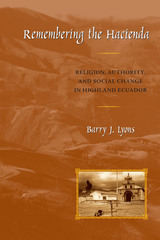
From the colonial period through the mid-twentieth century, haciendas dominated the Latin American countryside. In the Ecuadorian Andes, Runa—Quichua-speaking indigenous people—worked on these large agrarian estates as virtual serfs. In Remembering the Hacienda: Religion, Authority, and Social Change in Highland Ecuador, Barry Lyons probes the workings of power on haciendas and explores the hacienda's contemporary legacy.
Lyons lived for three years in a Runa village and conducted in-depth interviews with elderly former hacienda laborers. He combines their wrenching accounts with archival evidence to paint an astonishing portrait of daily life on haciendas. Lyons also develops an innovative analysis of hacienda discipline and authority relations. Remembering the Hacienda explains the role of religion as well as the reshaping of Runa culture and identity under the impact of land reform and liberation theology.
This beautifully written book is a major contribution to the understanding of social control and domination. It will be valuable reading for a broad audience in anthropology, history, Latin American studies, and religious studies.
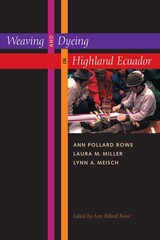
Although less well known than its much-admired counterparts in Peru and Bolivia, highland Ecuadorian weaving is an Andean tradition that has relationships with these more southern areas. A world away from the industrialized textile manufacturing of Euro-American society, these handmade pieces reflect the history and artistry of an ancient culture.
This comprehensive study, edited by Ann Pollard Rowe, is unrivaled in its detail and includes not only descriptions of the indigenous weaving and dyeing technology, but also an interpretation of its historical significance, as well as hundreds of photographs, drawings, and maps that inform the understanding of the process.
The principal focus is on backstrap-loom weaving, a major pre-Hispanic technology. Ecuadorian backstrap looms, which differ in various ways from those found elsewhere in the Andes, have previously only been treated in general terms. Here, the basic operation of this style of loom is covered, as are a variety of patterning techniques including warp-resist (ikat) dyeing, weaving belts with twill, and supplementary- and complementary-warp patterning. Spanish colonial treadle-loom weaving is also covered. The weaving techniques are explained in detail, so the reader can replicate them if desired.
Textiles have been an important art form among Andean peoples from remote prehistory up to the present. A greater understanding of their creation process can yield a more meaningful appreciation of the art itself.
READERS
Browse our collection.
PUBLISHERS
See BiblioVault's publisher services.
STUDENT SERVICES
Files for college accessibility offices.
RECENTLY PUBLISHED





UChicago Accessibility Resources
home | accessibility | search | about | contact us
BiblioVault ® 2001 - 2026
The University of Chicago Press