
 A SCHOLARLY BOOK REPOSITORY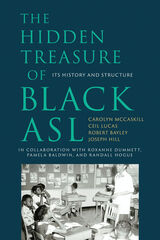
Black ASL has long been recognized as a distinct variety of American Sign Language based on abundant anecdotal evidence. The Hidden Treasure of Black ASL, originally published in 2011, presents the first sociohistorical and linguistic study of this language variety. Based on the findings of the Black ASL Project, which undertook this unprecedented research, Hidden Treasure documents the stories and language of the African American Deaf community. With links to online supplemental video content that includes interviews with Black ASL users (formerly on DVD), this volume is a groundbreaking scholarly contribution and a powerful affirmation for Black Deaf people.
This paperback edition includes an updated foreword by Glenn B. Anderson, a new preface that reflects on the impact of this research, and an expanded list of references and resources on Black ASL.
The supplemental video content is available online at the Gallaudet University Press YouTube Channel. Under Playlists, click “The Hidden Treasure of Black ASL: Companion Video to the Book.” The original Black ASL Project research videos are also available.
Featured in the film Signing Black in America: The Story of Black ASL, produced by The Language and Life Project at North Carolina State University (Dr. Walt Wolfram, Executive Producer). Look for it on PBS.
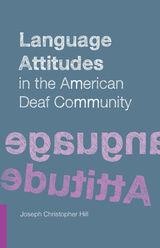
In a diverse signing community, it is not unusual to encounter a wide variety of expression in the types of signs used by different people. Perceptions of signing proficiency often vary within the community, however. Conventional wisdom intimates that those who learned at an early age at home or in school know true standard American Sign Language, while those who learned ASL later in life or use contact or coded signs are considered to be less skillful. Joseph Christopher Hill’s new study Language Attitudes in the American Deaf Community explores the linguistic and social factors that govern such stereotypical perceptions of social groups about signing differences.
Hill’s analysis focuses on affective, cognitive, and behavioral types of evaluative responses toward particular language varieties, such as ASL, contact signing, and Signed English. His work takes into account the perceptions of these signing types among the social groups of the American Deaf community that vary based on generation, age of acquisition, and race. He also gauges the effects of social information on these perceptions and the evaluations and descriptions of signing that results from their different concepts of a signing standard. Language Attitudes concludes that standard ASL’s value will continue to rise and the Deaf/Hearing cultural dichotomy will remain relevant without the occurrence of a dramatic cultural shift.

Grounded in the scholarship and reflecting contemporary developments in the field of signed language linguistics, the sixth edition of Linguistics of American Sign Language provides a clear, comprehensive, and fresh introduction to the structure of ASL. Focusing on language in everyday contexts, this new edition treats ASL as a dynamic system shaped by the diversity of its communities.
Organized into two parts, Linguistics of American SignLanguage begins by exploring fundamental concepts of language within communities, addressing language features, registers, variation and historical change, multilingualism, ideologies, and discourse. This first section sets the stage for in-depth analysis into core areas of linguistic study: syntax, phonology, and morphology. New content provides depth, exploring topics such as the representation of signed languages in texts, corpus linguistics, heritage-language signers, and Black ASL. To show how language is used by multilingual and multimodal individuals within their communities, the book pairs discussion with “grounding texts,” videos of ASL within varied authentic settings.
Linguistics of American Sign Language is supported by a companion website that provides access to the grounding texts and supplementary materials, including downloadable resources for hands-on analysis such as annotated videos and readings. Designed for readers with no background in linguistics, each unit opens with guided questions to prompt reflection and concludes with exercises and recommended readings.
Refining the standard for sign language scholarship, the sixth edition of Linguistics of American Sign Language guides readers beyond technical analysis to explore ASL as a vibrant system rooted in community, culture, and language.

READERS
Browse our collection.
PUBLISHERS
See BiblioVault's publisher services.
STUDENT SERVICES
Files for college accessibility offices.
RECENTLY PUBLISHED






UChicago Accessibility Resources
home | accessibility | search | about | contact us
BiblioVault ® 2001 - 2026
The University of Chicago Press