
 A SCHOLARLY BOOK REPOSITORY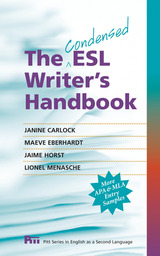
The CondensedESL Writer’s Handbook is a reference work for ESL students who are taking college-level courses. Because its purpose is to provide help with the broad variety of writing questions students may have when working on school assignments, the text focuses on English for Academic Purposes. Unlike other handbooks on the market, this book’s sole purpose is to address the issues of primary importance to language learners.
The Condensed Handbook complements a student writer’s dictionary, thesaurus, and grammar reference book. It would be suitable as a text for an advanced ESL writing course.
The Condensed Handbook is concise and easily navigated; is accessible, with clear and direct explanatory language; and limits its focus to the grammatical and style aspects of writing and reference material.
Included as special features in the Condensed Handbook are:
• The explanatory language is appropriate for ESL students, in contrast to the more complex and idiomatic language of other English handbooks.
• The level of detail is more manageable for ESL students, compared to what is in other English handbooks.
• Many of the examples of paragraphs and exercise sentences were written by ESL students; this encourages users of this Handbook to realize that they too can also become effective writers.
• Additional samples of MLA and APA reference entries.
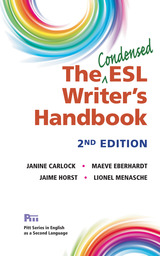
The Condensed version is concise and easily navigated; is accessible with clear and direct explanatory language; and limits its focus to the grammatical and style aspects of writing and reference material.
The 2nd Edition of The Condensed ESL Writer’s Handbook has been revised to better align with the exercises in Workbook for The ESL Writer’s Handbook, 2nd Ed.(978-0-472-03726-1). It also features an expanded Section 1 (to include more on pre-writing, drafting, revising, and editing), updated exercise items, and completely revised APA and MLA style guides (featuring MLA, 8th Edition). Overall, this handbook has these special features:
- The topic selection is based on ESL writers’ needs as observed by the authors over many years.
- The coverage of topics is more complete than the limited amount usually provided for ESL writers in first language or L1 handbooks.
- The explanatory language is appropriate for ESL students, in contrast to the more complex and idiomatic language of other English handbooks.
- Many of the text examples and exercise sentences were written by ESL students to help users realize that they too can become effective writers.
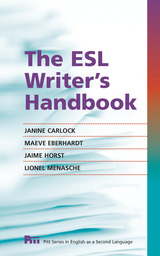
The ESL Writer’s Handbook is a reference work for ESL students who are taking college-level courses. Because its purpose is to provide help with the broad variety of writing questions students may have when working on school assignments, the text focuses on
English for Academic Purposes. Unlike other handbooks on the market, this book’s sole purpose is to address the issues of second language learners.
This spiral-bound Handbook complements a student writer’s dictionary, thesaurus, and grammar reference book. It would be suitable as a text for an advanced ESL writing course when used together with the companion Workbook (978-0-472-03404-8). The Handbook is concise and easily navigated; is accessible, with clear and direct explanatory language; features information on both APA and MLA styles (including a sample paper for each); and includes many examples from ESL student writers to provide realistic models.
Included as special features in the Handbook are:
• The topic selection is based on ESL writers’ needs as observed by the authors over many years.
• The coverage of topics is more complete than the limited amount usually provided for ESL writers in first language or L1 handbooks.
• The explanatory language is appropriate for ESL students, in contrast to the more complex and idiomatic language of other English handbooks.
• The level of detail is more manageable for ESL students, compared to what is in other English handbooks.
- Many of the examples of paragraphs, essays, research papers, and exercise sentences were written by ESL students; this encourages users of this Handbook to realize that they can also become effective writers.
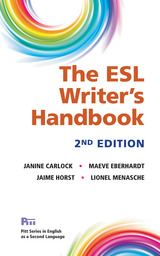
The spiral-bound Handbook complements a student writer’s dictionary, thesaurus, and grammar reference book. It would be suitable as a text for an advanced ESL writing course when used together with the companion Workbook (978-0-472-03726-1).
The new edition features significant revisions to Sections 3 and 4; in particular, both APA and MLA style guides have been updated and new sample papers for each are included. The new edition includes new and revised exercises and many new samples of student writing.
Like its predecessor, the 2nd Edition has these special features:
- The topic selection is based on ESL writers’ needs as observed by the authors over many years.
- The coverage of topics is more complete than the limited amount usually provided for ESL writers in first language or L1 handbooks.
- The explanatory language is appropriate for ESL students, in contrast to the more complex and idiomatic language of other English handbooks.
- Many of the examples of paragraphs, essays, research papers, and exercise sentences were written by ESL students to help users realize that they too can become effective writers.
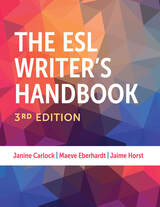
In addition to updated style guides, sample student papers, writing examples, and exercises, the 3rd edition highlights “tech tips” on different technologies that may be useful to students, explains inclusive language, and expands the section on taking notes as a research tool.
With this handbook, students will learn:
- The concept of genre and apply it to unpacking assignments and writing effectively.
- The process for generating ideas, structuring those ideas into a paper, and checking over a paper before turning it in.
- Five common patterns for organizing an academic essay: narrative, process, comparison/contrast, cause and effect, and argument.
- Different steps for creating a good research paper, including major citation styles.
- Guidance for addressing the grammar, punctuation, and style issues most often encountered by international students writing in English.
- How to differentiate between other types of writing U.S. undergraduate students are expected to complete, such as emails, resumes, cover letters, and personal statements.
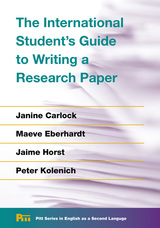
Each section of the book includes a discrete task called a Building Block, which requires students to apply the skills learned toward the development of their own paper. This step-by-step approach allows students to construct knowledge as they become more familiar with the process, making writing a research paper a less intimidating task.
Special features:
- This guide uses simple direct language for those for whom writing a research paper is new.
- Most example writing is from international students in an ESL program or first-year writing class, including two sample papers—one in APA and one in MLA.
- A section on responding to instructor feedback to provide students with the tools to read and understand comments and use them to improve the first draft.
- A subsection dedicated to constructing clear and cohesive paragraphs and sentences.
- The guide includes citation and style examples in MLA 8th edition.
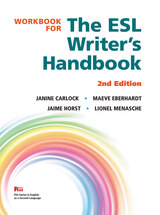
The new edition of the Workbook includes 85 exercises to facilitate students’ understanding of some of the most complex or troublesome writing areas discussed in the Handbook. Exercises have been revised, and new exercises have been added to Sections 4 (Research Paper) and 5 (Grammar and Style).
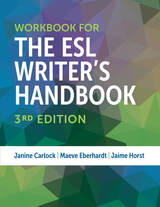
CEFR Levels: B1–C2
READERS
Browse our collection.
PUBLISHERS
See BiblioVault's publisher services.
STUDENT SERVICES
Files for college accessibility offices.
RECENTLY PUBLISHED


UChicago Accessibility Resources
home | accessibility | search | about | contact us
BiblioVault ® 2001 - 2025
The University of Chicago Press